
Review: “After Tamerlane”
– The one-handed economist (site)
Daniel Zetland . . . a political-economist from California who now lives in Amsterdam.
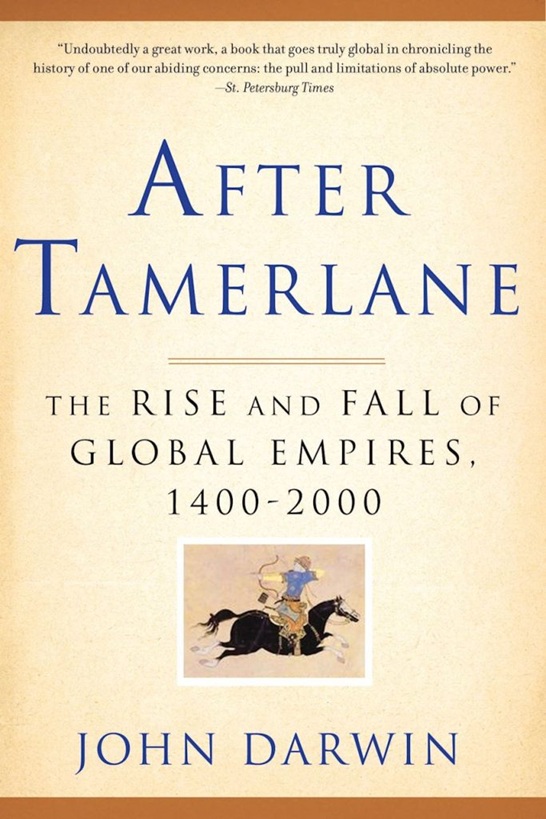
I read this 2007 book by John Darwin months ago, but only got ’round to writing up my thoughts here now. That shouldn’t matter about 600 years of history that ended in 2000, but it does matter for my bad memory.
On the other hand, what you remember is often the important stuff.
Or is it?
Indeed, Darwin’s point is that Tamerlane — a nomadic “imperialist” who blended and broke political stabilities across Eurasia — played a major role in establishing the political orders we live under today.
Let’s get into it.
- Tamerlane’s focus was Middle Eurasia, and his passing allowed “far” East and West of the continent to break free and develop independently. The rise of oceanic trade — as opposed to overland travel (e.g., Silk Road) — reduced the power and wealth of the middle.
- Darwin is keen to rebalance away from an over-emphasis on “the West” in history — due to a combination of ego, colonial-rationalization, and ignorance.
- European colonial-imperialism was relevant but it was much slower than “in 1492 the New World was discovered” since — in this example — 1492 only meant that a few dozen Europeans had contacted a few thousand inhabitants of (now) Bahamas, Cuba and Haiti/DR. For all the other millions of residents of the Americas, life went on.
- Indeed, Darwin’s main point is that globalization — the (in)formal integrations that strengthened after 1400 — was nowhere linear, logical or systematic. For every “trend” there was an exception. That should be of no surprise to anyone looking at politics today (always a mix of good and bad news), but it will upset anyone (including today’s onlookers) who prefer to think of history as a linear story where every piece of the puzzle fits. The past is just as messy as today, except we have decided to ignore the jagged bits.
- Most people in the West underestimate the power and development of other regions — those dominated by Islam and China, for example — which (a) limits their understanding of Western development (it had to deal with the non-West) as well as their appreciation of other ways of developing (without racism, for example).
These observations draw on the first 50 pages… and there are 450 more. I will stop with notes and conclude that this book is well worth the read, in terms of understanding the nuances and lost lessons of history in all (or, more) of its complexity. I’ll come back to read this book in 5 years, as it’s too dense to summarize. I suggest you read it whenever you can.