
Review: “The Dictators Handbook”
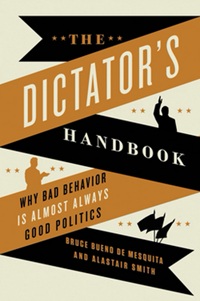
Book Review of “The Dictators Handbook by The One Handed Economist David Zetland.
How can you resist a book with a title like this?! — and a subtitle of Why Bad Behavior is Almost Always Good Politics?! Bruce Bueno de Mesquita and Alastair Smith (B&S) published this book in 2011, but I only got around to it recently.
The book is an easy read, and although you see the same message throughout the book (“All that matters is that you stay in power, and you do that by taking care of the people who can keep you in power, not the plebs“), it’s still worth reading the many examples of how this sine qua non plays out.
B&S also repeat it to crush our naive hope that rulers actually want to do the right thing for their people. They do not. Indeed, they are perfectly happy to steal food from the starving, allow the children to die, lose wars or territory to the enemy — you name it. All they care about is staying in power!
“Anyone who thinks leaders do what they ought to do that is, do what is best for their nation of subjects — ought to become an academic rather than enter political life. In politics, coming to power is never about doing the right thing. It is always about doing what is expedient.” [p 37]
B&S put citizens into three groups: interchangables, influentials, and essentials. Dictators need the essentials to stay in power. They can threaten the influentials with replacement by the interchangable if they ask too much. They ignore the interchangeable, of course, since they’re not relevant to staying in power.
Here are the five rules for dictators (p 19):
- Keep the coalition [essentials] as small as possible.
- Expand the set of interchangeables [to reduce their power].
- Take control of the sources of revenue [to reward essentials].
- Reward your essentials at all costs [see 3].
- Don’t rob your supporters to give to your opposition.
he implications of these rules are terrible for citizens: underprovision of public goods like law and order, heavy taxes on the majority to subsidize the minority, underinvestment in education, water, roads and other infrastructure because that money is needed for keeping supporters/essentials happy.
Foreign aid, for example, is not given to help the poor in poor countries, but to help the leaders in those countries stay in power and thus support the policies of the donor countries!
The truth is, foreign aid deals have a logic of their own, Aid is decidedly not given primarily to alleviate poverty or misery; it is given to make the constituents in donor states better off. Aid’s failure to eliminate poverty has not been a result of donors giving too little money to help the world’s poor. Rather, the right amount of aid is given to achieve its purpose improving the welfare of the donors constituents so that they want to reelect their incumbent leadership. Likewise, aid is not given to the wrong people, that is, to governments that steal it rather than to local entrepreneurs or charities that will use it wisely. Yes, it is true that a lot of aid is given to corrupt governments but that is by design, not by accident or out of ignorance, Rather, aid is given to thieving governments exactly because they will sell out their people for their own political security. Donors will give them that security in exchange for policies that make donors more secure too by improving the welfare of their own constituents. [p 166]
Indeed, when you look at what governments do, rather than what they promise, then you see how the Handbook represents the reality of leaders who win while their nations fail.
How to go from dictatorship to democracy? The dictator and essentials are forced to expand their coalition and provide public goods, thereby diluting individual shares of loot and increasing support from interchangeables for further change. After a tipping point, there is too much support for general welfare to protect private theft, and the system flips. This process is uncommon, which explains why dictatorships now outnumber democracies.
I give this book FIVE STARS for its insight to political trench warfare.
so this is Trump’s road map?
David:
Apparently, it is Trump’s road map. Thank you for the comment
Bill