
Weak and Changing Jobs Report
Simple report. Not feeling well enough to deep dive this topic.
I tend to agree with Paul Krugman and others (for that matter). Much of this fluctuation (jobs, etc.) is due to Trump’s creation of a nervous economy. There is no stability. The slightest change impacts the economy.
The facts keep changing from time to time. There is no stability and it is by design. So people and the economy are on edge. One sneeze or threat of a high tariff creates a reactive economy. The DOGE program as led by Musk did little to improve the economy. It is worse and more costly.
The earlier post (mine) today clearly shows Trump’s economic policy is costing far more than Biden’s last 4 years.
The Meaning of a Weak Jobs Report, Paul Krugman
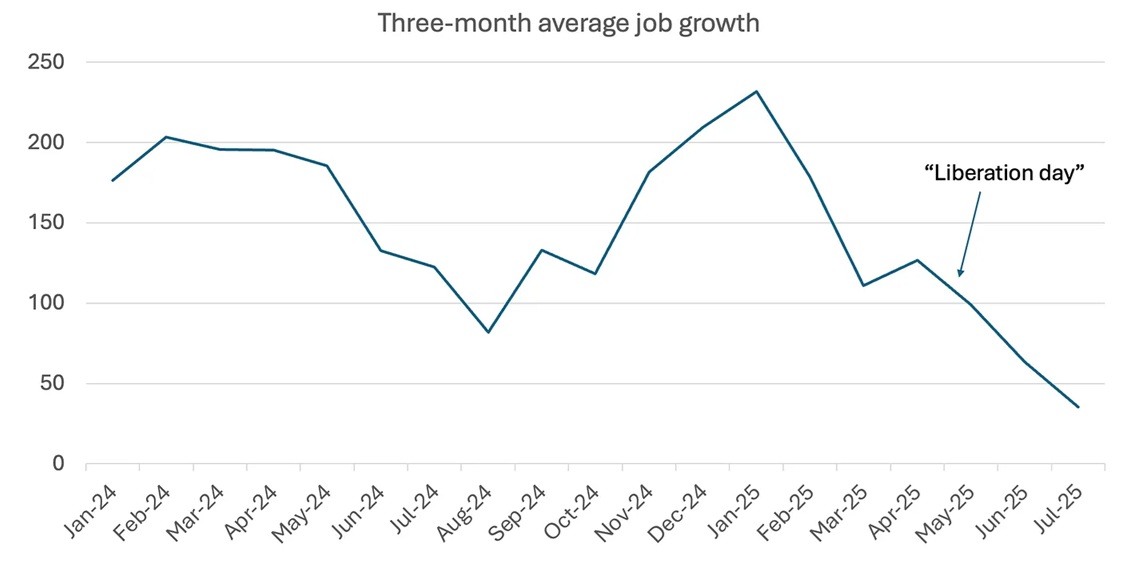
I’m (Krugman) working on a full-length primer on tariffs for Sunday, but this morning’s jobs report shocker needs a comment.
It’s highly likely that what we’re seeing is the effect of Trump’s tariffs — or more precisely the uncertainty that his erratic tariff policy has created.
Contrary to myth, tariffs don’t necessarily cause high unemployment. They make the economy less efficient and poorer, but don’t necessarily reduce the total number of jobs. For example, Britain in the 1950s had high tariffs and import controls, but also full employment. The claim that Smoot-Hawley caused the Great Depression is a myth, one fostered in part by anti-Keynesians who didn’t want to admit that the problem was inadequate demand and the answer fiscal stimulus.
But Trump has brought something special to the mix: Not just high tariffs, but unpredictable tariffs. Since April 2 nobody (probably Trump included) has had no idea what tariff rates will be for the next few months, let alone for the long term.
As many of us pointed out, this uncertainty was a huge deterrent to business investment. Build a factory based on the assumption that tariffs will go back down to more normal levels, and you risk having a stranded investment if 20-25 percent tariffs are here to stay. Build a factory based on the assumption that high tariffs are the new normal, and you’ll have a stranded investment if Trump chickens out.
So many of us predicted an economic slowdown caused not by the level of tariffs but by uncertainty. Yet the predicted slowdown, while visible in “soft” data like surveys, kept not showing up in the hard data, making these predictions look all wrong.
Hard data, however, aren’t as hard as we’d like. Payroll numbers, in particular, rely a lot on assumptions and interpolations, and are often revised.
And the revised numbers now show exactly the kind of uncertainty-induced slowdown I and many others predicted.
These numbers don’t show the long-run damage from Trump’s tariffs, which are really a completely different story. In fact, the short-run jobs picture may improve now that it’s clear that there won’t be any real trade deals, just Smoot-Hawley redux as far as the eye can see.
One thing is clear: The previously reported good numbers were proof of Trump’s brilliance. Now that they’ve been revised away, the bad numbers are clearly Biden’s fault, or maybe Jerome Powell’s, or Barack Obama’s.