
Union Pacific and Norfolk Southern Railroads
Rail Passengers Association | Substack
Bit of an Introduction. Having ridden in trains in other countries, I can see where having similar passenger rail services would benefit the United States. Rather than traveling by air, one could take a trip by passenger rail to another state several hundred miles away and arrive in better condition than by going by air. Flying is a hassle these days and it is getting worse.
~~~~~~~
Introduction: The Rail Passengers Association is the only organization that acts as a voice for train passengers (particularly Amtrak customers but also commuter rail and rail transit riders). It presents on Capitol Hill, before the US Department of Transportation, and before Amtrak management. The RPA (formerly the NRPA) is a source of straightforward factual information, presented in layman’s terms. It is relied upon by lawmakers’ staffs and by reporters. For example, in the three days following the December 1st Metro-North derailment? NARP’s phones were ringing off the hook with reporters, and members of the public, seeking information about the causes of the tragedy, and what could be done to prevent such accidents.
“UPNS Still Working To Answer STB’s Public Interest Queries“
Jim Mathews
Union Pacific (UP) and Norfolk Southern (NS) this week submitted the first installment of their response to the Surface Transportation Board’s May order requiring additional information about their proposed merger. As expected, the filing focuses chiefly on technical questions surrounding ownership interests in the Terminal Railroad Association of St. Louis, Kansas City Terminal Railway, and TTX.
The bigger filing is still to come. In the introduction to their latest filing, UP and NS say they expect to submit the remainder of their responses on or before July 27, including material “bearing directly on the substantial public benefits of the proposed transaction and why the merger satisfies the statutory public-interest standard.”
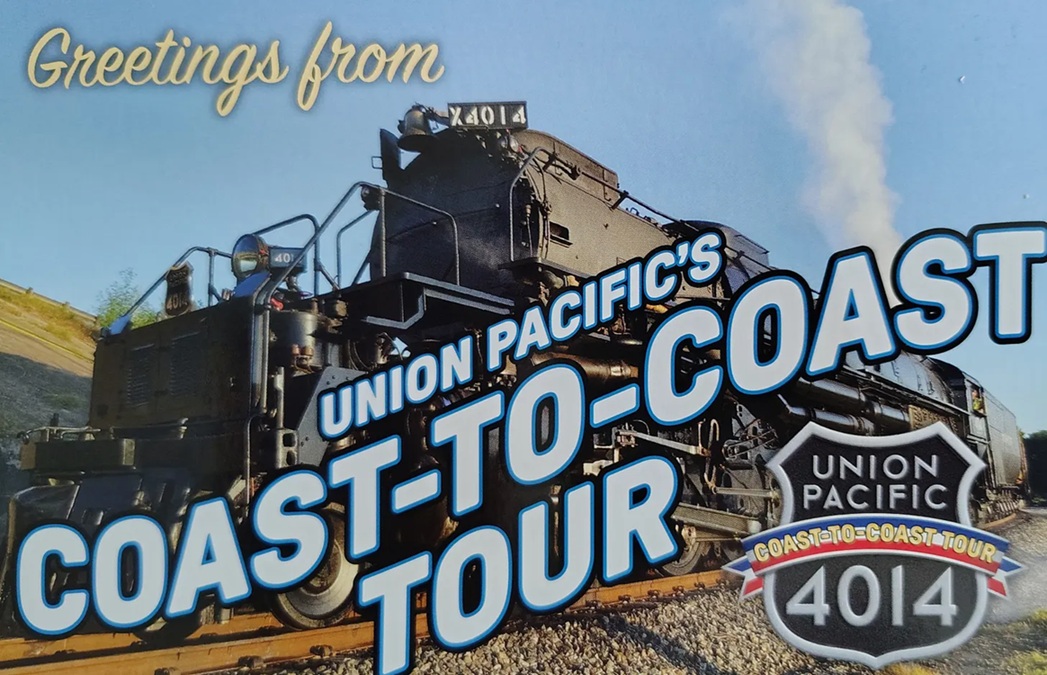
A postcard promoting the merger during Big Boy’s recent nationwide tour
In accepting, tentatively, the revised UP-NS application back in May, the STB also posed a series of questions the Board had apparently hoped that revised filing would have answered but did not. One of the Board’s passenger-rail supplemental information requests asked essentially the same question Rail Passengers Association and others have already been asking publicly: how can anyone independently verify UP-NS’s claims about future capacity and passenger compatibility when so much of the underlying modeling remains shielded behind confidentiality restrictions? (STB’s decision accepting the application but posing questions can be found here.)
That filing later this month is probably going to be one of the most important yet in the proceeding. STB was pretty clear that it expects applicants to provide a more complete record before the merger can move forward, and the July 27 submission should begin to answer many of the questions raised by the Board in May.
Rail Passengers Association will be reviewing that filing closely, particularly where it addresses issues affecting passenger rail service and future transportation capacity.
Jim Matthews: President & CEO of the Rail Passengers Association. Internationally recognized transportation policy expert. Writing about passenger rail, infrastructure, mobility, shared civic space, and public policy.
We could certainly use decent passenger rail service. But France has little to brag about. Sure, the TGV is great for downtown-downtown service between major cities. And commuter services are great, at least around Paris. But the rest of the system is decrepit. Local service in the countryside has all but been abandoned, and buses are infrequent. Intercity services are decrepit, too. Eight years ago I took an “intercity” from Toulouse to Montauban, and then onto Bordeaux. The passenger cars were at least a half a century old and probably hadn’t been refurbished in at least half that time. Sad.
Mexico, OTOH, has this amazing bus system featuring modern, comfortable buses departing from terminals located in the middle of the city. They resemble airport terminals without the long walks to the gates.
John:
My global travels ended a decade ago. I would be in China many times previous to retirement. However, I would fly to each city where I was to visit a plant. The one time I took trains was in China just before retirement. We went 2nd Class rather than 1st Class. The later of which is what many Americans might do. It was suggested by one of our Chinese associates.
It is hard to forget the modern train we rode in and traveling at ~200 mph. No clickety-clack, jumping or lunging. When we left the train, I was looking at the tracks. no connecting seams to be seen either. It was a rather silent ride (I forget the city). There are countries whch are well beyond the United States in infrastructure.
Riding in a historical passenger car happens. I was lucky enough to see other styles. I remember using the autobahn. Another experience to be remembered. Traveling at 100 mph or more was an experience. Other countries do manage to excel beyond what the wealthy United States does.