
The employment effects of ICE enforcement in US cities
Findings of the Republican and President Tr__p attack on labor and foreign Labor in surge and non-surge communities. If you scroll down on the Brooking’s article you will find figures 3 & 4 as mentioned in the footnotes in section “The enforcement surge cost 668,000 jobs” below.
“Shock, awe, and economic fallout” | Brookings
Brookings: We find that employment trajectories in surge and non-surge cities were closely aligned before ICE enforcement began.
Surge and non-surge cities diverged when ICE arrests intensified. The gap widened over time, and the knock-on effects extended far beyond those directly targeted. In surge cities, employment fell most in immigrant-intensive sectors, but job losses spread further.
American-born workers also experienced job loss.
Findings
The enforcement surge cost 668,000 jobs. Across the top 25% of cities (86 of 341 in our sample) that experienced the sharpest rise in ICE arrests,3 employment fell an average of 0.73% below what those cities would likely have seen absent the surge.4
Job losses far exceeded the number of people arrested. In these 86 surge cities, ICE made around 52,000 excess arrests. But arrests are only a proxy for a far broader disruption, including visible raids and heightened ICE presence. Each excess arrest, as a proxy for the broader enforcement shock, is associated with 13 jobs lost overall, jobs previously held by both immigrants and American-born workers.
Job loss deepened over time. In the 51 cities where we can observe outcomes at least six months after the surge began, that gap widened to 1.48%. The job loss grows over time, and the excess arrest-to-job-losses ratio rises to 30.
American workers were harmed. As firms faced sudden labor shortages, they scaled back operations, delayed projects, and cut headcount. At the same time, declining foot traffic and consumer spending hurt businesses whose customers stayed home. We applied the findings from Cox and East (2026). We estimate that, out of the 668,000 jobs lost, 51,000-297,000 would have been held by American-born workers. This implies that for every excess arrest, between one and six of the jobs lost would have been held by American-born workers.
Job loss concentrated in immigrant-intensive sectors, but others were also affected. Sectors where immigrant workers are heavily represented, such as construction and accommodation and food services, sustained the deepest direct job losses. But industries with very few immigrant workers, such as arts and entertainment, also contracted sharply in surge cities. This finding is not consistent with a simple story of workforce removal. It is consistent with fear-driven demand suppression. When enforcement actions dominate the news, and people stop going out, businesses lose customers and cut staff, regardless of who their workers are.
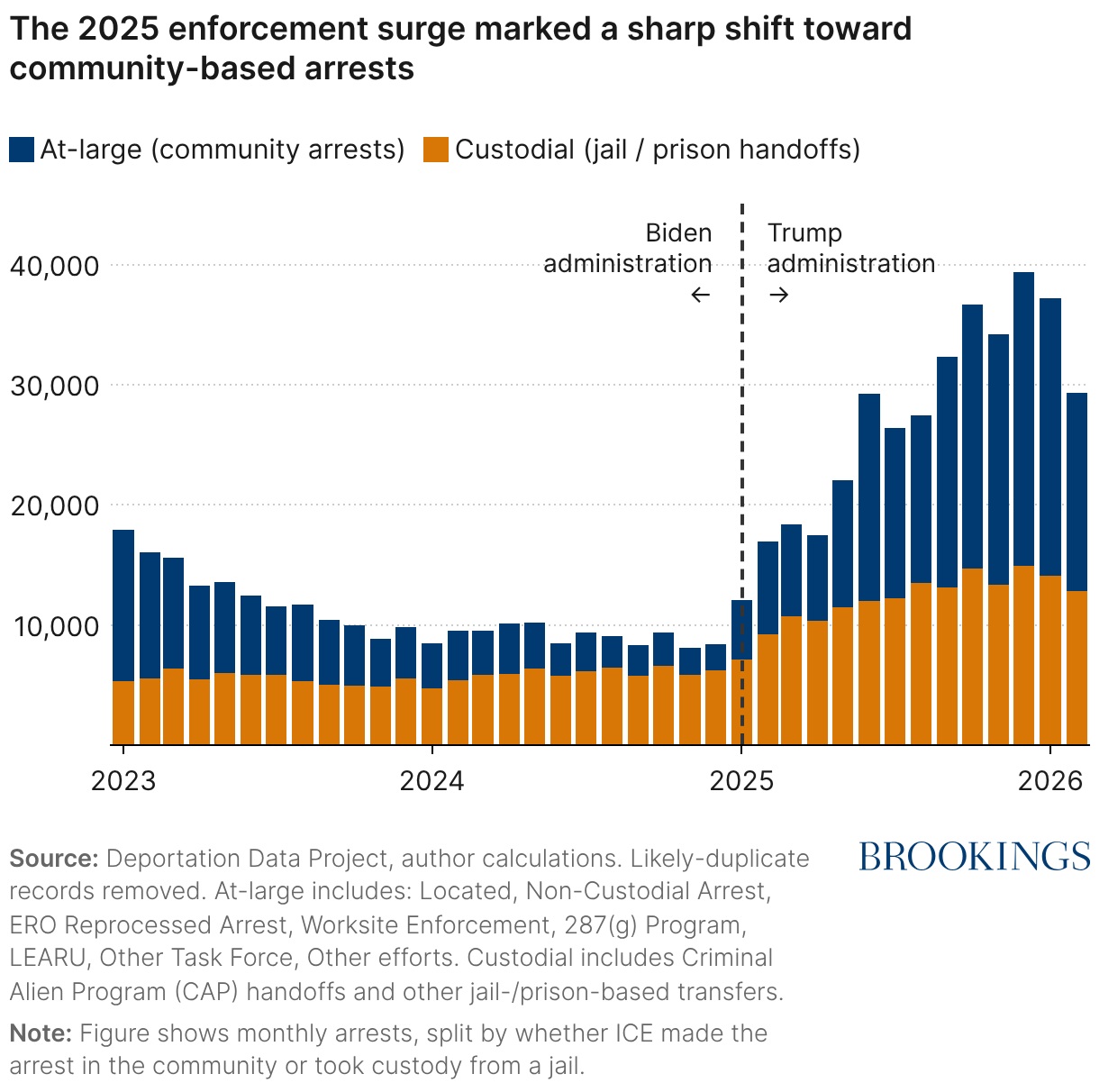
“Shock, awe, and economic fallout,” Brookings, (Foot Note 3&4: Figure 3 and Figure 4)
“Trump’s Deportations Are Costing Americans Jobs, Study Finds,” The New York Times