
Increasing Black men’s educational attainment and other hard skills are likely to be helpful . . .
but they will not solve the problem. The cause of the low employment rate is not due to a lack of hard skills.
A good piece examining the difference in employment between Black men, Hispanic men, etc, and white men. Even with an equivalent education as others, Black men employment is less than other groups. The first paragraph does recite percentages. The employment rate for Black men is lower than for a White men having similar or equal skills and education.
Understanding and Addressing the Extremely Low Employment Rate of Black Men, CEPR
Black Men’s Employment Rate is a Low Outlier
The employment rate for Black men is lower than the rate for White, Hispanic, and Asian American men.4 Figure 1 shows the employment rate for prime-age (25 to 54 years old) Black men ranged from 7.4 percentage points (in 2024) to 15.5 percentage points (in 2011) below the rate for prime-age White men from 2000 to 2025. The average over this period was 11.4 percentage points lower. In 2025, Black men ages 16 to 64 needed 1.3 million more jobs to have the same employment rate as White men. This Black-male jobs deficit cost Black America roughly $65 billion in lost earnings and may have increased the number of Black people in poverty by about 230,000. (The jobs deficit for Black women relative to White women was 500,000 jobs and cost roughly $22 billion in lost earnings.)
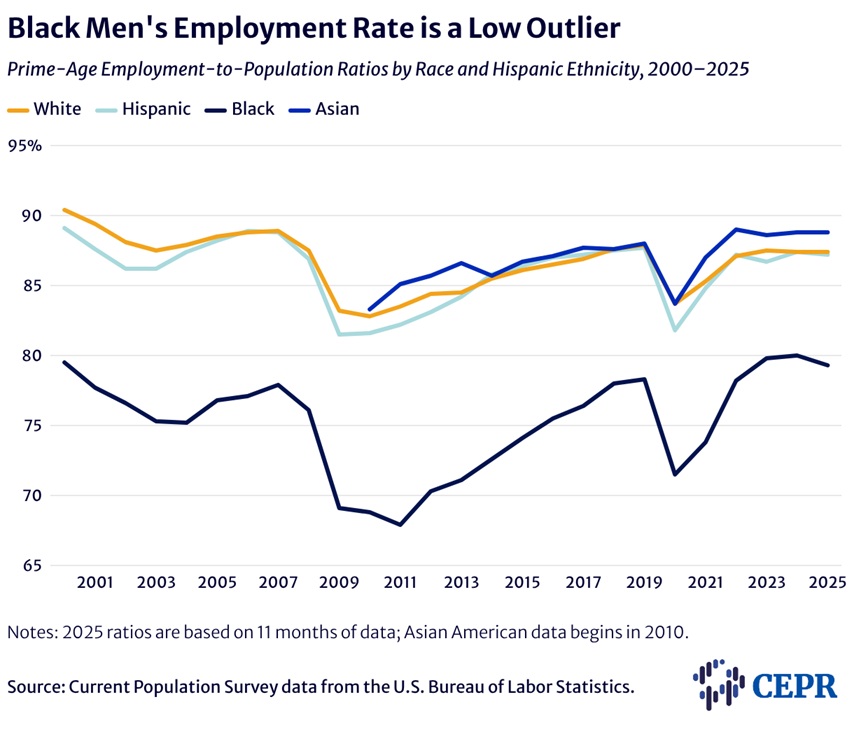
As bad as these numbers are, they understate the problem: The incarcerated population is not included in the calculations. The data undercounts disadvantaged Black men.
The state and federal incarceration rate for Black men is over five times the rate for White men and over 27 times the rate for Black women. Nearly 400,000 Black men are in state and federal prisons. Over 200,000 are in jail. Individuals in prison should be counted as jobless, but they are generally not included in labor force calculations. Many imprisoned Black men have children and other family members who are burdened by these men are not able to contribute an income. Their joblessness has an impact on lives even if they are deleted from employment statistics.
Jobless Black men are also undercounted in official statistics. There is a growing problem of survey nonresponse. In 2021, (Julie) Yixia Cai and Dean Baker reported an overall nonresponse rate of 13 percent in the Current Population Survey and a 30 percent nonresponse rate for young Black men. They found young Black men not responding to government surveys are more likely to be jobless than those who do respond. This pattern distorts statistics derived from these surveys. Cai and Baker found that adjusting the data for the higher rate of joblessness among young Black male nonresponders yields an employment rate that is two percentage points lower for these men. The problem of declining response rates also applies the American Community Survey data used in much of this report.
While it is clear many Black men would be better off if their rate of employment were comparable to the rate of White, Hispanic or Asian American men, these benefits would reach beyond the Black male population. Increasing Black male employment would be a positive for Black women, Black children, and for reducing crime in Black communities. Improving Black America does benefit all people in the United States.
The Black crime rate: Street crime is common in the marginalized and economically deprived communities. In the United States, these would be poor, majority Black communities. As a result, Black people experience higher than average crime victimization rates. Rates of street crime also tend to be highest among young men. While there may be complicating factors in the relation of Black men’s joblessness to street crime, there are reasons to believe that increasing Black men’s employment rate can help reduce street crime in Black communities. Summer jobs programs for youth have been found to reduce involvement in street crime. Patrick Sharkey and his colleagues found that community workforce development nonprofits contributed to a decline in street crime. Subsidized employment programs have been shown to be effective at reducing criminal recidivism and involvement with the criminal legal system. Research by John Laub and Robert Sampson also suggest that employment is an important factor helping individuals end criminal careers. Thus, increasing Black men’s employment will likely make Black communities safer.
There are widespread benefits to Black Americans from an increased Black male employment rate. It is important to understand why their employment rate is so low and what policies can increase it.
The Role of Hard Skills, Part 1: Education and Training
Individuals learn hard skills through formal education, and educational credentials can also signal one’s ability to acquire additional hard skills. Thus, educational attainment is one useful measure of the hard skills of Black men. Using educational attainment, a hard-skills gap does not appear to explain the low employment rate of Black men.
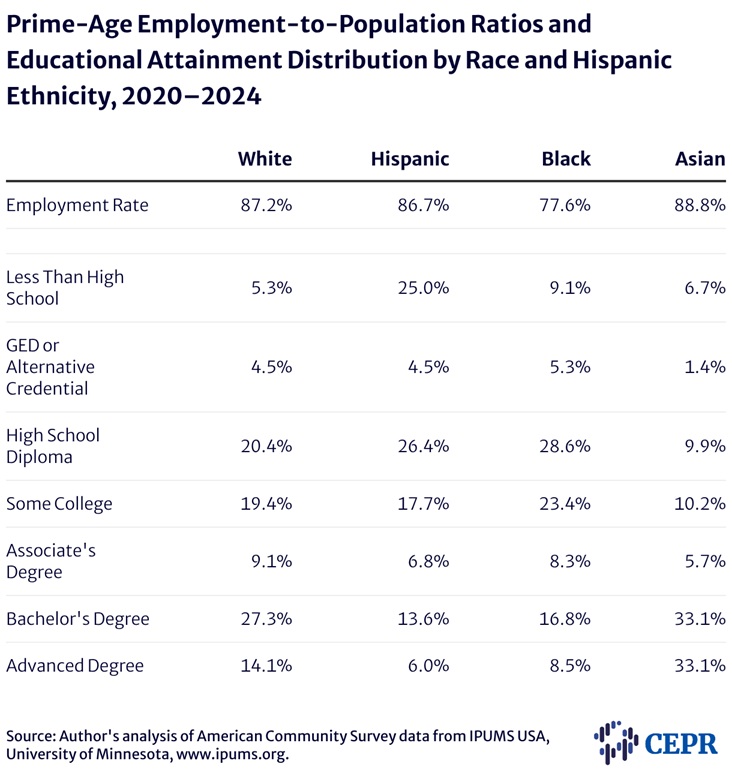
Table 1 again shows that Black men’s employment rate is an outlier. Asian American men have the highest employment rate at 88.8 percent, which is 1.6 percentage points higher than the employment rate for White men. The employment rate of Hispanic men is basically the same as for White men, only 0.6 percentage points lower. The Black rate, however, is 9.6 percentage points lower than the White rate.
If deficient hard skills are the cause of this disparity, one would expect Black men to have the lowest educational attainment. This is not the case. A quarter of Hispanic men do not have a high school diploma or equivalent. For Black men, it is only 9.1 percent. Black men have slightly higher rates of bachelor’s and advanced degrees than Hispanic men. Although Black men have a higher educational attainment than Hispanic men, they have a much lower employment rate.
White men’s educational advantage over Hispanic men is even greater than their advantage over Black men, yet White men have essentially the same employment rate as Hispanic men. Asian American men are even more educationally advantaged. Asian American men have advanced degrees at more than twice the rate of White men and approaching six times the rate of Hispanic men, but the White and Hispanic employment rates are only a little below the Asian American rate.
These data suggest that hard skills do very little to explain employment rates. They may be very useful in explaining wages, but they don’t help explain why the Black employment rate is a low outlier.
Another example of a challenge to the hard-skills argument is a study based on an experimental research design evaluating a training program in computer repair. Three-quarters of the study participants were male. Fifty-three percent of the Black participants in the treatment group who received the training received an A+ certification. For the Latino participants, 54 percent did.
In other words, the computer repair skills of the Black and Latino treatment groups were essentially the same. In spite of this fact, the Latinos in the treatment group were able to increase their employment rate relative to the Latino control group, but the Black participants in the treatment group did not have an increase in employment relative to the Black control group. Improving hard skills did not have a positive employment effect for the Black participants. There are reasons to be skeptical of the idea that hard skills are a key explanation to Black men’s low employment rate.
The Role of Hard Skills, Part 2: The Effect of Lowering Hard-Skills Demands
Another way to explore the issue of the role of hard skills would be to examine employment rates for jobs that have no hard-skills demands. If there are no hard-skills demands, then groups with weak hard skills and groups with strong hard skills would be viewed the same by employers because hard skills are irrelevant. Both groups would be equally likely to be employed in these jobs.
However, if most or all of the group with strong hard skills are employed in jobs with high hard-skills demands, then the group with weak hard skills would dominate jobs with no hard-skills requirements. This means that if lower hard skills of Black people are driving the Black-White employment disparity, in jobs with no hard-skills requirements, the disparity should be greatly reduced or even possibly reversed.
There are no jobs with zero hard-skills needs, but there are jobs that require less time to train for or more easily obtained credentials. Employers who hire young high school dropouts are likely to have relatively low hard-skill demands. People without a high school diploma generally have weaker education-related hard skills than individuals with higher levels of educational attainment. Young workers have less work experience than older workers and therefore generally have acquired less in terms of skills from working. Employers of young high school dropouts are comfortable with workers with relatively low levels of hard skills.
It is also useful to examine young men without a high school diploma because this is the population most at risk for becoming involved in street crime. Finding ways to increase this population’s employment rate could reduce street crime and its many social and economic costs.
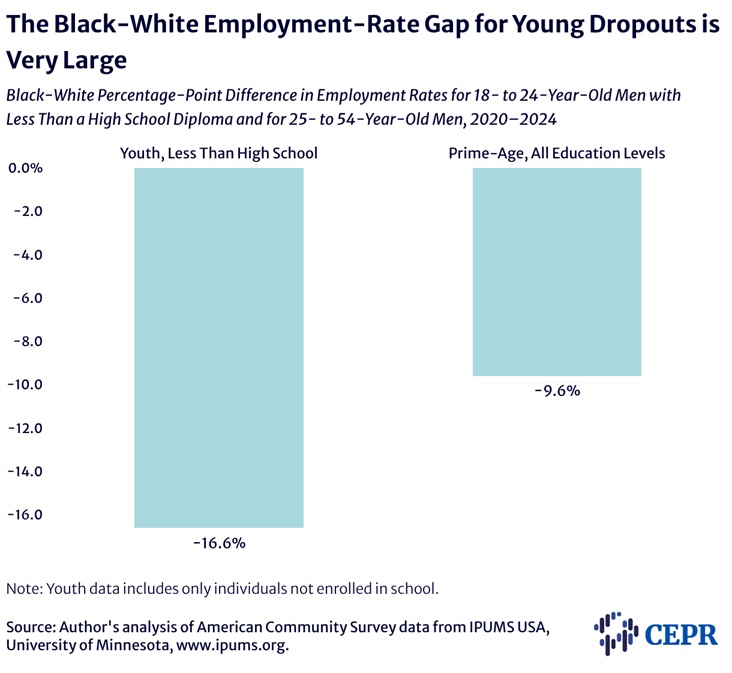
Figure 2 compares the Black-White employment-rate gap for young men (18 to 24 years old) who have less than a high school diploma with the gap for prime-age men of all educational attainment levels. The prime-age gap is large. The prime-age Black employment rate is 9.6 percentage points below the employment rate for prime-age White men. The gap for young high school dropouts, however, is even larger — 16.6 percentage points. Focusing on jobs with a low level of hard-skill demands does not improve the relative employment outcomes for Black men, it makes them worse. This finding also suggests that something other than hard skills is the driving factor behind the low Black male employment rate.
The Role of Hard Skills, Part 3: The Benefit of Increasing Black Hard Skills
Black men’s educational attainment does not provide an explanation for Black men’s low employment rate, since Hispanic men have a lower educational-attainment distribution but a much higher employment rate. Also, it appears that the lower the hard-skill demands, the greater the Black-White employment-rate gap.
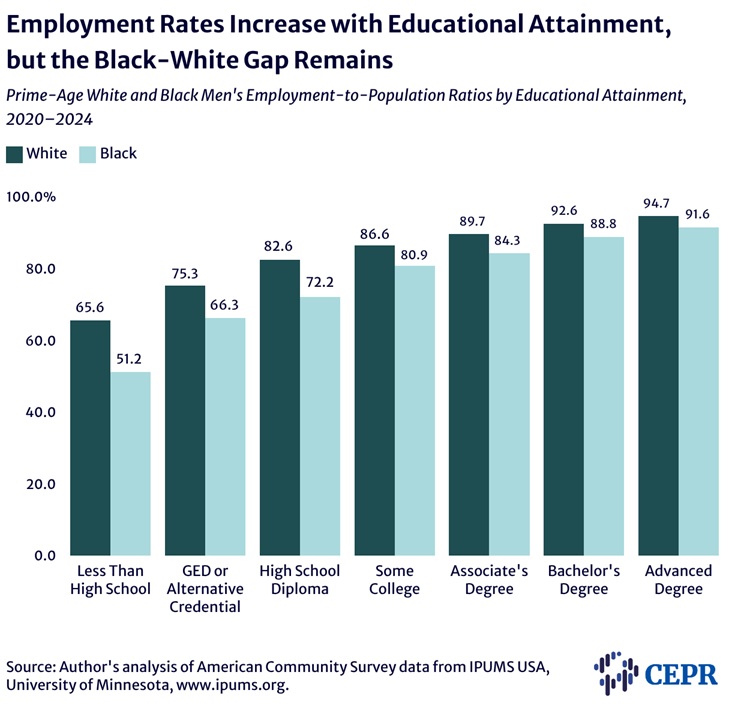
To complicate the story, there is an employment-rate benefit to increasing the educational attainment of Black men. Figure 3 shows that prime-age Black men who do not have a high school diploma have an employment rate of 51.2 percent, but prime-age Black men with advanced degrees have an employment rate of 91.6 percent — 40.3 (due to rounding) percentage points higher! As educational attainment increases, so does the Black male employment rate. Thus, there is an employment-rate benefit to increasing Black men’s educational attainment and probably Black men’s hard skills more generally.
While the Black male employment rate increases with educational attainment, it is still lower than the White male rate at every level of educational attainment. Also, the data shows that the employment-rate gap tends to become smaller as educational attainment increases. Prime-age Black men without a high school diploma have an employment rate 14.3 percentage points below their White peers. For Black men with advanced degrees, the employment-rate gap is only 3.1 percentage points. Again, it appears that Black men have relatively more difficulty obtaining employment in occupations with lower hard-skills demands.
Since the Black male employment rate is lower than the White rate at every educational level, increasing Black men’s educational attainment is not a realistic strategy to eliminate the Black-White employment-rate disparity. For example, if prime-age Black men’s educational-attainment distribution were increased so that it is identical to prime-age White men, but Black men had the same employment rates by educational level, the prime-age employment-rate gap would only be reduced by about a third. Most of the gap would remain.
Increasing Black men’s educational attainment and other hard skills are likely to be helpful, but they will not solve the problem, since the cause of the low employment rate is not due to a lack of hard skills.
If anyone is familiar with Cincinnati, the educational part of this rests on concepts like that collectively diplomas from Withrow High School and Walnut Hills High School are equivalent. To do these kinds of studies you likely need to make such assumptions, but employers don’t need to. I think many STEM professors in the UCal system recently highlighted that the enormous variability of student preparation in situations where all have one of the same credentials used in this study (high school diploma) was causing a lot of pedagogical difficulties in their fields.
These significant variances could have racial correlations. It’s not a good study if based on “constants” that have a great deal of variation. I get that it’s good practice not to “boil the ocean” in designing studies, but not sure how useful the education angle is here in thinking about employment. At the college level, there has been great competition to gain admission to certain schools specifically because the education provided for the same credential is thought of as far superior than other schools. I don’t want to be too harsh here, because research not using controlled experimental results can be hugely difficult.
Eric:
Your comments are harsh as you are creating an illusion by discussing preparedness. After a couple of years of having left college, more likely than not your college preparation will make little difference in one employment setting. Even in later settings, the education will get you through the door. However, it is your experience which will take a primary role.
Your mentioning of race is becoming a call-sign in your commentaries. With you, it appears race is always an issue.
THE root cause of poor educational performance is the poor marriage rate in the USA population. In white culture 57% and in Black culture 25% marry a productive father to form a family before having children. WELFARE encourages this generational destructive behavior.
The children of single parents often lead lives in poverty crime homelessness and parasitic behavior in society.
Charles Murray is that you on Angry Bear?
Does welfare corrupt the poor?
Few ideas are so deeply ingrained in the American popular imagination as the belief that government aid for poor people will just encourage bad behavior.
The proposition is particularly cherished on the conservative end of the spectrum, articulated with verve by Charles Murray of the American Enterprise Institute, who blamed welfare for everything from higher youth unemployment to increases in “illegitimacy.” His views are shared, to a greater or lesser degree, by Republican politicians like the unsuccessful presidential candidate Mitt Romney and Paul Ryan, the chairman of the House Ways and Means Committee.
projectileboy on Oct 25, 2015:
“Getting average citizens worked up over welfare is a standard way for the extremely wealthy and powerful to distract those same average citizens from noticing where their tax money gets squandered the most – large corporate subsidies, infrastructure projects that benefit the richest neighborhoods, and so on, and so on. The largest welfare programs I know of are unneeded weapons systems, which very intentionally subcontract work out to nearly every congressional district in the land (see the B-2 as an example).” The Myth of Welfare’s Corrupting Influence on the Poor Hacker News
Welfare is a subsidy. Economic fact: states you get more of anything that is subsidized. The EV Auto was subsidized and sales increased.
Unmarried women having children for a subsidy is no different. Illegal immigrants were subsidized and the numbers increased—These are all mainly for building voter blocks to control DC —works very well as one party had congress for 30 yrs. 1964 till 1994
@William,
“Economic fact: states you get more of anything that is subsidized.”
LOL!
So if the state subsidizes emergency room care because indigent people must be cared for regardless of ability to pay, that causes more emergent life-threatening conditions (traffic accidents, heart attacks, broken bones, etc)? If the state subsidizes fire departments, that causes more house fires? If the state subsidizes court-appointed attorneys, that’s cause more crime? If the state subsidizes vaccination, that causes more infectious disease?
Did unmarried women stop having babies in 1994? Did illegal immigration end in 1994?
You do know that illegal immigration in America is subsidized by consumers? Illegal immigrants who clean hotel rooms, mow golf courses, roof houses, pick vegetables and fruit and work in meat packing are all subsidized by the people who purchased those goods and services. Not to control DC but to subsidize cheaper goods and service.
Did you know that illegal immigrants have been subsidizing Social Security for decades by providing fake SS numbers? Employers send the money to the SS program, but no claims will ever be filed. Economic fact.
Heh.
Joel –sorry your logic is not correct. Subsidizing services does not cause more use of the services.
@William,
LOL!!
Sorry, that was your logic, not mine. You asserted: “Economic fact: states you get more of anything that is subsidized.” I falsified your assertion with several examples.