
What It Takes to Payoff Student Loans
I would guess most people do not know what it takes to pay off a student loan. Many of them are quite large. And over time a newly hatched employee just out of college will be paying a lot more than in the past. I do not believe the payment is proportional to the past in payment. I do believe the debt is greater, the payments higher, and are done over a longer period of time.
This particular article touches upon costs per profession. In which case lawyering and doctoring debt are higher than what one pays for a business degree. Once you dive into this, I believe you will see what I see and thought all along. I did challenge Stabenow on student loans several years back. You get nowhere in getting a viable solution.
“Average Student Loan Payment [2025]: Cost per Month, Education Data Initiative
Some points to consider . . .
Report Highlights: The average monthly student loan payment is an estimated $536 based on previously recorded average payments and median average salaries among college graduates.
- The average borrower takes more than 20 years to repay their student loan debt.
- 42.9% of borrowers are on the standard 10 year or less plan with fixed payments.
- The average outstanding federal student loan debt per borrower is $38,375.
- 52.4% of indebted borrowers owe $20,000 or less in federal student loans.
Related reports include Average Time to Repay Student Loans | Student Loan Debt Statistics | Average Student Loan Interest Rate | Student Loan Default Rate
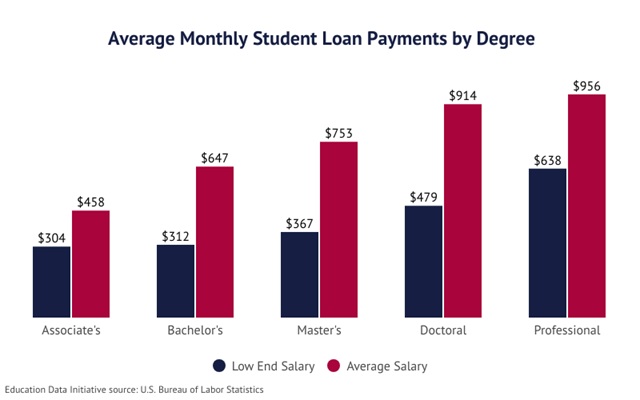
Average Student Loan Payments
An appropriate monthly payment is based on multiple variables, including income, total debt, interest rate, and repayment timeline.
- 20% of your gross income (GI) should go toward paying off debts based on the 50-20-30 rule of finance.
- The average monthly student loan payment of $523 is equivalent to 10% of a $62,760 annual GI. $376 monthly payments are 10% of $45,120.
- 36% of income is the maximum amount that should go toward paying off debt according to the 28/36 rule of finance.
- $523 monthly payments are equivalent to 36% of a $17,433 annual GI.
- The average starting salary among all new graduates with bachelor’s degrees is $64,291.
- 10% of the average starting monthly salary for new graduates is $536.
- 42.9% of borrowers are on the standard 10 year or less plan with fixed payments.
- The most commonly used federal student loans have an interest rate closer to 6.53%.
- The average outstanding federal student loan debt per borrower is $38,375.
- 16.0% of borrowers owe less than $5,000.
- 20.2% of borrowers owe between $10,000 and $20,000 in student loans.
- 18.0% owe $40,000 to $100,000.
- 5.54% owe between $100,000 and $200,000.
- 2.44% owe in excess of $200,000.
- In 2016, the average student loan payment was $393; adjusted for inflation, the average student loan payment in 2016 was equivalent of $523.
- In 2005, the average student loan payment was $227; adjusted for inflation, this is equivalent to $376.
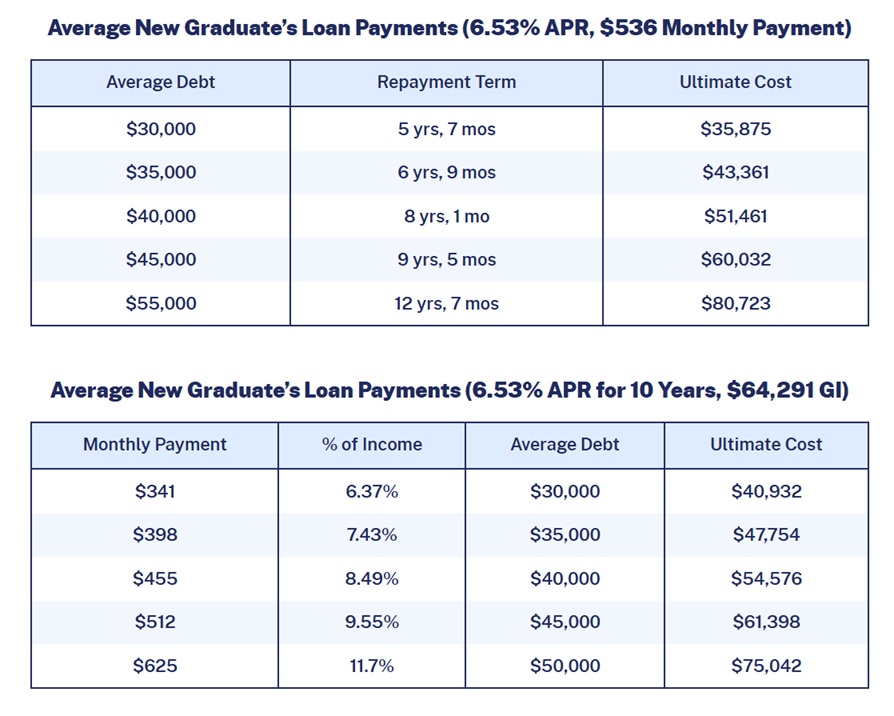
Class of 2023 Student Loan Payments
Because student loan interest rates are at historic highs, current students may not be able to pay off their student loan debts within the recommended 10-year timeline.
- 6.53% is the interest rate for Direct Subsidized and Unsubsidized federal student loans to undergraduate borrowers.
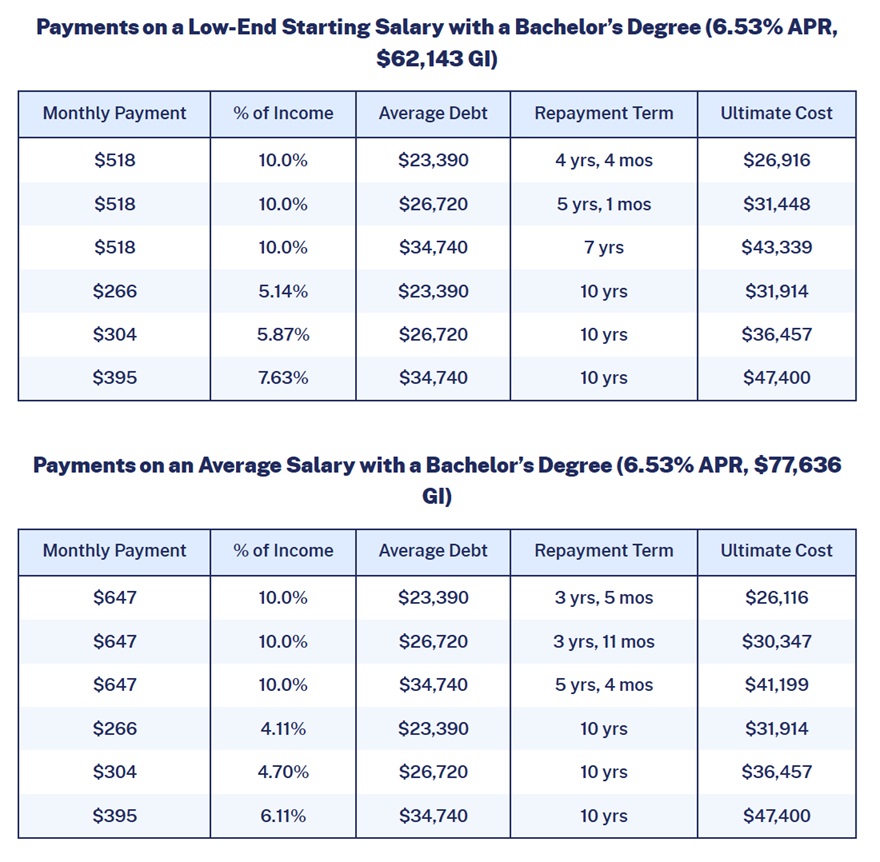
- $62,143 is a low-end starting salary for a new graduate with a Bachelor’s degree.
- $91,411 is a high-end salary for a Bachelor’s degree.
- $77,636 is the median annual salary for a recent graduate with a Bachelor’s degree.
- $23,390 is the average student debt for a federal loan borrower who graduated from a public institution with a Bachelor’s degree.
- $26,720 is the average student debt for a federal loan borrower who graduated from a private, nonprofit institution with a Bachelor’s degree.
- $34,740 is the average student debt for a federal loan borrower who graduated from a private, for profit institution with a Bachelor’s degree.
Bachelor’s Student Loan Payments
Borrowers with a bachelor’s degree benefit from increased earning potential, but student loan debt and interest rates can still create financial challenges. The ultimate cost of a bachelor’s degree depends largely on income and repayment terms.
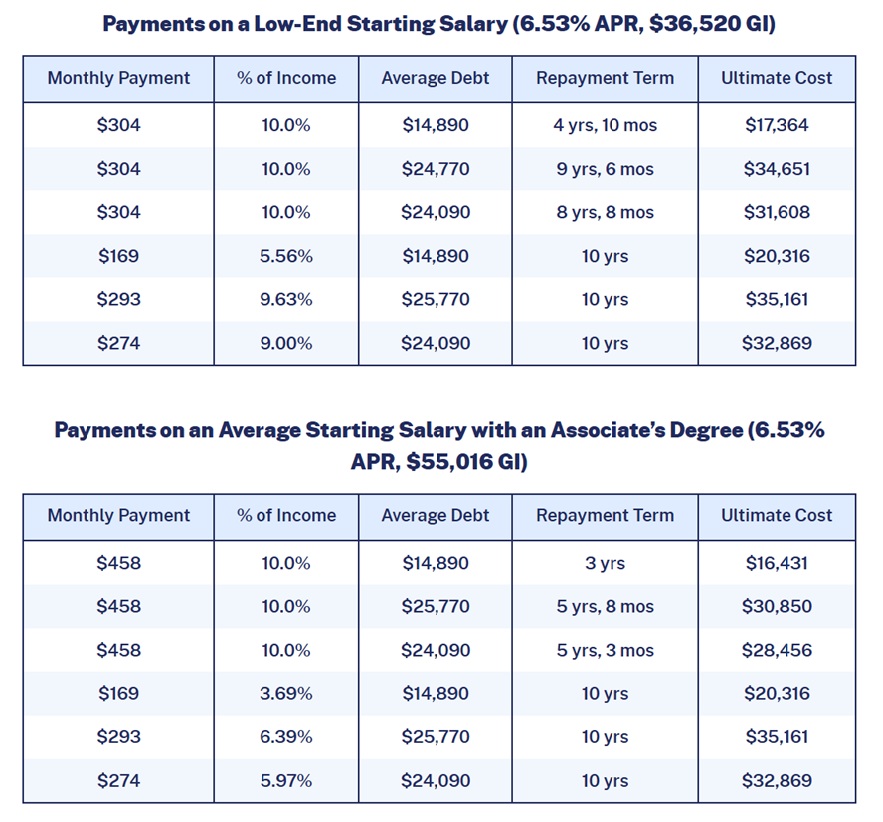
Associate’s Student Loan Payments
Student borrowers with Associate’s degrees are the most likely to pay off their student loans faster than other degree holders. From a purely financial stand-point, this gives the average Associate’s degree the highest value in terms of cost-benefit ratio.
- Just 31% of Associate’s degree holders who graduated from public institutions use student loans to pay for school.
- 77% of attendees of private, nonprofit schools take on student loan debt.
- 91% of attendees of private, for-profit schools take on student loan debt.
- $55,016 is the median annual salary for an Associate’s degree holder.
- $36,520 is the low-end average annual salary.
- $14,890 is the average student debt for a federal loan borrower who graduated from a public institution with an associate’s degree.
- $25,770 is the average student debt for a federal loan borrower who graduated from a private, nonprofit institution with an associate’s degree.
- $24,090 is the average student debt for a federal loan borrower who graduated from a private, for profit institution with an associate’s degree.
Average Payments for Graduate Student Loans
Graduate students logically must make higher monthly payments. For some degrees, this does not just mean paying a higher dollar amount; it may also mean a significant portion of a borrower’s income goes toward repaying student loan debt.
- 8.08% is the interest rate for Direct Unsubsidized federal student loans to graduate or professional borrowers.
- 9.08% is the interest rate for Direct PLUS loans, which go to graduate or professional borrowers as well as parents of undergraduates borrowing on their behalf.
- 48% of graduate degree completers have student loan debt. 54% have both undergraduate and graduate student loan debt.
Master’s Student Loan Payments
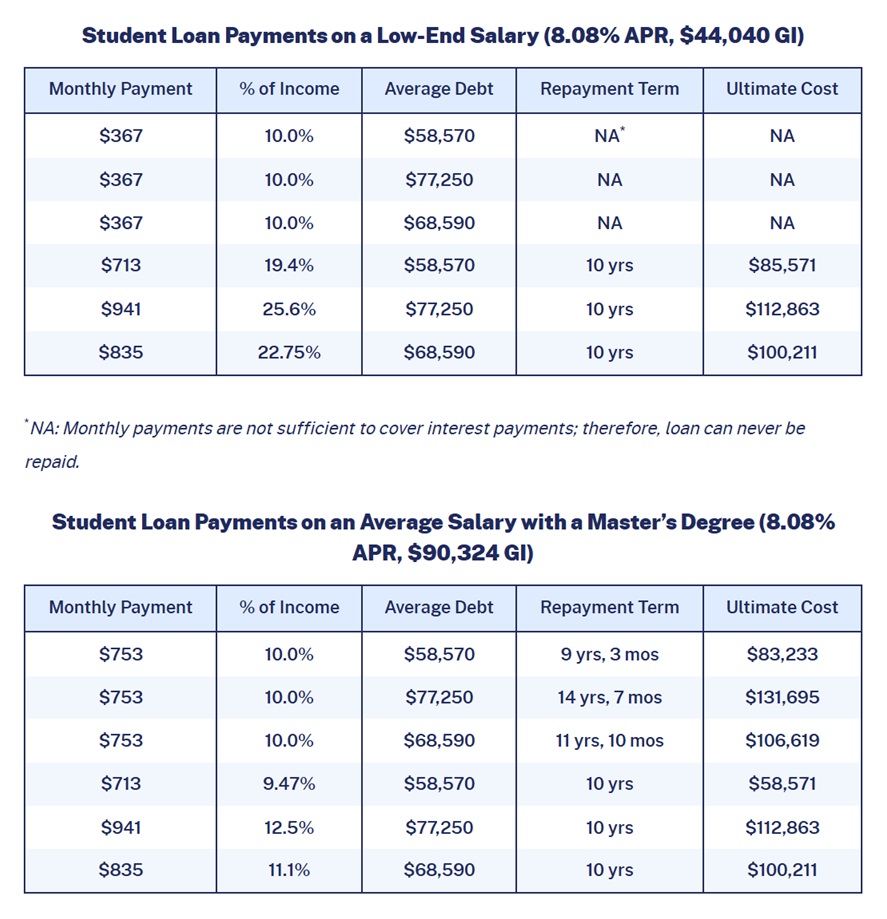
Student borrowers with Master’s degrees who make an average salary are more likely to be able to pay 10% of their salary to pay off their loans than students with other graduate degrees.
- $58,570 is the average student debt for a borrower who graduated from a public institution with a Master’s degree.
- $77,250 is the average student debt for a borrower who graduated from a private, nonprofit institution with a Master’s degree.
- $68,590 is the average debt for Master’s degree holders who attended a private, for-profit institution.
- $90,324 is the median salary for a Master’s degree holder.
- $44,040 is the low-end salary for a Master’s degree holder.
Professional & Doctorate Student Loan Payments
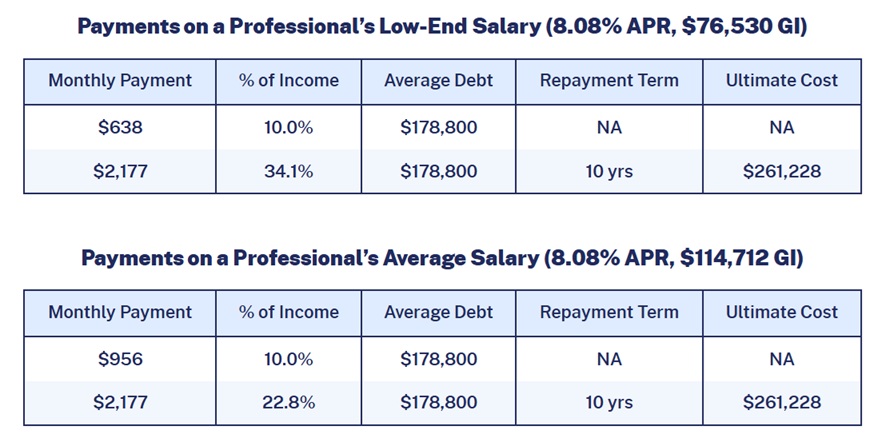
The average debt for a graduate from a private, nonprofit institution with a Professional degree is about the same as the average medical school debt.
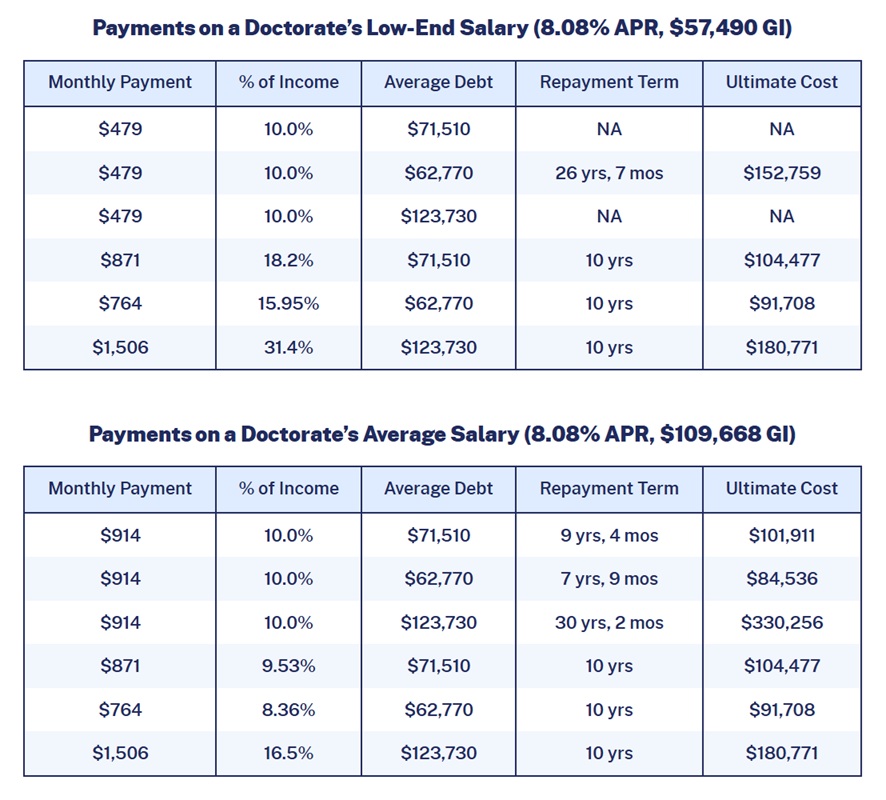
- $109,668 is the median salary for people with Doctoral degrees.
- $57,490 is a low-end salary for Doctoral degree holders.
- $71,510 is the average debt for a Doctoral degree at a public institution.
- $62,770 is the average debt for a Doctoral degree at a private, nonprofit institution.
- $123,730 is the average debt for a Doctoral degree at a private, for-profit institution.
- $178,800 is the average debt for Professional degree holders.
- $114,712 is the median annual salary for someone with a Professional degree.
- $76,530 is a low-end salary for someone with a Professional degree.
Payments for Medical School Debt
Among professional degree holders, medical and law degrees are among the most commonly sought. They are also among the most expensive.
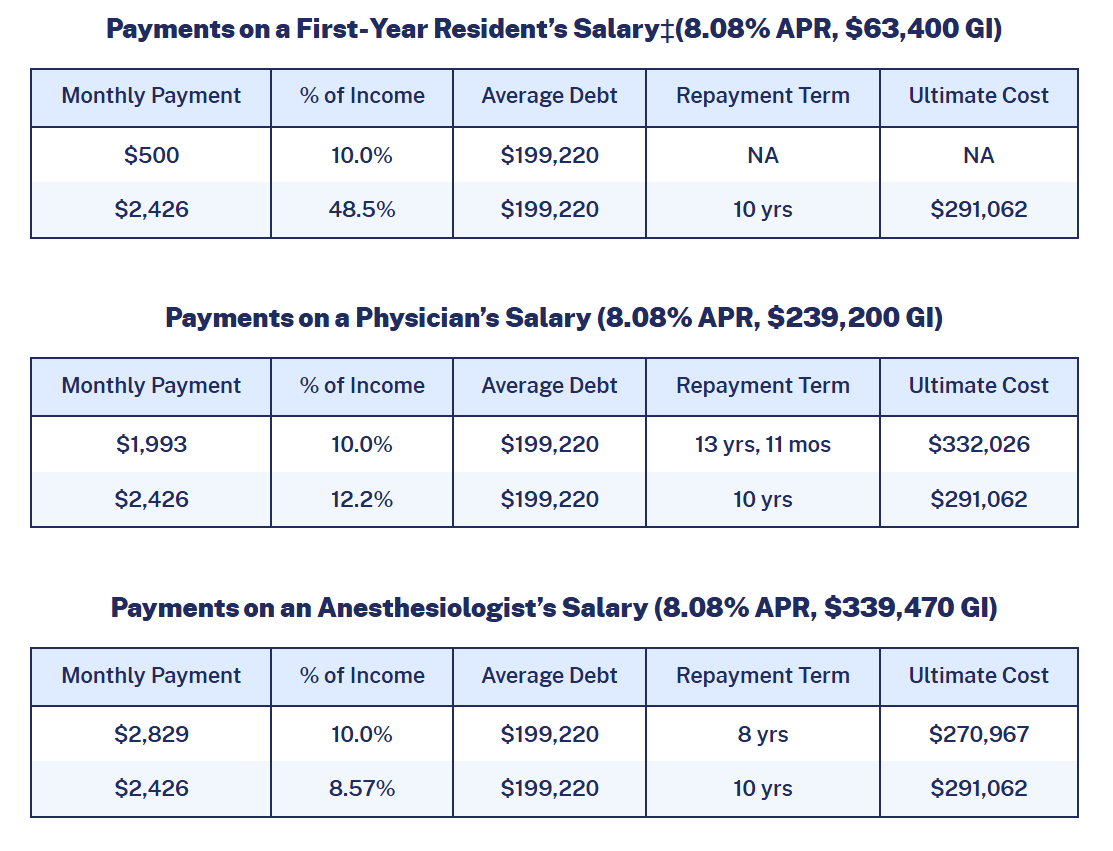
- $199,220 is the average student loan debt for a medical school graduate.
- $60,000 is the average salary for a first-year resident.
- $239,200 is a general physician or surgeon’s salary.
- $339,470 is an anesthesiologist’s salary.
Payments for Law School Debt
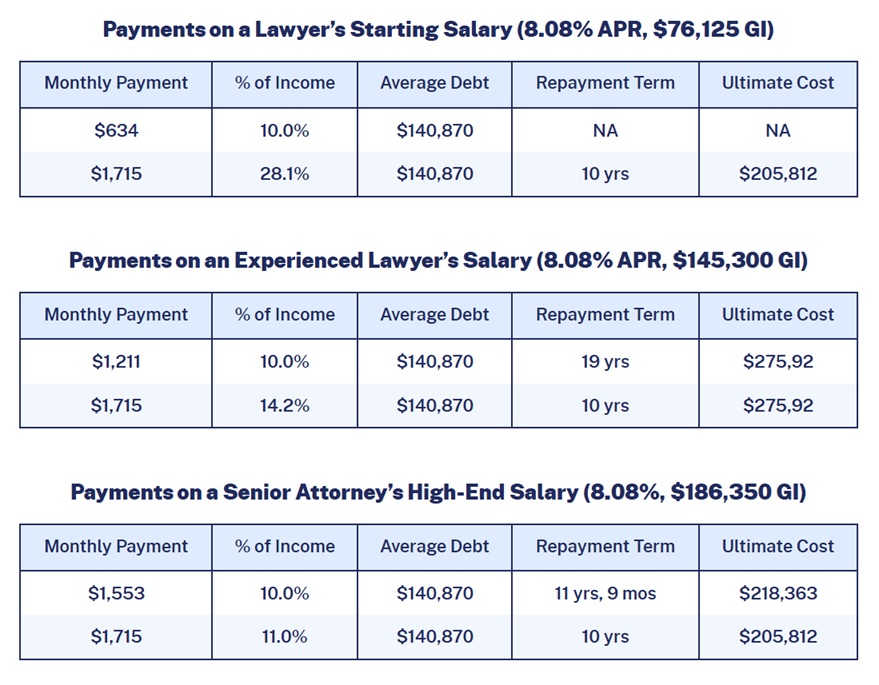
The average law school debt is more than four times higher than the average undergraduate student debt but still only two-thirds of the average medical school debt. The average starting salary for a new law school graduate is similar to the average salary for someone with a bachelor’s degree.
- $140,870 is the average student loan debt for a law school graduate.
- $76,125 is the average starting salary for a law school graduate.
- $145,300 is the average salary for an experienced attorney.
- $186,350 is the average high-end salary for a senior attorney.
Private Student Loan Payments
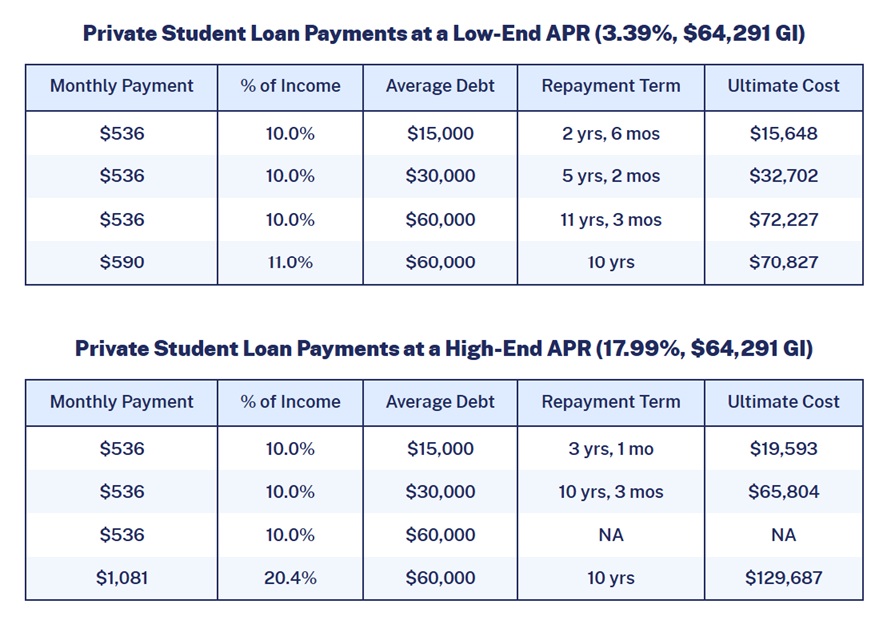
Private student loans, for the most part, come from academic institutions as well as banks and credit unions. The total amount of private student loan debt is difficult to track because little of the related data is a matter of public record.
- 3.39% is the low-end private student loan interest rate for most student borrowers.
- 17.99% is the high-end interest rate.
- The total amount of student loan debt for private student loans is $50.9 billion.
Sources for the Statistics can be found here at the bottom of the article.
Access to bankruptcy but a few other reforms at the same time. Get rid of special repayments, but you could make the “standard” repayment different to offset this to some degree. Low interest rates for a few years and higher late, when principal should be lower. Whatever might – in aggregate – recognize the tendency for incomes to rise during careers, but without tying to specific individual circumstances (that is handled in bankruptcy if needed). No more “public service” write offs….’this is your loan and you can try to get it discharged’.
Bankruptcy is such a huge win for borrowers, this would probably end up accepted. There need to be some tough go-forward reforms as to who gets money and for what purposes. With bankruptcy I expect the public will want to lend money to students very likely to pay it back – much more likely that we currently see. That I think is potentially very conflictive. Like ‘we loan officers are not so interested in exactly why your school district has had such poor performance, but you need a co-signer.’ Or, ‘we don’t lend more than $X for that course of studies.’ So conflictive that I expect that the current template of guaranteed loans, no bankruptcy and minimal credit risk concern probably survives for quite some time.
I just don’t think America is prepared to stomach what it takes to make the educational loan portfolio resemble the credit risk of loan types that currently are dischargeable. I do think that beneath all this is the question of K-12 performance. The higher that achievement gets and the more consistent national levels of achievement become, the more willing the public will be in federally investing in higher levels of education, whether via loans or grants.
Eric:
The key words to your comment is “I do not think.”
There is no water falls of debt cancellation yet.
In 2023, a “total of 588 people filed cases seeking student debt discharges through bankruptcy between October 2023 and March — a 36% increase from the prior six-month period.
As of March 2024, a total of 1,220 new cases had been filed since the new federal guidance was put in place. Of cases decided by the courts during that time, 98% have provided a full or partial student debt discharge.
Student loans are still a La Brea tar pit. You can get a student loan but you can never leave it 100%. My three have had them. I helped to pay them off. But then I had the earnings to do so and little debt.
So many other parents may not have the ability to do so. There are very few other types of loans which have such constraints on them. Much of the relief was due to President Biden. Much of the stringency against student loan relief was the result of a Senator Biden.
The Guardian: “How Biden helped create the student debt problem he now promises to fix”