
Design, Growing Old, and the Impact
This is stuff I do not even think about. I am on the precipice of it happening as I age into it more and more. I am already there.
“How Dangerous Design in our cities and homes is killing our olders,” Carbon Upfront!
The Wall Street Journal recently published Seven Ways to Track Your Risk of Falling—and Prevent an Injury, noting that falls are the leading cause of injury for people 65 and older. Quoting a study, Falls and Fall Prevention in Older Adults, Julie Jargon of the WSJ writes:
“The risk of falling in a given year doubles with every additional related issue—including reduced muscle strength, balance problems, medication side effects, and even forgetting to take that medicine.”
The article and the study left me frustrated and angry because neither discusses the scale of the problem, and they both blame the victim for getting old. The article is all about technology- fitness trackers, vital-sign monitors, smart pill dispensers, even doorbell cameras so you don’t have to rush to answer the door. The study goes through all those medical issues that cause people to fall, and then throws in one line on “extrinsic causes”:
“Environmental factors correlated with falls in older adults include poor lighting, uneven surfaces, and floors that are slippery. Studies show that these factors account for 30%-50% of falls in this population.”
This is what I have called dangerous design, and it’s a lot higher than 30%-50%. My late mother was a victim of dangerous design, suffering a traumatic brain injury that changed her life and contributed to ending it.
I used to write about it often (see my second post after I was laid off and started writing on Substack) and pitched a book about it to two publishers, neither of which thought there was a market for it; who wants to read about old people falling down? But now I have Substack and I can write about it here.
How big is the problem?
Many others and I have often written about the deaths and injuries caused by cars, and the number of people in the USA killed and injured by firearms every year is shocking, and a major news story every day. Yet in 2023, in the USA:
- 46,728 died from firearms;
- 40,901 died from car crashes;
- 47,026 died from falls.
There were 14,688 news reports on firearm incidents in mainstream news media in 2013, but you don’t see nearly as many about car deaths and almost none about falls; after all, 41,400 of those deaths from falls were adults over 65, so it’s not news.
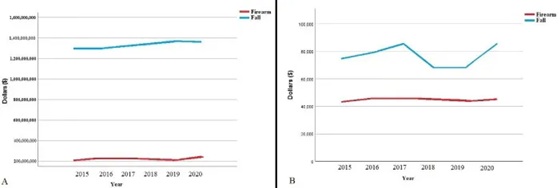
It should be big news; not only are there more deaths from falls than there are from firearms, they are also more expensive. A fascinating study, Geriatric falls: an enormous economic burden compared to firearms found that falls cost society far more than guns. The reason “could be attributed to survivability bias, as victims of firearm injuries often die immediately, whereas victims of falls may endure prolonged hospitalization and rehabilitation therapy, leading to higher costs.” The authors conclude:
“Raising awareness about the economic burden of geriatric falls is paramount. Public perception plays a crucial role in shaping healthcare policies and resource allocation. By dispelling misconceptions and highlighting the true cost of falls, societies can foster a more informed discourse that prioritizes preventative strategies and long-term care for the elderly.”
That economic burden is huge. According to Consumer Affairs, in 2021, the medical costs of falls in the USA were $70.79 billion, including the hospitalization of 985,188 non-fatal victims of falls. Medicare and Medicaid covered 75% of that; it will be interesting to see what happens when the cuts due to recent legislation kick in. And it doesn’t end in the hospital room: “Factor in computations for work lost, diminished quality of life and years of life unlived and the total cost soars to just shy of $676 billion.”
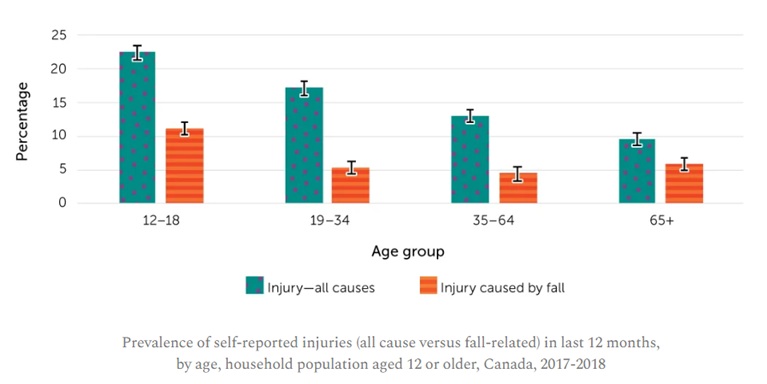
Falls don’t just happen. In Canada, the Public Health Agency notes:
Falls among older adults continue to be a serious public health issue in Canada. ED visit and mortality rates show upward trends, and although hospitalization rates appear stable, the number of Canadians aged 65 or older requiring hospital admission for fall-related injuries is growing. Falls and fall-related injuries among older adults are preventable.
This isn’t just a problem of people being old and frail; it’s a design problem. It’s an interior design problem, a building design problem, an urban design problem, a maintenance problem, and an attitude problem of blaming the victim. As the population ages, the problems and the costs will only get worse.
The Wall Street Journal article aggravated me so much because it was so typical: It’s the victim’s fault for being old. But don’t worry, technology will save us, from Apple watches to self-driving cars, and of course, Artificial Intelligence to track our biodata and end social isolation with chatbots and virtual assistants.
In fact, what we really need are better bathrooms, safer streets, walkable communities, appropriate housing, and universal design.
More to come. Lots more.
Some background on why this is going to be such a big problem:
“The demographic time bomb is about to detonate,” Lloyd Alter My last post, in which I complained that Toronto just blew it with its rejection of sixplexes in the suburbs, was illustrated with a photo of my late mother-in-law’s house. It had a bathroom on the second floor, a powder room at the entry, but no bathroom on the mid-level with the living, dining, and kitchen.
“How Dangerous Design in our cities and homes is killing our olders,” Carbon Upfront!
This was the standard design of some vacation condo’s in Mammoth Lakes built not that many years ago. Except the entry level had a full bath and outdoor gear storage area. Presumably to shower and clean up when you completed your great outdoors adventuring. One visit was enough to convince me that it was poorly designed. Even for younger more agile people than I am. At least more newer developments are dropping tubs for showers in most of their baths.
This was put out by the WHO almost two decades ago: untitled
Thank you Pat . . .
“Global Age-friendly Cities: A Guide,” World Health Organization
I will take a look at it.