
Fast Trains in Japan
My (Samuel Walker) observation is that railroads capable of high speed, that is over 110 mph are passenger services. Where they have been built, they have been built with different goals and purposes.
Often there is not enough in fare to cover all costs. The Japanese built the first high speed railroad because of its practicality for creating time and place utility for people without the need for Air Service. Their initial Shinkansen (New Main Line) covered costs – Tokyo to Osaka. As the system was expanded for political purposes, financial stresses followed, Nonetheless, purely political purposes can have overall future benefits.
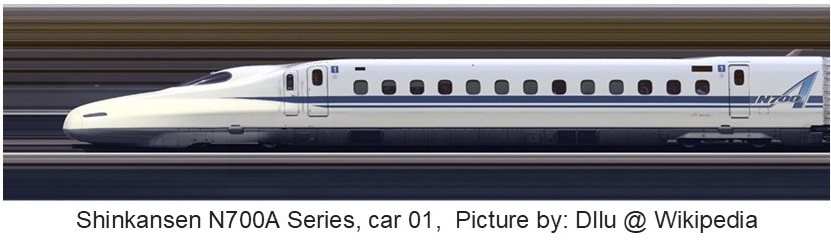
In all cases for high speed rail, there are environmental benefits.
It occurred to me that the extra cost to high speed rail and single people moving focus has economic drawbacks. Upgrading the American freight railroad system to being a higher speed railroad system, that is, 110 mph maximum operating speed, is a pragmatic and incremental approach to pursue. Create a 110-mph freight railroad service and the passenger service will follow. As passenger demand increases, there will be identified routes to be upgraded to high-speed rail, 110+ mph.
The conventional American freight railroad system is privately owned. It is balkanized with freight service monopoly. As such, it occurred to me that a way to achieve the 110 mph higher speed freight railroad would be to have a separate government owned 110 mph system that is accessible by any privately owned freight railroad similar to being a turnpike. But, it would be a “rail” pike rather than a turnpike. Such a new service level would create new transport opportunities for freight as well as for people.
Our current freight railroads have excessive dwell times in intransit classification yards. Time is lost in collecting and delivering freight cars from siding to siding. Siding to siding the total elapsed speed can be in the vicinity of 7 mph. This is accepted for bulk products. It is a system incapable of fully competing with truck freight.
Following up this introduction to high speed trains a letter I am mailing to Congressman Seth Moulton, sponsor of a bill to provide funding for higher speed / high speed railroad developments. Similar information is being shared with Pennsylvania cosponsors, Representative DeLuzio and Representative Boyle.
It is a small effort to steer them away from privately owned railroad system ownership, management and control. More to come . . .
The data show that we have the most efficient freight rail system in the world.
Analysis: US Railroad System Is Great for Freight
dave:
2019 report? I believe the railroads have lost efficiency before 2019 and since 2019. There is another report by Samuel coming up tomorrow. He is a railroad guy.