
The Little or No Change, Changed Little, Unchanged, Held, or Declined Employment Situation Report May 2026
In a Nut Shell?
Civilian Labor force for May increased by 83,000 over April while Not in Labor Force went up by 17,000. Unemployed dropped by 66,000. Unemployment Rate remained at 4.3%. Participation Rate remained the same at 61.8 which is down from the same month in 2025. Civilian Labor Force is growing but a lower percentage of them are employed. What is usually reported is in the chart below.
Trump and Repubs should not be celebrating any time soon. Tariffs and Iran are playing a role in what is happening in the US economy. Neither of these Trump inspired actions are helping the situation.
BLS: Employment Situation News Release – 2026 M05 Results
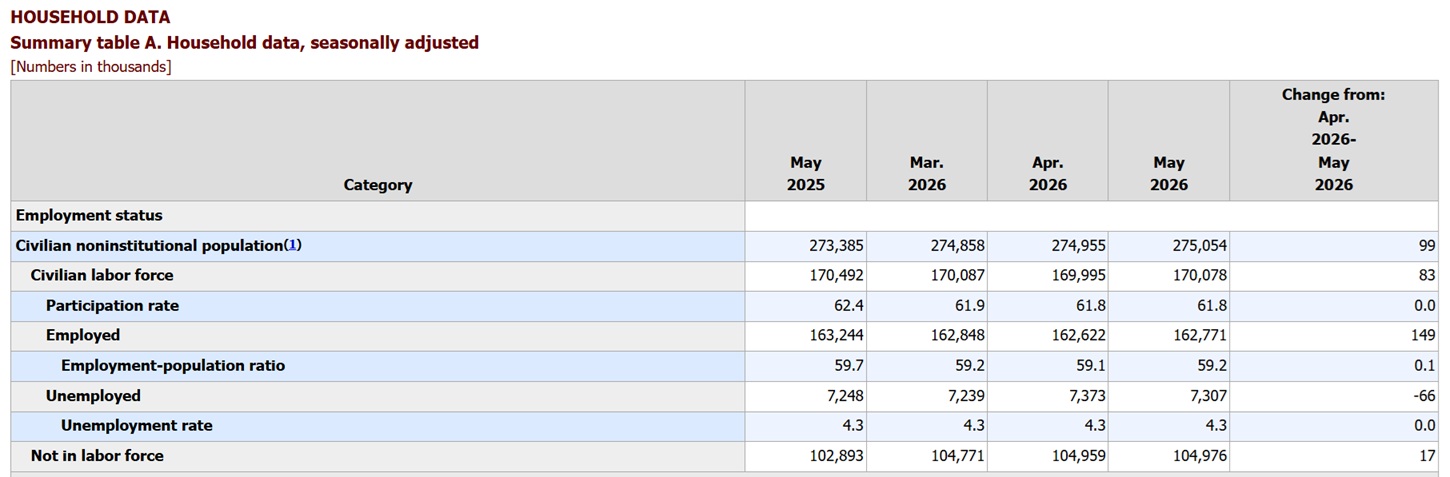
May 2026 Household Survey Data C&P
The major labor market indicators from the survey of households continued to show little or no change in May. The unemployment rate held at 4.3 percent and has remained in a narrow range of 4.3 percent to 4.5 percent since July 2025. The number of unemployed people, at 7.3 million, changed little over the month. (See table A-1.)
Among the major worker groups, the unemployment rates showed little or no change in May for adult men (4.0 percent), adult women (3.8 percent), teenagers (14.7 percent), and people who are White (3.8 percent), Black (6.6 percent), Asian (3.8 percent), or Hispanic (5.0 percent). (See tables A-1, A-2, and A-3.)
The number of people jobless less than 5 weeks declined by 286,000 to 2.2 million in May, largely offsetting an increase in the prior month. The number of long-term unemployed (those jobless for 27 weeks or more) was little changed over the month at 2.0 million but is up by 524,000 over the year. The long-term unemployed accounted for 27.5 percent of all unemployed people in May. (See table A-12.)
The labor force participation rate held at 61.8 percent in May, and the employment-population ratio changed little at 59.2 percent. These measures showed little change over the year, after accounting for annual population control adjustments. (See table A-1.)
The number of people employed part time for economic reasons, at 4.8 million, changed little in May. These individuals would have preferred full-time employment but were working part-time because their hours had been reduced or they were unable to find full-time jobs. (See table A-8.)
In May, the number of people not in the labor force who currently want a job changed little at 6.2 million. These individuals were not counted as unemployed because they were not actively looking for work during the 4 weeks preceding the survey or were unavailable to take a job. (See table A-1.)
Among those not in the labor force who wanted a job, the number of people marginally attached to the labor force changed little at 1.7 million in May. These individuals wanted and were available for work and had looked for a job sometime in the prior 12 months but had not looked for work in the 4 weeks preceding the survey. The number of discouraged workers, a subset of the marginally attached who believed that no jobs were available for them, was 486,000 in May, essentially unchanged from the previous month. (See Summary table A.)
More Information or other information can be found at the Establishment Survey Data on the same site. For example:
Total nonfarm payroll employment increased by 172,000 in May, similar to the gain of 179,000 in April. In May, job gains occurred in leisure and hospitality, local government, and health care. Employment in financial activities declined. (See table B-1.)

So now you know where the 172,000 is coming from in the news. It used to be they would use the Household numbers. Quickie information: Private Service leads the increase in jobs.

Let's see what New Deal democrat will say.