
Book Review: “Land is A Big Deal”
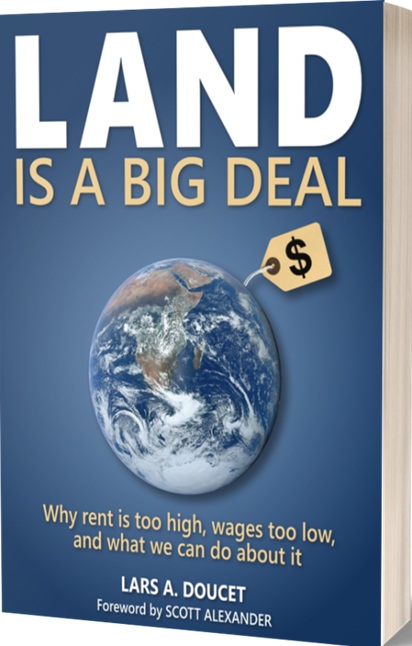
Taxing land and not improvements according to the value of the land? Sounds like a novel idea.
Review: Land is a Big Deal – The one-handed economist, Daniel Zetland
OB recommended this 2022 book by Lars Doucet (LD) because I was asking for advice on lowering rents in the NL.
LD writes with a different style from most non-fiction authors: He’s more casual, more geeky, more fun. He decided to write the book as a way of “checking in” on the utility and feasibility of a land value tax (LVT) — the type associated with Henry George in his 1879 bestseller, Progress and Poverty.
What’s the connection between an LVT and rents? Here’s the idea:
- Tax land, not improvements, based on its value.
- Set LVT high enough (i.e., around 80% of its annual rental income) and the value of that land will stay low.
- Land without improvements (=additional value or income) pays the same tax as land with improvements, so it’s really expensive (opportunity costs) to leave land bare. Indeed, there’s a big incentive to build improvements, since those are not taxed.
- So, more buildings and less empty land means more places to live and thus lower rental (or purchase) costs.
It’s worth mentioning that we see the opposite with mortgage interest tax deductibility (MITD). Since that lowers tax bills, it means that borrowing is cheaper, which leads to more borrowing (or buying power), which — holding all else equal — leads to higher housing prices. Oh, and those prices rise quickly after MITD is introduced, so today’s buyers — if they borrow — are not really saving anything from the existence of the MITD as prices are already higher. Cash buyers always lose from the MITD.
The movement to put George’s LVT ideas into practice is known as “Georgism,” and I am a quasi-Georgist. In this nearly 20-year old post (!), I argue that property taxes (PT on land + improvements) should replace income taxes for several reasons. Most of them agree with George (e.g., can’t dodge the tax, won’t change your behavior), but one reason is fundamentally different. My goal is to tax wealth (i.e., the improvements), whereas the LVT aims to put as much land into good use as possible (e.g., in San Francisco and Amsterdam). These goals are not incompatible, since there is wealth in land as well as improvements.
I think that a mix of LVT/PT might vary from place to place, e.g., 80/20 in Amsterdam but 20/80 in rural areas.
Here’s some data on how LVTs work (or not) in DK, EE and AU.
People who oppose LVT and PT often worry that the tax will be passed from owner to tenants, in the case of rentals. Doucet explains and shows that the LVT would not be passed through if the land market is competitive (i.e., renters have elastic demand), but that condition does not hold very well if location matters enough to create “local monopolies”. I am sanguine about passing taxes through, since renters only look at total cost. Some people want to “stick it” to the landlords, but I think that feeling is often wasted or counterproductive.
It’s also worth mentioning that Proposition 13 (California) and other limits on LVT/PT have forced local governments to cut services (education), raise taxes elsewhere (encouraging more retail, thus sales taxes), and frozen owners in place (since they cannot take their low tax with them to a new property). There’s no free lunch here folks!
Read chapter 5 in this excellent OECD (2023) report on housing inequalities, but do not bother with chapter 6 (green LVT), since its author has delusions about the accuracy of “energy certificates.” It’s better to just tax dirty energy if you want people to use less of it. Read more here.
But back to the book. It’s a fun read, and LD does a good job at dealing with objections to LVT, one by one, i.e.,
- “Land just isn’t an important part of the economy anymore.
- Land Value Tax will just be passed on to tenants and make everything more expensive, and
- Even if all the theory is correct, unimproved land can’t be accurately assessed in practice, so the whole project is doomed.”
I think he does a good job on each of these, and his final recommendations (multiple ways to improve the valuation of land and improvements) are sound.
What would a viable LVT mean, in practice? First, you could reduce many other taxes (thus, their transactions costs and distortions) and perhaps fund universal basic income — especially when you take the view that land, at its most basic, belongs to the country and its people (as a commons) more than individuals. Second, those funds would help local governments improve people’s lives where it matters — in their neighborhoods (anti-Prop 13). Third, anything that government does to increase/decrease the value of land (building a park or a waste dump) will change land values — and LVT revenues — aligning incentives. Fourth, land use would improve at the same time as land speculation eased (since most of the appreciation would be taxed away). DL, channeling George, notes that wages in the “new world” were so high because land was so cheap. Here’s a better statement of that logic (p 60):
Where land is free and labor is unassisted by capital, the whole produce will go to labor as wages.
Where land is free and labor is assisted by capital, wages will consist of the whole produce, less that part necessary to induce the storing up of labor as capital.
Where land is subject to ownership and rent arises, wages will be fixed by what labor could secure from the highest natural opportunities open to it without the payment of rent.
Where natural opportunities are all monopolized, wages may be forced by the competition among laborers to the minimum at which laborers will consent to reproduce.
This is the reason George says that wages are so high in “new countries” where there’s more land available than in countries where it has been locked up for centuries.
Here’s how it all fits together: Though neither wages nor interest anywhere increase as material progress goes on, yet the invariable accompaniment and mark of material progress is the increase of rent—the rise of land values.
And: “where the value of land is highest, civilization exhibits the greatest luxury side by side with the most piteous destitution.”
Both of them are right, and North Americans should note that much of the current “housing crisis” can be blamed on “Old World” scarcity. It’s only in places where expansion (to farmland) is easy that you see new, cheap houses. Oh, and inequality? Given that the rich own over half the property in most rich countries, LVTs would — by reducing the value of their land and distributing the money to everyone (or services that everyone uses) — reduce inquality.
I’ll give the last word to Milton Friedman (p122):
Well, there’s a sense in which all taxes are antagonistic to free enterprise. And yet, we need taxes. We have to recognize that we mustn’t hope for a utopia that is unattainable. I would like a great deal less government activity than we have now, but, I do not believe we can have a situation where we don’t need government at all. We do need to provide for certain essential government functions. The police function, the national defense function, function of preserving law and order, maintaining a judiciary. So, the question is, which are the least bad taxes? And in my opinion—and this may come as a shock to some of you—the least bad tax, is a property tax on the unimproved value of land, the Henry George argument of many many years ago.
I give this book (for its style and clarity) FIVE STARS. I also give the LVT, which has replaced PT as my favorite tax, FIVE STARS.