
The Economies of Biden and Trump . . . Similar?
Inherited Economies Biden and Trump, Patreon
– by Dean Baker
Donald Trump may not be able to remember what things were like five years ago, when he handed the economy and the country to Joe Biden, but it is important that the rest of us do. As in so many other areas where Trump tries to turn reality on its head, he pushes the story of Biden inheriting a great economy, which he then wrecked. The reality is the opposite, Biden turned around an economy in shambles due to the pandemic and handed off an economy that was widely touted as the envy of the world.
The most important reversal was in the labor market. More than 19 million people were laid off in the pandemic shutdowns in the spring of 2020. Many quickly came back to work in the summer and fall, but the huge bounce back had stopped by the time Biden took office.
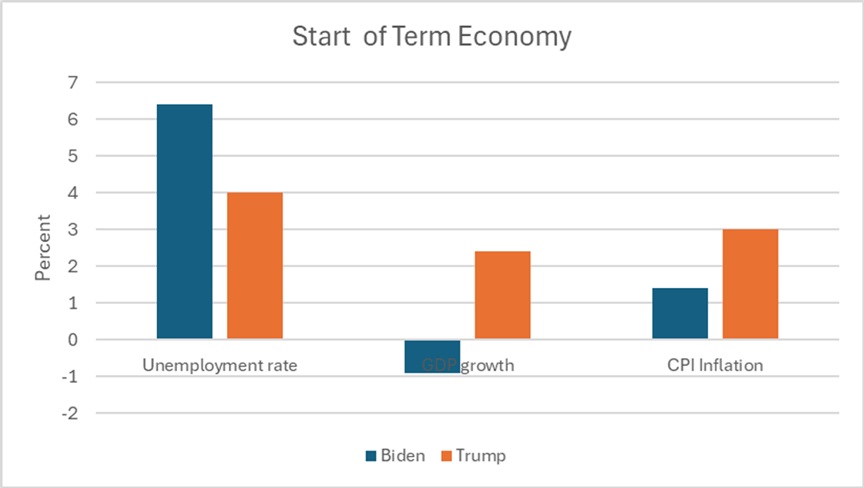
Job growth averaged just 150,000 in the last three months of the Trump administration. In fact, the economy actually lost jobs in December of 2020, so it is clearly wrong to imagine that there was a surge of rehiring at the time Biden took office. Employment was still 9.4 million below its pre-pandemic peak in January of 2021. The unemployment rate stood at 6.4 percent.
Biden’s recovery package quickly turned the economy around. Unemployment was down to 4.0 percent by the end of 2021. Employment levels regained the lost ground by June of 2022. It would have taken more than six years to get back to pre-pandemic employment levels at the rate of job growth in the last three months of the Trump administration.
One cost of Biden’s aggressive recovery package was a surge in inflation. The year-over-year inflation rate began to rise rapidly from pandemic lows, peaking at 9.0 percent in June of 2022. Clearly the recovery package contributed to this increase, but most of the story is the world-wide supply chain crisis stemming from the pandemic. (The surge in energy prices following Russia’s invasion of Ukraine was also a big factor pushing inflation higher.)
The story here is straightforward. As a result of the pandemic, people were not spending money on services like restaurants and travel. Instead, they spent it on goods, like appliances, television sets, and cars. The world could not meet this huge surge in demand, especially at a time when many production and shipping facilities were still crippled by the pandemic.
It is also important to recognize that this shift from services to goods was not the result of governmental restrictions. It was due to people not wanting to go into crowds and risk getting a potentially deadly disease that they could then transmit to friends and family members. Service spending did not return to its pre-pandemic share of consumption until early 2024.
However, the rate of inflation fell quickly. By the fall of 2024 the year-over-year rate was down to 2.5 percent, only slightly above the Fed’s 2.0 percent target. It’s also important to note that wages outpaced inflation over the Biden years, with the lowest paid workers seeing the largest real wage gains in more than half a century. It’s also important to note an increase of 20 million in the number of people who work from home, which is estimated as equivalent to a wage gain of 8 percent.
Finally, there is the question of overall economic growth. The economy had an unprecedented plunge in the spring of 2020 associated with pandemic shutdowns. It shot back in the summer and fall, but it had lost momentum by the end of the year. GDP in the fourth quarter was still 0.9 percent below its year ago level.
The recovery package quickly ramped up growth. The economy had some shaky times due to supply chain issues, two subsequent and unanticipated waves of covid in the summer of 2021 and winter of 2022, Russia’s invasion of Ukraine, and the sharp rate hikes by the Fed beginning in March of 2022. But it had settled down to a healthy pace of growth by 2024, with a year-over-year rate of 2.4 percent in the fourth quarter. That is the economy Joe Biden handed off to Donald Trump.
It would be foolish to say everything was great when Biden left office. The United States has a badly undeveloped system of social supports. Tens of millions of people struggle to put food on the table, pay the rent, and cover medical bills. But by almost every measure most of the country was doing better in 2024 than they had been doing in 2020 or even before the pandemic in 2019.
Donald Trump might want people to forget this fact, but just because he has memory problems, it doesn’t mean the rest of us should also.