
Does Government Military Spending “Fund” Shareholder Dividends, Buybacks, and Concentrated Wealth?
Short answer: yeah. The long answer is . . . longer.
– by Steve Roth
Originally posted at Wealth Economics
There are a lot of pathways and mechanisms in the US and worldwide that deliver wealth to assetholders, and that have perennially concentrated that wealth (hence power) into the hands of dynasties over millennia — notably over recent decades in the US.
Stephen Semler has recently highlighted US military appropriations as a big pathway, that’s getting a lot bigger next year. For 2026, US congress critters are budgeting $1T for military spending, and 54% of that spending will go to private military contractors/corporations. He’s published this in a few places recently. (I first saw it this week on Popular Information. See also here from July 8.)
Semler’s eye-catching claim is that $109 billion (~11%) of those payments to contractors won’t/don’t fund actual military spending, but will instead go to owners/shareholders of the corporate military contractors in dividends and share buybacks.
Now, $109B is only a minute fraction of the $13T in assets currently held by the top-10% wealthholders (who since 2020 have received ~10% average annual return on their assets). But as I said up top, this is just one pathway/mechanism; there are innumerable others. And it’s just one year; wealth accumulates across generations and dynasties; there’s nothing more magical than compounding interest.
For those that are interested, here’s Semler’s premise and arithmetic in simple form:
- Dividends and buybacks come out of corporate revenues — a reasonable understanding in accounting terms. The disbursals have to come from some flow (or stock).
- 67% of the top-four military contractors’ revenues come from government spending. So assume that 67% of their dividends/buybacks ($154T total) do as well: voila, $103B.
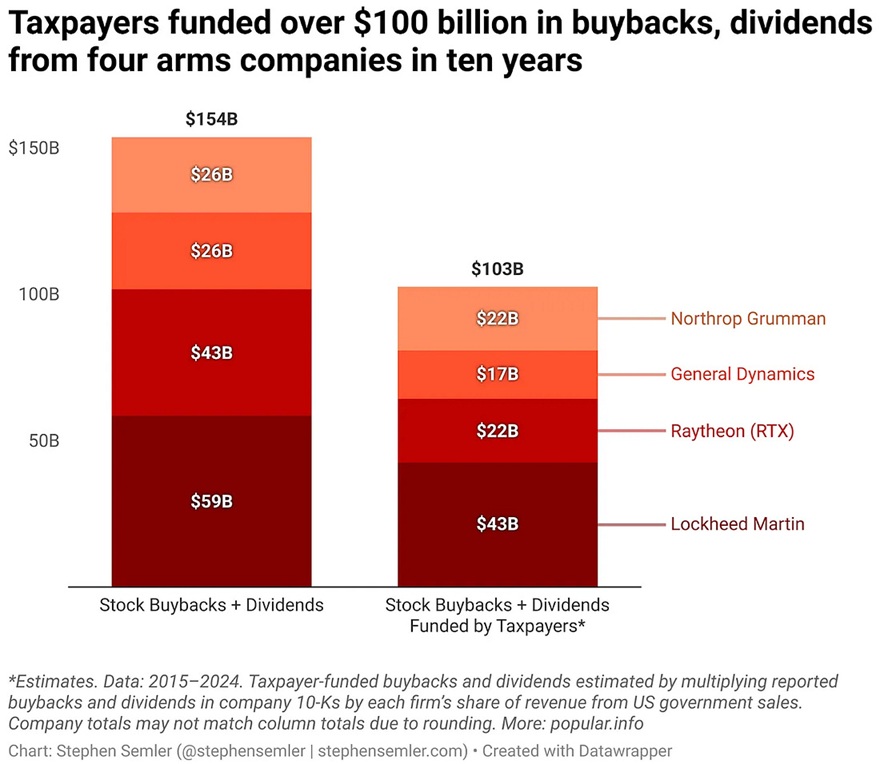
These are small numbers in the big picture, but they’re a good illustration of the many ways that they system comprises a “wealth pump” (in Peter Turchin’s excellent term), “fire-hosing” wealth to the top while “trickle-down” operates…exactly as it’s described.
How did past societies end their disintegrative periods? A critical step is reversing the root cause of crisis—the perverse wealth pump that takes from the common people and gives to the elites.
Interesting piece from Forbes about Lockheed, even though it’s from 2019: “The U.S. government was responsible for almost 70% of the company’s revenue in 2018. In fact, Lockheed Martin accounts for 28% of the U.S. Department of Defense (DoD’s) total military procurement. Furthermore, a large number of the company’s international customers are allies of the U.S. government who cannot buy from Lockheed Martin without the consent of the U.S. government. ” International customers account for 28% of Lockheed’s sales.
How Much Of Lockheed Martin’s Revenue Comes From The U.S. Government?
What’s also intriguing is that LMT’s stock price spiked right before Trump’s reelection but has now receded back to where it was before the Russian attack on Ukraine. All this despite European countries’ commitment to spend 5% of GDP on their military, much of which would have to be spent in the US.