
Wasting $Billions While Chain Sawing the Government for Efficiency
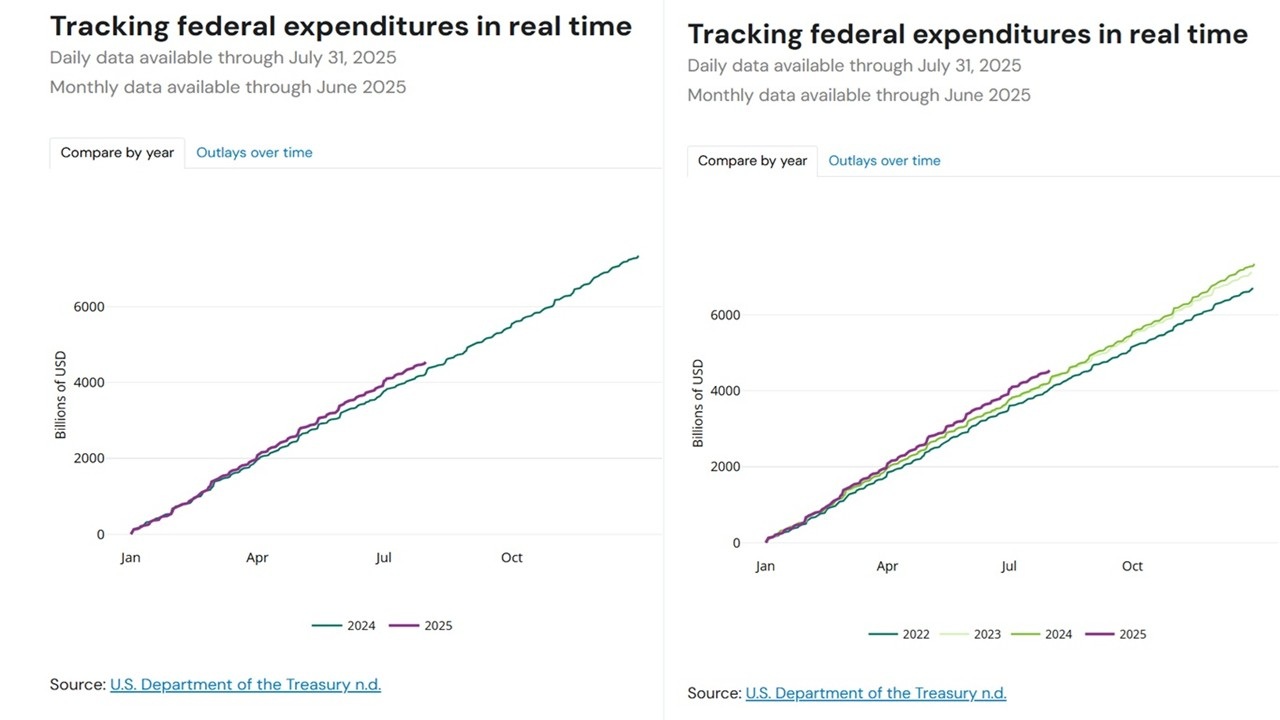
Taking from “Tracking federal expenditures in real time.” Brookings we are able to see Federal Gov. expenditures over time. In this case, I chose years. The original graph is on the left and was presented by Common Dreams, “DOGE Wasted Tens of Billions.”
It is a great graph depiting the differences in administrations. The article was taken from Common Dreams presents an excellent point. DOGE did not cut costs (period). But DOGE worked for Pres. Tr__p. Tr__p is ultimately responsible for government expenditures. He insists he is in control. How does the Tr__p administration match up against the Biden administration?
The original graph (left) only shows one year (2024) of the Biden administration expenditures. I did not believe it to be enough. So, I added more years (graph on the right). Originally, I had it from 2021 to 2024. It gets too cluttered. So, I dropped 2021 and only matched up 3 years of the spendthrift Biden administration to the chart on the right. The Biden’s administration for 2021 to 2024 was ultimately less costly than the Tr__p administration so far. Even with all the cuts, the Tr__p administration is more costly.
“DOGE Wasted Billions While Chain Sawing the Government in the Name of ‘Efficiency'” Common Dreams
The Department of Government Efficiency wasn’t so efficient after all. It was extraordinarily wasteful. This according to a Thursday report by the U.S. Senate’s investigations subcommittee.
Elon Musk spent the early part of this year ransacking the federal government. The billionaire promised his mass layoffs of federal employees, the choking off of critical foreign aid, and the gutting of consumer watchdogs all served a greater purpose. The goal of saving the government and the American people $billions by rooting out waste. While it did not work as planned.
Musk is already known to have wildly exaggerated the amount his initiative would save. Indeed and as the charts show, Government spending in 2025 has been higher than previous years despite Musk’s dramatic cuts. Some analysts have estimated the initiatives might actually cost taxpayers money in the long run by slashing funds for tax collection and other forms of spending that increase economic activity.
The Biden government was less costly.
The staff report released by the office of Sen. Richard Blumenthal [the ranking Democrat on the Senate Homeland Security Permanent Subcommittee on Investigations (PSI)] only focuses on waste by DOGE quantified in the here-and-now. It finds that in just six months of operation, DOGE wasted more than $21 billion.
This comes at “the very same time,” Blumenthal said, that “the Trump administration is cutting healthcare, nutrition assistance, and emergency services in the name of ‘efficiency’ and ‘savings,'” via the recently passed “One Big Beautiful Bill Act,” which itself is projected to add $3.4 trillion to the federal deficit over the next 10 years.
Blumenthal said his investigation shows that “DOGE was clearly never about efficiency or saving the American taxpayer money.”
By far the largest source of waste it identifies comes from Musk’s mass layoffs of nearly 200,000 federal employees. In January, he announced the “Deferred Resignation Program” (DRP), which he described as the “fork in the road.”
In order to quickly thin the ranks of government, Musk offered federal employees the opportunity to retire early with their benefits and pay through September 30—a deal that around 200,000 took. The Senate report calculates that the government has spent $14.8 billion to pay these employees not to work for eight months.
Roughly another 100,000 employees were also involuntarily fired from their jobs, and had to receive severance pay that amounts to an additional $6.1 billion.
DOGE’s funding freezes also resulted in massive waste: freezes on loans for energy utility projects meant that the government lost out on $263 million worth of interest payments and fees. Meanwhile, $110 million worth of food and medicine was left to spoil in warehouses due to the shuttering of the U.S. Agency for International Development (USAID).
While many of these costs are temporary, other studies looking at the long-term effects of DOGE have found that many of the programs it cut also brought in vastly more revenue than they cost to run.
For instance, according to Yale’s Budget Lab, DOGE’s firing of thousands of Internal Revenue Service (IRS) employees could cost $395 billion in lost revenues over the next decade, and potentially as much as $2.4 trillion if the decrease in enforcement leads to more tax-dodging.
Musk also virtually eliminated the Consumer Financial Protection Bureau (CFPB), which has returned over $26 billion to American consumers since its creation in 2011 while costing a fraction of that amount to run.
Cuts to public health research by the National Institutes of Health (NIH) may also lead to significant costs in the long run. An April study by the University of Maryland found that it could cost the U.S. 68,000 jobs and $16 billion in revenue annually.
Even the $125 million cut from USAID—which the White House has claimed results in “no return for the American people”—is projected to result in nearly $29 billion lost each year by U.S.-based organizations.
Meanwhile, the human costs to these cuts, especially to USAID, have been catastrophic, with hundreds of thousands already dead from preventable diseases in a matter of months, and potentially as many as 14 million by the end of the decade.
As economics writer Maia Mindel summarized in a post on X:
“Okay, yeah, so DOGE was illegal and didn’t cancel any big-ticket items and also it didn’t increase government efficiency and it lied about all its accomplishments and also none of its staff were even remotely qualified. But at least a million Africans died. Take that, libs.”
Check my graphs. I am pretty sure they are correct.