
Destabilizing the US Job Market
Cuts to Medicaid will impact the people receiving healthcare from Medicaid. Such cutbacks will result in layoffs in Long-Term Services & Supports (LTSS). Medicaid is the “single largest payer” for Long Term Services & Supports (LTSS). It accounts for nearly half of total LTSS spending in the US. It includes care provided in a nursing home or other facilities.
Also impacted will be in “Community-Based Services (HCBS)” leaving many people dependent up HCBS stranded. HCBS) provides for Medicaid beneficiaries to receive services in their own homes or communities rather than institutions or other isolated settings. Read on for the particulars as taken from . . .
“Cuts to Medicaid Will Destabilize the US Job Market,” Health Affairs Forefront
Pre-Memorial Day . . . the House of Representatives passed a bill which includes dramatic cuts to Medicaid. Of course this threatens health care coverage for millions of Americans. These cuts will have a significant negative impact on a large and growing segment of the private-sector workforce. Workers who provide vital services to people with Medicaid coverage and serve an essential role in care for our aging population.
Under this bill, roughly 16 million people (the number keeps changing) would lose coverage, between the Medicaid cuts, changes to the Affordable Care Act Marketplaces, and the expiration of enhanced premium tax credits for Affordable Care Act plans. There is another issue which goes unmentioned. There has been less focus on the bill’s potential impact on the U.S. labor market, specifically how the estimated $700 or so billion in cuts to Medicaid may result in significant job losses.
Medicaid is also a Source of Health Care Jobs
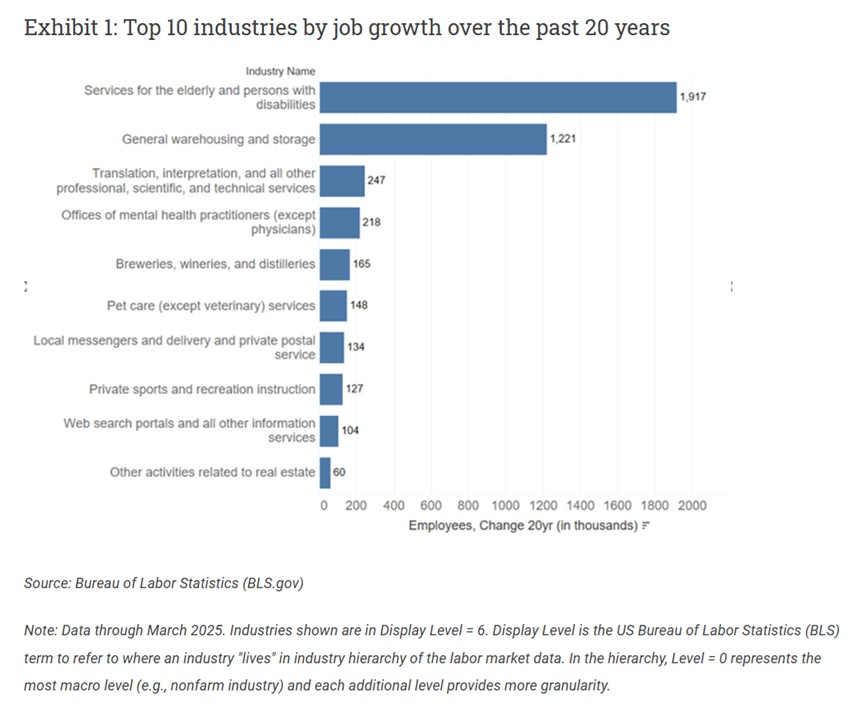
An analysis of the Bureau of Labor Statistics data shows illustrates (at a level more granular than broad industry) how important Medicaid is to the job market (Exhibit 1). For example:
“Services for the elderly and persons with disabilities” is the single largest private-sector industry with net job growth over the past 20 years. It adds an estimated 2 million jobs to the labor market. An example of the former’s size and importance? The second largest industry for job growth is “General warehousing and storage” with 1.2 million jobs. This is the result over the past 20 years of Amazon’s delivery network.
To be sure, Medicaid is not the only payer for services for the elderly and disabled, but Medicaid is definitely the single largest payer for Long Term Services & Supports (LTSS), accounting for nearly half of total LTSS spending in the US. LTSS includes care provided in a nursing home or other facility. It also includes Home and Community -Based Services (HCBS), which is care provided to older adults, people with physical disabilities, and people with intellectual and developmental disabilities in their own homes or communities rather than institutions or other isolated settings. States are not required to cover HCBS in their Medicaid programs, but all states cover some HCBS benefits.
The job growth in “Services for the elderly and persons with disabilities” has risen in correlation with the trend of states providing more HCBS over time. However, if Congress enacts the House bill’s dramatic Medicaid cuts, states will be forced to make significant cuts to their Medicaid programs. States have three basic options for where to apply Medicaid cuts: optional benefits (like HCBS), eligibility (cover fewer people), or provider rates (pay doctors and hospitals less).
When states are having to cut Medicaid spending, HCBS was among the first benefit on the “chopping block.” The most recent example occurred during the Great Recession, when every state Medicaid program cut services and benefits for HCBS between 2010 and 2012.
Recently a published report from the White House Council of Economic Advisors (CEA) pointed such failure to enact the reconciliation bill would cause a recession by reducing consumer spending, small business investment, and hiring. The report also warns the bill’s failure to pass could spark a global confidence shock and dollar deflation, a tightening of credit, and push real interest rates high.
The CEA is missing another issue. Its report did not acknowledge the potential significant labor market impact of the Medicaid cuts. It overlooks the tie between Medicaid spending and job growth. In other words, the report ignores the impact of the federal spending cuts serving as the offsets for the cost of some of the tax cuts and extensions. Taking into consideration the potential for interaction effects from the Medicaid cuts, as of March 2025, there were more than 2.6 million jobs in the HCBS industry alone that could be at risk (Exhibit 2).
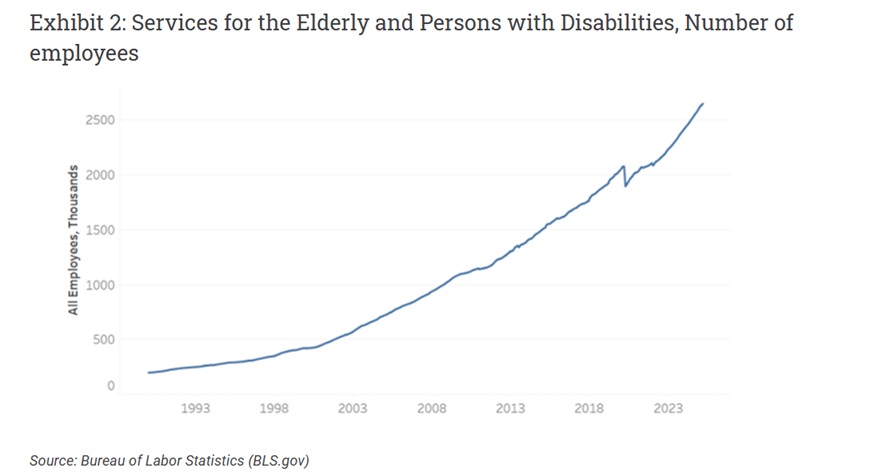
The US Continues to See Growing Demand for Jobs to Support an Aging Population
With the demand in LTSS services increasing due to an aging population and the significant number of jobs on the line, cuts to Medicaid will be devasting for individuals and the economy. CBO estimates that by 2030 nearly 7 million people (about twice the population of Oklahoma) will use paid LTSS delivered in home and community settings, and almost 2 million people (about the population of Nebraska) will use services delivered in institutional settings.
Nationally, the overall demand for HCBS workers, including home health aides, personal care aides, nursing assistants, and psychiatric assistants, is projected to grow by 39% between 2022 and 2037. Given these jobs provide services, such as personal care and adult daycare, it is hard to imagine technology or AI would replace these jobs.
A Drag on Economic Growth
US hiring is cooling. However, jobs in health care and social assistance continue to grow accounting for more than half of total payroll growth over the past 16 months. The US needs to add an estimated 150,000 jobs per month to maintain “full employment,” and the potential for losing the 2.6 million jobs in HCBS could erase 18 months of “full employment” monthly job growth. This job sector could continue to grow and expand the economy. The impact of proposed Medicaid cuts will likely wipe out the gains over the years. Millions of people will be without jobs and millions more will be without healthcare.
It is obvious from the lack of noise that brother and sister have yet to realize that mom, dad or both are going to be coming to live with them.
I heard on NPR that China does not have a national health insurance system (single payer).
Daniel:
Very true. As to China: Short summation:
China’s healthcare system has made great achievements in the management of medical services and public health challenges for the Chinese people. However, the issue of an aging population in Chinese society is becoming more and more salient. The gap between demand and supply of healthcare is expanding. China’s healthcare system is facing unprecedented challenges. These problems include an insufficient medical insurance fund, nonuniform insurance reimbursement policies, a poor integrity system, and a lack of supervision in the management of the medical insurance fund. To address these challenges, some practical solutions are worth considering. A national medical insurance supervision platform should be strengthened. Besides, blacklists for illegal medical institutions and individuals engaged in malicious medical disturbances should be created. The country should also introduce policies to narrow the differences in regional medical insurance policies and balance the reimbursement levels of residents in different regions. Big data and artificial intelligence can be used to monitor the entire process of medical insurance fund utilization. The government needs to establish relevant laws and regulations to optimize the medical insurance system and ensure the safe and effective operation of the medical insurance fund. Achievements and Challenges of the Healthcare System in China
Thank you Daniel . . .