
Review: Money: A Story of Humanity
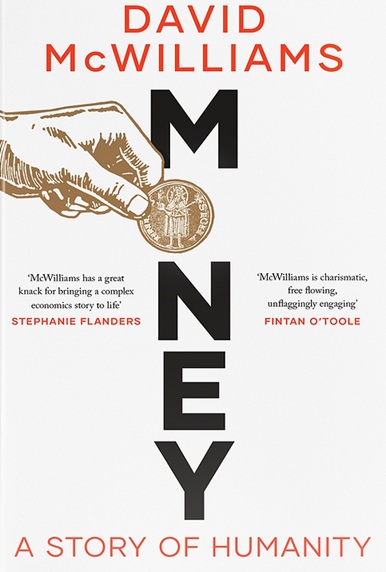
I’ve been enjoying David McWilliams’s podcast for a few years now, and I was planning to ignore his 2024 book on the history of money until I didn’t, and I’m glad I read it.
Review by The One-Handed Economist, David Zetland.
McWilliams (DM) is a story teller, but he’s also a legit academic economist with decades of macroeconomic experience, so he brings a lot of depth to a 400-page book that’s easy to read and informative.
“Money: A Story of Humanity”
– by David McWilliams
Notes
- Money, like the prices that go with it, facilitate cooperation as well as “gains from trade.” Both inventions have massively increased our prosperity.
- Some people see money as the root of all evil (this version blames women as the root). David Graeber, for example, argued that money and debt are abused for the sake of power and exploitation. He would prefer a non-monetary world where social obligation takes the place of money. It’s easy to see how that world may have existed (and still does, in small groups where “I owe you one” holds), but not how it would scale above the Dunbar limit of about 150 people. Sure, Graeber and fans would love to live in that world of hunter-gatherers, but most of us prefer to drink our coffee with a roof over our heads.
- Debt and money also facilitated 3-way trades, where A would give a promissory note to B, who could trade it to C in exchange for goods. Transaction costs fell, and economic efficiency rose. (We will get to inflation, bubbles, and fraud in a bit…)
- The Sumerians had interest rates and used base-60 for calculations. DM makes the straightforward but mindblowing observation that interest rates link the present to the future (in expected terms) as well as noting how base-60 — by allowing one to divide by 2, 3, 4, 5, 6, 10, 12, 15 and 30 — contributes to social numeracy. “The trading bazaar required pragmatism over elegance: if you didn’t grasp calculations in a monetized society, the chances of getting ripped off soared. The introduction of money forced people to think numerically… Numeracy nudges us towards rationality because numbers demystify the world“
- Coins (later paper) inverted power-relations. In a Graeberian world of debt as a social obligation, only the rich and powerful could be assured of good credit (otherwise, you’d end up in jail or worse). With coins came anonymity, and thus the option to trade with anyone, regardless of their political and social standing.
- The shift from mythos (narrative) to logos (logic) radically changed ancient Greek society: “why was there such a flowering in philosophy, economics, medicine, democracy, and ultimately the thoroughly modern idea of the engaged citizen and the Republic? The evolution of Greek thought and the widespread dissemination of money, particularly in the form of silver coins, is too closely correlated to be dismissed as coincidence. Money gives rise to an element of individual control and personal responsibility. The Greeks would have seen that a baker with two drachmas has equal purchasing power in the market to a princess with two drachmas. Such relative equality, where hierarchy is flattened by trade, must’ve been socially revolutionary.”
- Currency allowed a shift in activities from farming and barter to trade and taxes. DM says that Athenians paid 8% taxes in coin while Egyptians paid 15-15-50% in kind. Money didn’t just make the pie bigger (via efficiency) — it also allowed workers to keep a larger share of their production.
- DM argues that Christianity arose as a counter-revolution to money: preaching charity, forgiving debt, throwing the money changers from the temple — these actions and more were popular with the Have-nots. What about the Haves? They could buy forgiveness.
- The Romans had credit, speculators, bubbles, debasement, and the rest. Plus ça change.
- The fall of the Roman empire led to a loss of money and the commerce is facilitated. In the early Medieval period (the Dark Ages), these items disappeared: “dyed cloth, concrete, glazed ceramics, aqueducts, paved roads, frescoes, realistic sculptures and portraits, paper, indoor flush toilets, complex bridges, screw presses, hydraulic cranes, segmented plate armor, cavalry saddles, greenhouses, lighthouses, most glassmaking and silver work, pain relievers, and vinegar as antiseptic, central heating, and surgical tools.” They would not come back until money was reintroduced in northwest Europe in the 900s.
- The Arabs had one tool the Europeans lacked: they could count in our heads… Anchoring this new way of thinking was the concept of zero, which allowed the Arabs to count in large numbers, to mentally conceive of balance sheets with positive and negative numbers, and to use an amazing tool, algebra. These advantages put the Arabs on a different commercial footing to their European competitors. While European traders relied on the clumsy abacus, a technology unchanged since Roman times, the Arabs displayed an extraordinary mental agility that allowed them to express an amount of dates, figs, or raisins in terms of an amount of wheat, corn or nutmeg. They accepted various coins, from places like Alexandria and Cyprus, and gave change back in the local Sicilian currency without missing a beat. The Europeans were dealing with money. The Arabs were dealing with finance.
- Fibonacci (1170-1240) didn’t just invent his sequence (beloved of mathematicians and architects); he also popularized the use of zero and “Arabic numbers” (imported from India, via the Arabs) and the calculation of interest rates. Pacioli (1447-1517) built on his work by devising the balance sheet and thus double-entry bookkeeping.
- These commercial innovations allowed merchants and guilds in the [now Italian] city states to trade through “horizontal” networks that challenged “vertical” political powers, very much like coins challenged reputation in ancient Greece. State and religious powers were not pleased, but they could not crush ideas (fractional reserve banking, bills of exchange) that could move to more friendly jurisdictions. (The Hanseatics pursued the same strategies a bit later in the North.)
- In medieval Germany, wealthy land owners wanted cash. They pledged their land to the moneylender, typically the monastery, and with the collateral in the bag, the monks – who got some of their money from the collection box – lent out the lump sum to the squire. The squire paid a rate of interest to the monastery for the pleasure of getting the cash lump sum. The income from the land, those rents extracted from the peasants, went to the monastery. At the end of the term, the monastery looked to be repaid. As aristocrats are notoriously bad with other people’s money, defaults were regular. In the event of default, the lender took the title and thereby acquired the land. (How do you think the Catholic Church became one of the biggest land owners in the world?) The contract thus had default (or death) built-in, hence the name mortgage, or death contract.
- Like many Russians, Peter the Great was both impressed and unnerved by western European sophistication and technological prowess… Russian leaders regularly embrace cosmetic, western characteristics, but balk at the deeper inconveniences actual western liberal policies can impose on the powerful… Although Peter wanted the fruits of Dutch money — the innovation, the wealth, the naval power — he wasn’t too keen on the democratic and institutional compromises the Dutch establishment made to achieve them. Encouraging debate and accepting people who might not agree with you on everything wasn’t for him, but sometimes you can’t have one without the other. Dissent and creativity often contribute to the great adventure of commercial enterprise. Dutch tolerance, Dutch wealth and Dutch financial genius appeared to go together.
- John Law and Tallyrand were interesting guys!
- When money dies, trust and stability in society breakdown. One of money’s many psychological qualities is that it simplifies our complicated world. It is an organizational technology that imposes discipline. Functioning as it should, money means prices can be trusted. Prices contain a vast array of information about value, scarcity, and relative worth. Apart from their economic impact prices serve as psychological anchors. Money provides a shortcut, allowing us to absorb this information in a trustworthy number, or a series of numbers. Kick away the crutch of dependable money, and society is unmoored.
- Skipping ahead a few hundred years (sorry Spanish real, sorry US
thalerdollar) we get to the gold standard (GS), which — like bitcoin — is deflationary (the price of one unit of a good, given a fixed quantity of money, will fall if there are more goods). Deflation is “bad” for economic activity since people will wait as long as possible to trade their scarce money for abundant goods. - Skipping ahead but still on inflation, DM turns to fiat money, which became a thing in the 1970s, after Nixon took the US off the GS. Now there was a problem of stagflation during that time — and high interest rates and gold prices signaled something wrong — but DM claims that the economic growth rate doubled from 1-1.5% per year on the GS to 2-3% per year with fiat money. That’s a huge difference, and he credits it to the flexibility that central bankers — and DM was one — have with fiat (and not with the GS). Claude kinda demolishes his claims, so that’s an issue. He also points out how much easier it is to move from a bad fiat currency to a good fiat currency, which is not possible if both are on the GS.
- DM gets into modern central banking and says (among many things) that the tail (banks) may be wagging the dog (central banks) since banks (in a fractional reserve system) can create money. And then there are the “non-bank banks” which can do the same, or more!
- The book ends with interesting discussions of how low interest rates in the 2010s boosted inequality by inflating asset values (mostly held by the rich) and thus populists and a look into various digital moneys.