
Republicans’ gaslighting . . . it will be necessary to cut Social Security benefits
Maybe not? Paul Krugman discussing Social Security and how it could be saved with a few changes. If you read what Paul Krugman is suggestion as a solution, I believe you will understand what could be done. Also, you will get an understanding of what should not be done and which is having a negative impact on Social Security funding.
The reality is that nothing being done will doom Social Security. A growing population of workers can keep Social Security solvent. Everything being done by this administration creates a bigger issue.
“Social Security is Facing a Political Crisis”
causing the issues of funding and not necessarily a financial crisis.
“America can afford to keep paying full benefits. But will we?”
On Tuesday (June 2026) the Social Security Trustees released their latest report on the system’s finances. The numbers didn’t change much: Unless something is done, the Old Age Survivors and Disability Insurance (OASDI) program, Social Security’s official name, will be unable to pay full benefits starting in either 2032 or 2034, depending on some technical issues. That’s not far away: If the Trustees are right, the prospect of a Social Security crisis will loom over the next presidential administration.
It’s important to understand, however, the nature of the looming crisis. It won’t be an economic crisis. It won’t even be a serious fiscal crisis. Whatever you may have heard, Social Security isn’t in danger of going bankrupt.
What we’re facing, instead, is potential political crisis. Congress and the White House could easily take action to sustain America’s retirement system. But given the current state of our politics, there’s no guarantee that they will.
There is a widespread misunderstanding of how Social Security works. While Social Security was designed to look like a pension fund, it isn’t. A pension fund pays benefits out of a stock of assets it has accumulated over time. In contrast, Social Security operates as a government transfer program, like food stamps or Medicaid.
Now, unlike food stamps — but like the highway trust fund — Social Security is on paper supported by a dedicated tax, the payroll tax, that is assigned to that program. But I say “on paper” because from an economic point of view assigning the payroll tax to Social Security is just an accounting convention. What matters for the U.S. economy is the overall balance between government spending and government revenue, not the difference between one type of spending and one source of revenue. So there’s no inherent economic significance to the fact that by 2034 payroll tax receipts will be insufficient to cover promised benefits.
There is, however, a legislative issue. As long as the Social Security Administration can pay benefits out of payroll taxes and its cash reserve, there’s no need for Congress to vote each year to authorize benefits — they just keep going out until further notice. However, once those resources become insufficient, benefits will fall —by 17 percent according to the Trustees — unless Congress passes new legislation that “tops up” Social Security’s finances.
Yet the current administration and Republican party are such extremists that there is a real risk that Social Security will be held hostage on behalf of their goals. If this should come to pass, the hostage-takers will claim that shoring up Social Security is unaffordable. Right on cue, Mike Johnson, the Trump-sycophant Speaker of the House, declared on Monday that “entitlement programs” like Social Security “have to be adjusted and fixed,” and that Republicans will introduce a plan to that effect next year.
But this is a ploy, because while the cost of maintaining Social Security benefits at their promised level isn’t trivial, it is in fact affordable. According to the Trustees’ report, the actuarial balance of OASDI up through 2050 — the amount of additional funds it would need to keep paying full benefits for the next 25 years — is 1.06 percent of GDP. To put that number in perspective, the Trump administration proposes increasing military spending next year by $420 billion, equivalent to about 1.4 percent of GDP – without any discussion of whether that’s affordable
Yet how did we get to the point where Social Security will need to be topped up? The main answer is that we have an aging population, with a growing ratio of retirees collecting benefits to workers paying into the system:
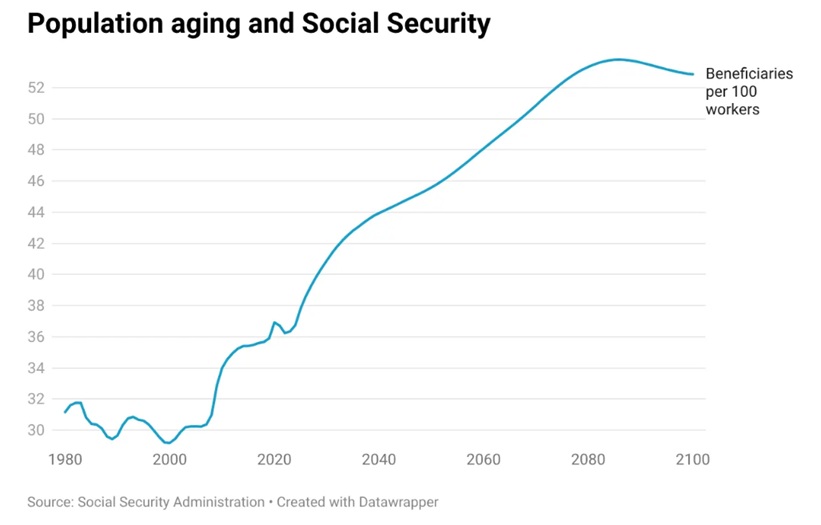
Trump’s anti-immigration policies are making this problem worse. According to the Trustees’ report, lower immigration will deepen Social Security’s financial hole because many immigrants are working-age adults who will pay into the system for decades before they collect benefits.
In fact, this problem may be much bigger than the report acknowledges:
1. The report’s baseline assumption is that we’ll have net immigration of almost 1.2 million people a year, and even the pessimistic case assumes 750,000 a year. Meanwhile actual net immigration has already been cut far below that — and may now be negative.
2. Moreover, Social Security is being financially damaged by growing income inequality in America. Payroll taxes are levied only on wages up to $184,500, and they don’t touch capital income. With the distribution of income increasingly shifting from labor to capital, as well as becoming more unequal among wage-earners, revenue from the Social Security payroll tax has been falling as a share of national income. From 1990 to 2024, it fell from 5.02 percent of gross domestic income to 4.46 percent.
Which brings me to the question that, these days, we ask about everything: How might Social Security be affected by the advent of AI?
A short answer: If, as many of us fear, AI accelerates rising income inequality, it will further reduce the payroll tax receipts that currently pay for Social Security and further endanger its finances.
On the other hand, if AI, as its advocates promise, leads to faster economic growth, it will increase the potential tax base that could and should be used to support Social Security and other social insurance programs. But to take advantage of that larger base, we’ll have to get serious about taxing wealth and capital income.
Is Social Security in trouble?
Yes, but only because of the way its financing is currently structured — a structure that no longer works well because our society and economy have become so unequal. Moreover, Trump’s immigration policies are further endangering its already deteriorating financial condition.
So don’t believe Republicans’ gaslighting that it will be necessary to cut Social Security benefits. All that is necessary to preserve Social Security is political will to raise taxes on the wealthy and a sensible immigration policy.
“But I say “on paper”……is just an accounting convention.”
Okay, it only took AB about 8 or 9 years (or was it more even?) to understand that the idea that SS had nothing to do with federal deficits or the resulting debt needed to finance them wasn’t reality. Progress!
@Eric,
“. . . just an accounting convention.”
LOL! In the same sense that the deficit and the national debt are just accounting conventions.