
High-Speed Rail (HSR) is in U.S. Transportation Planning and Spending
“Moulton Bill Plants a Flag for Major Funding—and Policy Reforms—to Develop U.S. High-Speed Rail”
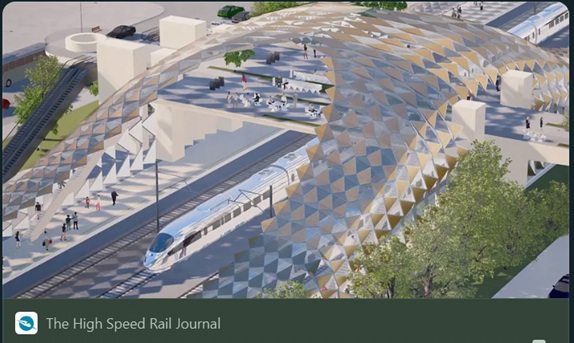
The American High-Speed Rail Act of 2026—introduced by Rep. Seth Moulton (D-MA) in May with 52 cosponsors—aims to put high-speed rail (HSR) front and center in U.S. transportation planning and spending. It would authorize a total of $205 billion (over five years) for a national high-speed rail network. That’s $35 billion annually for corridor development, $3 billion for planning, and $3 billion for technology improvements.
As we’ve described elsewhere, authorization bills (like Rep. Moulton’s) create policy and spending frameworks. Actual spending levels are determined in appropriations bills. The two are handled by different committees in Congress.
Rep. Moulton’s bill is crucial—beyond just the funding levels—because it puts forward policies and reforms designed to promote the development of high-speed rail in the U.S., especially in three key areas: defining HSR, right-of-way acquisition, and sustainable development.
And it comes at a crucial moment in the debate in Congress over U.S. transportation priorities and spending (as described below). By planting a flag for big investments in high-speed trains—and major policy reforms to encourage HSR development—it can shape that debate.
Informing our representatives that we support it.
Speed, Right of way, and Sustainable development
First, the bill raises the bar by defining high-speed rail as sustained speeds of 186 mph or more. And it creates a tier for “higher-speed rail” (110 to 186 mph).
Defining HSR as 186+ mph—and funding its development—is key to creating a thriving railway network because it widens the pool of potential riders. People weigh the total, door-to-door trip time when they decide if it’s “worth it” to take the train. A two-hour train ride might be technically faster than a three-hour drive, for example. But if it takes more than an hour to get to the departure station—and then get from the arrival station to the final destination—the train actually takes longer.
A high-speed line lowers the overall trip time—and increases the distance that people are willing to go to catch the train. So it’s not just that high-speed trains carry people from one point to another quickly. They also drive up demand by making trains a better option for a broader swath of people. And that leads to a thriving network of passenger trains and transit.
Second, Rep. Moulton’s bill addresses one of the great practical barriers to building high-speed rail in the U.S.: right-of-way acquisition. It eliminates the requirement that public and/or private entities wait until the environmental impact statement is completed to purchase the right of way for a high-speed line. This has been a sticking point—driving up costs and pushing back milestones—in California’s HSR project, especially in Bakersfield.
The bill also exempts rail carriers from paying taxes on income from selling, leasing, or granting easements on their property to high-speed rail projects. So, privately-owned railroads would have strong financial incentives to help build the national passenger rail network. (These taxes are a major barrier to upgrading railways.)
Third, the bill aims to promote sustainable development—and address the U.S. housing crisis—by promoting dense residential and commercial development around train stations. It does so by linking eligibility for federal grants to specific affordable-housing outcomes. And it prioritizes grants for projects with measurable climate benefits.
In addition to these reforms, the bill would direct the Department of Transportation to develop updated performance-based safety regulations, based on international best practices; it would modernize labor protections by updating standards based on agreements negotiated directly between railroads and labor; and it would encourage private-public partnerships by financing HSR projects at low interest rates—and subsidizing the “credit risk premium” paid by the project’s developer, i.e., the insurance policy they’re required to have to secure a low-interest federal loan.
Show Support for Moulton’s Bill
A strong show of support for Rep. Moulton’s bill can shape the work that’s going on—right now—on the surface transportation reauthorization in Congress.
The current law expires on September 30. It will almost certainly be extended, temporarily, because the Senate has not yet completed amendments on its version of the bill; while the House did mark up its bill, it does not seem likely that it will be brought to the House floor for a vote before the expiration deadline, hence the extension.
The new Congress that meets in early January, following the November elections, will inherit this Congress’s version of the reauthorization. But it won’t be bound by it. And, as things usually go, it will take a last-minute push—with plenty of changes and negotiations—to get the bill over the line.
The more cosponsors Rep. Moulton’s bill has, the more impact its proposals and ideas will have on the process. It proposes not only unprecedented funding levels for HSR but concrete reforms and incentives to make it a reality.
This post appeared first on the Alliance