
U. S. Labor is Down Sizing
Not that this is any surprise. Employers have always been looking for way to downsize Labor input in products. Whether it is through automation, better throughput due to factory upgrades, or going overseas. A I have pointed out previously, upgrading equipment (nc to cnc) can have a big input to reducing costs. Improve factory layout by straightening out material and part flows.
Or like the article suggests, increase labor and then cut back when demand is less. I do not recommend such actions as companies do have a social responsibility to treat labor properly. Many of the people I have worked with over the years were with the companies’ years longer than I was.
~~~~~~~
U.S. Workers Continue to Report Downsizing
– Mary Page James and Ryan Pendell
Just 1% of laid-off employees cite AI as the primary reason.
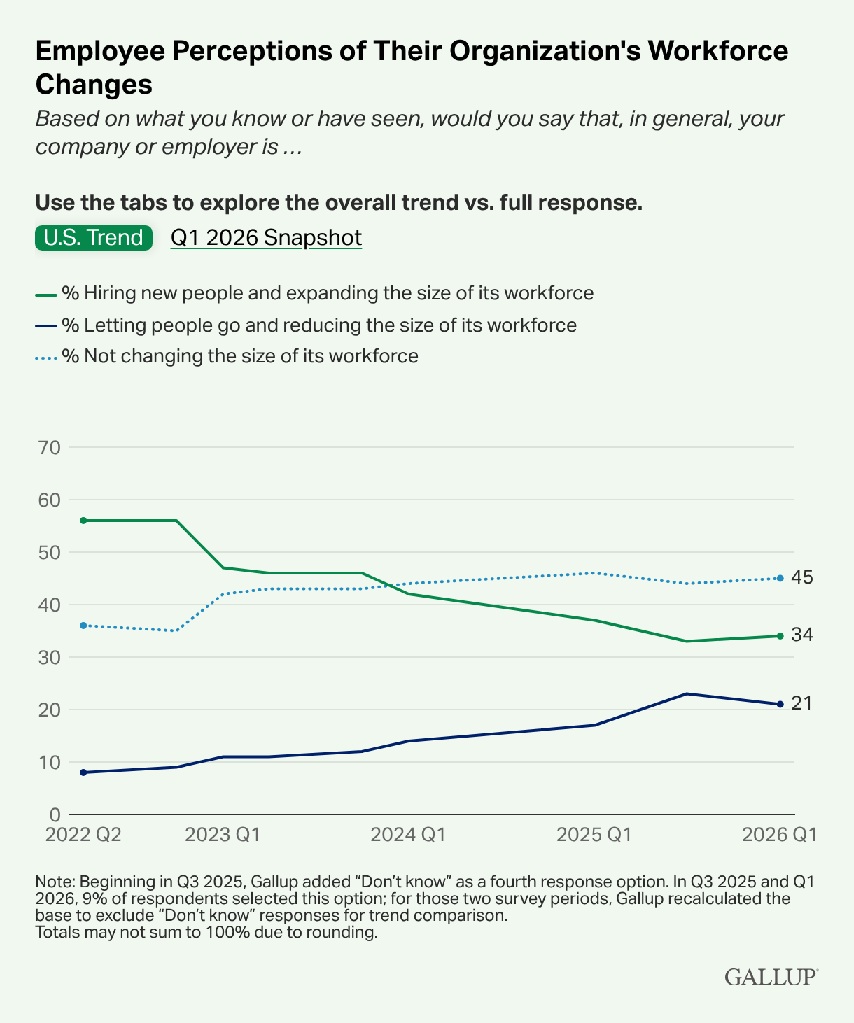
The share of U.S. employees reporting that their employer is letting people go and reducing its workforce held steady in the first quarter of 2026 at about 21%, after nearly tripling from Q2 of 2022 to Q3 of 2025. Still, more workers in the latest reading said their employer is hiring new people and expanding its workforce (34%) than cutting back.
As has been the case since the start of 2024, the largest share of workers in the first quarter (45%) reported no change in staffing where they work. That differs from 2022 and 2023, when the largest share said their company or employer was hiring. Since 2022, U.S. employers have consistently hired more workers than they have laid off in absolute terms. For March 2026, the Bureau of Labor Statistics reported 5.5 million hires and 1.9 million layoffs and discharges.
Federal Workers Report Higher Levels of Layoffs
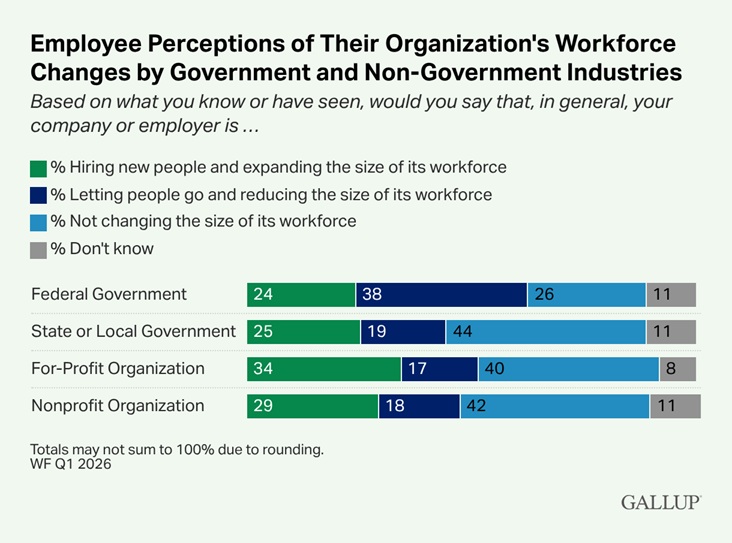
Employees’ perceptions of workforce change at their organization vary by sector. Federal government workers stand out: Nearly 38% say their employer is letting people go, compared with 19% of state or local government workers, 17% of for-profit workers and 18% of nonprofit workers. State and local government employees (44%) and nonprofit employees (42%) are the most likely to say their organizations are not changing their workforce sizes. Private-sector employees are the most likely to report growth, with 34% saying their organizations are hiring.
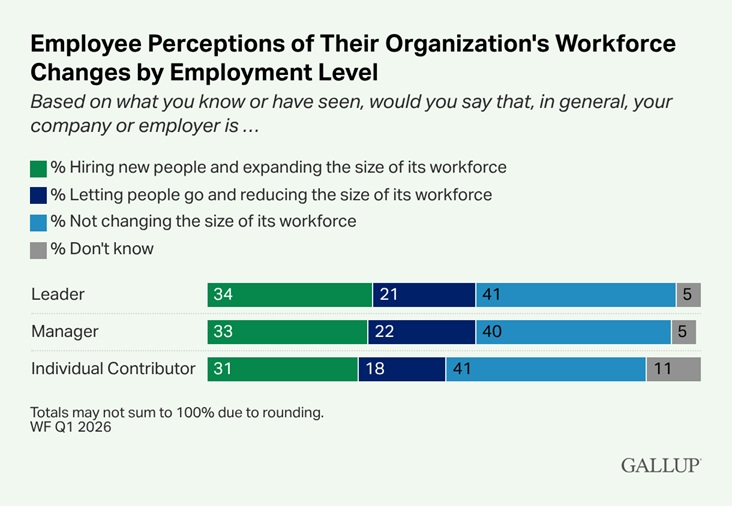
Worker perceptions of staffing are similar across different employee roles. About three in 10 employees, whether leaders, managers or individual contributors, say their organization is expanding its workforce. But individual contributors (11%) are more likely than managers (5%) and leaders (5%) to say they don’t know whether their organization is changing its workforce size.
Technology and Remote Workers Are Overrepresented Among Laid-Off Workers
Gallup asked currently unemployed adults whether they were unemployed because they had been laid off. Six percent of unemployed adults said they were unemployed because of a layoff. People who previously worked in the technology industry or who worked fully remotely make up a disproportionate share of those currently unemployed because of a layoff, suggesting higher layoff rates for these groups.
- Among currently laid-off workers, 13% previously worked in the technology industry, roughly double the 6% share of tech workers among the currently employed workforce.
- Twenty-five percent of currently laid-off workers say their previous job was fully remote, compared with 13% of currently employed adults who work fully remotely. Hybrid and on-site remote-capable workers are represented at similar rates among both laid-off workers and currently employed workers. Among laid-off workers, 28% were hybrid and 27% were on-site remote-capable. Among currently employed workers, 26% are hybrid and 31% are on-site remote-capable. These differences are statistically equivalent.
Other occupation and industry groups appear in roughly similar proportions across both the working and laid-off populations. Laid-off workers generally mirror the broader workforce in terms of employment level and job type. For example, 37% of currently laid-off workers held technical or professional positions (typically desk- and office-based positions) in their last job, matching the share of the overall workforce. This suggests these workers, as a group, do not face a greater risk of layoff. Managers show a similar pattern, making up 11% of laid-off workers versus 9% of the total workforce, a statistically similar share.
Only 1% of Laid-Off Workers Cite AI as the Primary Cause
Despite widespread public and media attention on AI as a factor in job displacement, Gallup data offer little evidence that AI has become a major direct reason for layoffs as of the first quarter of 2026. When Gallup asked workers who were currently unemployed because of a layoff to describe, in their own words, the primary reason they were let go, few mentioned reasons specific to AI.
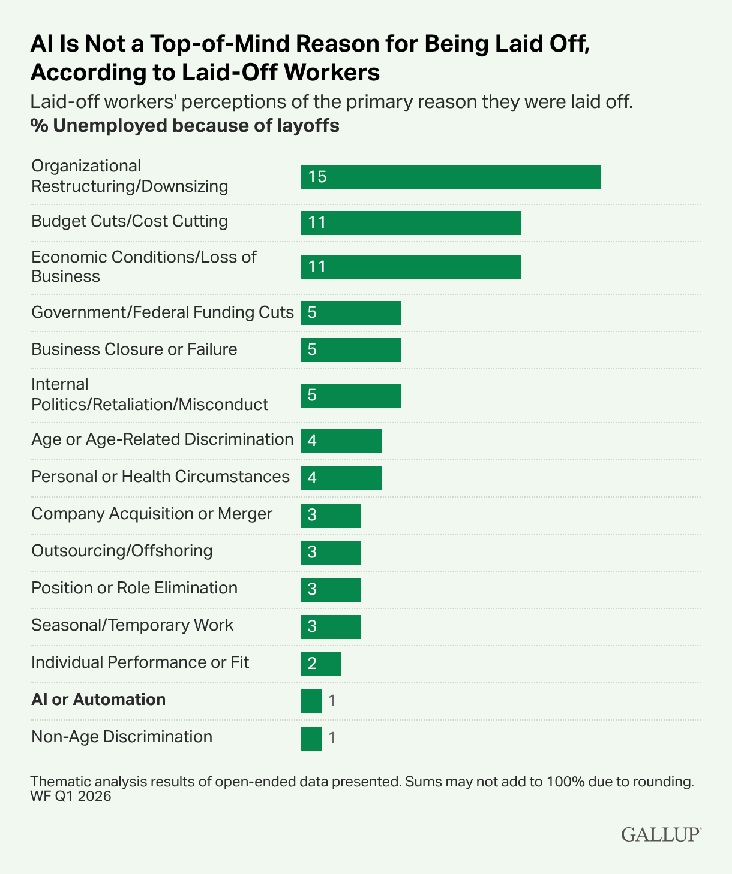
The vast majority of currently laid-off workers report being laid off in the past year (80%) and in the past two years (91%). Despite concern about automation, 1% of currently laid-off workers specifically cited AI or automation as the primary cause.
That does not necessarily mean AI has played no role. Many workers cited reasons such as organizational restructuring, cost-cutting or the elimination of their role. Those explanations may reflect AI’s influence on internal decisions, even when workers were not told that AI influenced the outcome.
Workers Who Never Used AI Were More Likely to Be Laid Off
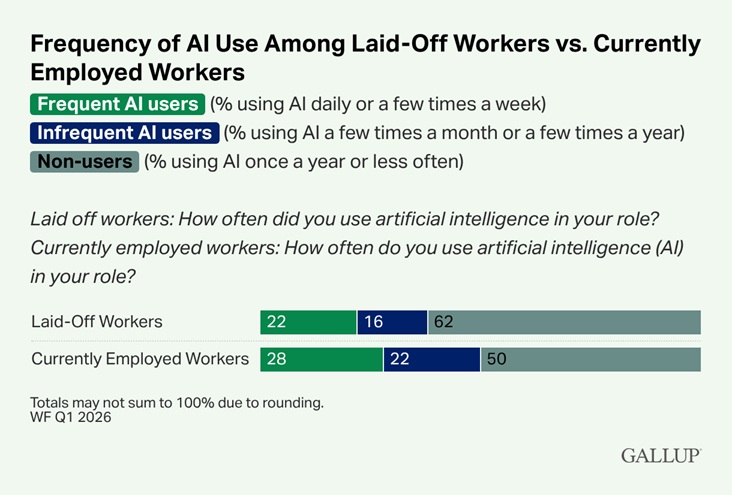
While AI may not be the stated cause of most layoffs, workers’ use of AI tools appears related to layoff risk. Laid-off workers (62%) are more likely than currently employed workers (50%) to be non-users of AI (use AI once a year or less often). In contrast, currently employed workers (28%) are more likely to be frequent AI users than their laid-off counterparts (22%), a statistically significant difference. This pattern holds even after accounting for age, education, type of industry and the length of time since being laid off, suggesting that workers who are AI non-users appear to have been more vulnerable in the job market.
The intersection of industry and AI use reveals a particularly vulnerable group. When examining layoff rates by both workers’ industry and AI use, tech workers who used AI less than monthly in their role were three times as likely to have been laid off as tech workers who used AI at least monthly.
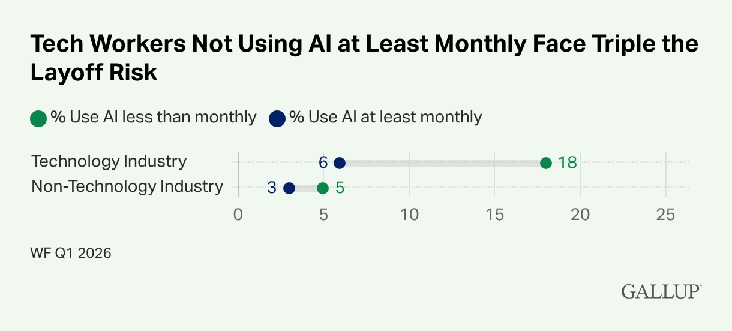
This finding suggests that, within technology, an industry already showing higher layoff exposure than other industries, workers who had not made AI a regular part of their work faced greater risk. Across the rest of the workforce, AI use is also associated with lower layoff risk, but the pattern is stronger in the tech sector.
The same pattern emerges when Gallup defines AI use as frequent, meaning daily or a few times a week, versus infrequent or none, meaning a few times a month, a few times a year, or never. Elevated layoff risk among technology workers is concentrated among those who have not regularly integrated AI into their work.
The Bottom Line
U.S. workers’ reports of employer workforce reductions have leveled off after steady increases since 2022, but they remain elevated compared with the past few years. Tech industry employees who have not adopted AI as a regular part of their work appear to be among the workers facing greater layoff risk.
At the same time, the data do not support the narrative that AI is directly displacing large numbers of workers. Only 1% of laid-off workers name AI as the primary reason for their layoff. That figure may understate AI’s indirect influence through restructuring and cost-cutting decisions, but it is an important data point for leaders and workers. The clearest AI-related finding is not that AI is eliminating jobs outright, but that workers who use AI at least monthly appear more insulated from layoffs than those who do not.
For leaders, these findings may offer a way to think about workforce resilience. Workers who regularly use AI tools, particularly in technology roles, appear better prepared for changes in work. Whether the gap in AI tool use reflects skills differences, role type or other unmeasured factors, leaders should understand where AI use stands across teams and functions. Employees’ engagement with AI tools can serve as one indicator of how prepared a workforce is for AI-related changes.