
Birth Rate and Labor
Its Saturday and I am on the run. So, I am being brief. Another Dean Baker piece. This time on Immigrants. The one thing I keep saying over and over again is about our replacement rate. This is not like after WWII when men came home from WWII. got married, and population increased dramatically. The Macrotrends Chart shows such:
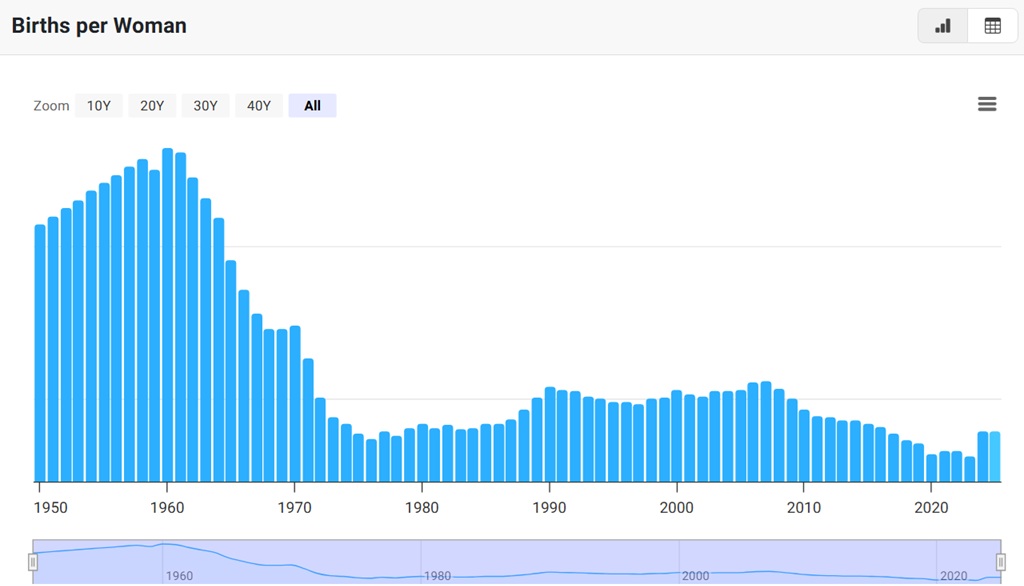
I tend to look at this chart and say; Wow, it appears that we may be needing Labor as the US has a low reproduction rate from 1970 onward. The 2025 rate (chart is 1.75. Other sources say less. The country is big and we could take in more people. There is a potential issue on the horizon as the rest of the baby boomers and the next generation age out. Also immigrant labor has to start somewhere. Whether it be on a farm of mixing cement and carrying the 5-gallon buckets to the cement workers like I did. We do need lower cost labor whether Trunmp likes them or not. His efforts are not matching up properly nd we will have issues in the future.
“Trump Mistake #27,462: Chasing Away Immigrants Doesn’t Help Native Born Workers'” Patreon, Dean Baker
I just have a quick note today.
It probably is not a surprise to most people outside the Trump administration, but it looks like their mass deportation has not done much to help the native-born workforce. The unemployment rate for native-born workers in May was 4.2%. That’s up from 4.1% last May, and 3.8% in May of 2024, when Joe Biden was in the White House, and immigrants were taking all the jobs.
This outcome shouldn’t be a big surprise to people who have given the issue much thought. Most of the jobs that immigrants do are not ones that native-born workers are lining up for. Few people born in this country want to work on farms picking lettuce or tomatoes or in meat-processing plants. It’s the same story with low-paying jobs such as home health care aides or custodians.
It was Trumpian silly to think that mass deportation of immigrants was going to lead to a huge wave of jobs for native born workers. In fact, as much research has shown, immigrant workers tend to act as complements to native-born workers, not substitutes.
This is perhaps most clearly seen in the construction industry, where close to 30% of the workforce are immigrants. The availability of lower-cost immigrant labor allows many projects to go forward that would not otherwise. In this way, it is a net job gainer for native-born workers. This is likely true in many other areas as well.
To be clear, this doesn’t mean that immigrants never lower the wages of native-born workers. There are likely cases where workers on H1-B visas have reduced the wages of workers in some occupations, even if the effect of the program in general may still be positive. I am also confident that if we eased the immigration barriers to foreign-trained doctors, the pay of our doctors would not still be twice as high as in other wealthy countries, thereby lowering healthcare costs.
Also, negative impacts may not be reversible. There is now solid evidence that opening trade to China cost the U.S. millions of manufacturing jobs. That doesn’t mean that putting up tariffs will bring the jobs back. Half a century ago, the meat-packing industry had many good-paying union jobs that were later taken by low-paid immigrants. Chasing away immigrants now will not bring those good-paying jobs back.
Anyhow, the results to date are clear. Trump’s mass deportation has not led to any sort of windfall for native-born workers. As the Trumpers say, “Trump was wrong about everything.”
Again, this assessment of what makes sense today feels in conflict with what will make sense in the pretty-near future if it develops along Reich’s vision of trying to “co-exist” with AI net devouring paid human occupations via much earlier retirement plus UBI. No point in dancing around what Reich is telling us to prepare for: very high unemployment, to be handled by absurdly limiting human careers and renaming unemployment insurance as UBI, but not giving it a limited term.
Reich could be wrong, but let’s prepare as if he isn’t because there is a pretty good chance if in 15 year’s most Americans have fulfilling careers and we still can’t find enough folks to cut new pin positions at all the golf clubs, we can have a program for that. If Reich is right, what will we see in 5 years? Millions of immigrants – many still pretty young – whose access to American labor markets depends on undercutting labor law and standards much worse than we see today. Yes, it will depend on unscrupulous employers, but they don’t ever seem to be in short supply. Not saying Baker is totally wrong, but policy needs to address the future more than the idea that for a few years maybe roofing jobs will slip 8 months.
Eric:
Am I missing something you are referring to? Where did I mention Reich? I didn’t. Non Sequitur?
With the deportation of numerous people, the nation will suffer a loss of Labor. Labor which adds value to cars, houses etcetera. The birth rate is down and usum baby boomers are aging out and will no longer be able to carry you on our backs. Replacement is at 1.60 down from 2.01 which I wrote or C&P about in Snithsonian’s “300 Million and Counting“ Angry Bear: Immigration, Population, Replacement, Politics and the Economy
Two nice pieces for you to read.
note they are saying we will not have enough people to make the things and provide the services that our aging population will need. then they turn around a say the unemployment rate is rising. I get really scared watching people say completely contrary things without even noticing.
Dale:
Wrong place at the wrong time factor? Maybe, the nation needs to retrain Labor so they can fit in new positions. That is one way I might read that Labor resource conflict.
One other factor being replace rate is at 1.6. In 2006 we were at 2.01 or just barely replacing ourselves. If we trash all the young immigrants, we could be heading towards issue. Jared Berstein just said similar. Just posted a partial of his commentary. He says similar towards the end of his post. I have been saying replacement rate is going too be an issue since I posted a Smithsonian article :300 million and counting.”
Immigrant labor in the 1970s and 1980s was a major element in breaking the unions. Meatpacking, for example, used to be done by unionized Americans. It is now mainly done by non-union immigrants. Roofing, in many cities, was a union job that paid fairly well until immigrants started taking roofing jobs at lower wages and with fewer safety hangups. I gather this was repeated in many areas. Private sector unions took a big hit, and a lot of jobs became lower paying.
The upside of this is that meat and housing – OK, not housing – have gotten cheaper except when they haven’t and the labor savings became corporate profits. One problem is that a lot of businesses have gotten used to having much higher profit margins than in the unionized past, and they have the money and will to fight on the shop floor and politically. Those companies would rather burn the world down than accept a lower profit margin.
Kaleberg:
I look at the quality of my home and wonder why they took the short cuts that they did. It has a stucco outside which should be relatively safe.We have been here 5 years. It was a new build. Since I am the son of a bricklayer/tuckpointer and labored for my dad and crews, I know a few things.
We started to develop hairline cracks in the exterior wall mostly on one side. To me that would indicate there is no grating beneath. What I means is lathing consisting of a wire mesh. So I called and mentioned it to the builder’s representative. “Well sir, there is only a one-year warranty on that.” Which is BS. I can get a better warranty on a used car in comparison.
Housing has gotten cheaper for the builder. Just not for the home buyer. And would a home buyer want cheaper if there were issues in one years?
I presented an article about kids being used in labor in meatpacking Child labor laws are under attack in states across the country
The amount of labor in a product is the smallest of three items. Materials, Overhead, and Labor. The insurance, etc. they may get is Overhead. So they do not pay it. Companies are still very active is lessening the costs in association with Labor. In Mexico, people are covered by health insurance. But, but, that is a backwards country. Or is it?
Government should step in like they did with the ACA.
The Reich mention was from a post made like a week ago. But it seemed germane and I thought that many would remember that post. Anyway, it’s disconcerting as Dale suggests that such seemingly profoundly different futures are being held up for examination without much mention that they are in fact very different. Reich thinks we might all need to retire at 50 pretty soon and even then come up with UBI programs to keep folks solvent due to serious job erosion right around the corner from AI. Of course, he is from the Bay Area and might be more likely to believe this. But it could be true and the guy is a former Sec. of Labor, so he’s pretty qualified to talk this stuff. Baker is no dummy for sure, but what will happen if Reich is more correct? Are we going to really and truly do very coercive repatriation – make current efforts look tame – so that actual Americans have first priority on jobs here in 2031 or whenever? Do we think that millions of immigrants are going to say “yes, I see things are way different then I jumped the fence, so I will go home now” after they’ve been here a decade plus?