
An Angry Constituency
I cut Jared Bernstein’s Commentary “Why Are People So Damn Mad?” short because I wanted to get to the reasoning why people are mad and why they own it too.
It used to be the modus operandi working hard will gain you the fruits of getting ahead, going to college will more likely than not give you an edge in getting a good paying job. etc. There are any number of things we can add here. The two I believe are the most important factors many of us have been raised under. And Jared even says such in the first paragraph of his commentary here.
Jared goes on and states: “along with prices/affordability,” I see three big reasons for the current discontent: a broken social contract, corruption in high places, and folks’ perception that nobody in politics has “got their back.”
He is right. I do not have to be some place to put food on our table. We are both retired. If gasoline is high? Hey, I can cut back on trips. I do not drive a pickup truck for show in AZ, we drive the Mazda or Passat which are both very efficient on gasoline. Many do not have such in their procession. UMich’s report put it’s also pretty revealing way regarding how respondents feel about where things are headed. You can view the chart at his site (follow the link).
Jared:
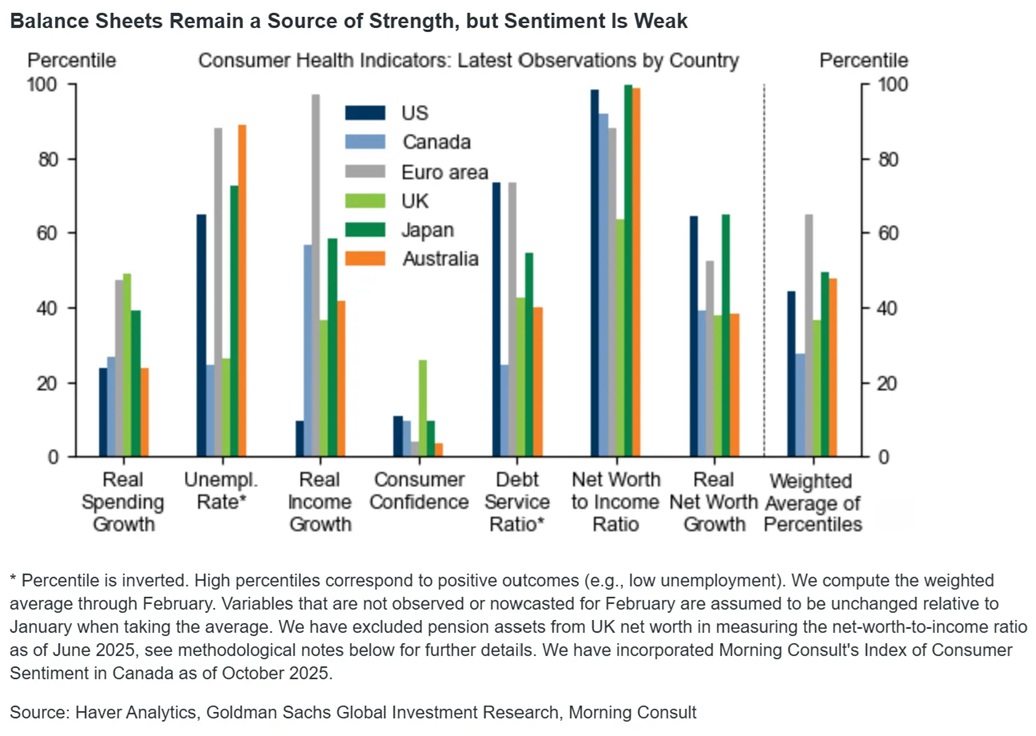
This is personal for me, something I’ve felt and experienced acutely, as I held a high-level economic-policy positions in two presidential administrations, most recently in the Biden admin, when, post-pandemic, the economy recovered quickly and strongly, but sentiment, as you see in the first two slides, did not. I mention my personal role in this not because it matters, but because it has forced me to think long and hard about why there’s such a large and persistent gap between the aggregate indicators and the vibes. And having been placed adjacent to the highest levels of political power, my perch has enabled me to see close up the disconnections I’m about to try to articulate.
As readers know, my research (with Daniel Posthumus) argues, with what we consider to be strong evidence, that price levels are a big part of this. But what I want to argue here is that those prices, and the affordability stress they engender, are a proxy for bigger and deeper problems.
Let me start with a bit of an abstraction, one that I don’t have a graphic for but I’m confident is part of this.
People are mad because the social contract isn’t holding.
There is an implicit contract in America, one that says if you work hard and play by the rules, you ought to be able to get ahead, building a better life for yourself and even more so, for your progeny. Now, let’s keep it real: this contract has never held for groups that have suffered systemic discrimination and entrenched barriers to upward mobility. But that hasn’t stopped many Americans from believing that the basic deal is that if they’re working hard and following the rules, they’ll be able to not just make ends meet, but to get ahead.
However, when buying a house or renting an apartment where you want or need to live is out of reach, when healthcare premiums and childcare costs eat up all of your budget…well, you get trend lines moving as they do in the above figures. This is why the affordability crisis is so resonant. It’s not just about what’s left in your bank account after you’ve paid for necessities. It’s about a broken contract.
People are mad about the corruption of the elites, with Trump as exhibit A.
While families are struggling to make ends meet, headlines tell of Trump’s “weaponization fund,” which surely ranks among the most corrupt actions he’s taken thus far, and that’s a high bar. It’s a veritable slush fund of $1.8 billion taxpayer dollars that Axios describes as a “fund for MAGA allies who claim political persecution.” Trump’s acting AG said that “As part of this settlement, we are setting up a lawful process for victims of lawfare and weaponization to be heard and seek redress.”
In other words, the president is going to give your and my money to anyone he wants to.
This hit the news the same time as reporting about Trump’s thousands of recent stock trades, which invariably involve insider trading. How’s this sound to you?
[Trump’s] accounts purchased at least $1.75 million of Nvidia’s stock in the quarter, including $500,000 on Jan. 6. A week later, the administration cleared the way for Nvidia to send its H200 artificial-intelligence chips to China. Last week, Trump invited Nvidia CEO Jensen Huang to travel aboard Air Force One for the state visit to China.
To be clear, I’m not saying everyone in America is following all these corrupt machinations. People have way too much to do for that. But it’s in the ether, and it’s part of what’s making folks mad.
People are mad because nobody’s got their backs.
Before anyone concludes that peoples’ anger is fully or even largely at Trump and his spineless, feckless, enabling Republican party, consider that they’re pretty skeptical that the Democrats are much better. Summarizing a lot of polling I’ve tracked, majorities recognize that Trump is corrupt, in way over his head, not the slightest bit concerned about their well-being, and in fact pushing hard in the wrong direction on affordability.
But they’re not hearing any coherent messages or policy agendas from Democrats that shows how that party’s leadership is fully and powerfully focused on correcting all of that.
So, yes, the fact that groceries are up 2.9% over the past year and real hourly wages for mid-level workers fell last month is a real problem, which is why this Substack aims to track the economic data with as much rigor as I can bring to that project.
But let’s not lose the bigger picture. People are mad because the system isn’t working for them. No question, far too many of them cast a terrible, irresponsible vote—and not once, but numerous times—for a corrupt, self-dealing scammer for president. And many (though sadly not all, by a long shot) are mad about that too—they know they made a mistake. Which, ftr, is very good news. It means there’s an opening for change, even if it’s just “throw these corrupt bums out!”
But if those of us in policy and politics want to do better than that, as in building a lasting coalition to get this country back on track, we need to understand and address the current discontent. I’ve tried to lay out a high-level road map here, which maybe is or maybe isn’t the right one. But if I’m anywhere near the ballpark, there’s a wide opening for a politics that reestablishes the social contract, ends the corruption, and gets solidly and lastingly behind a lot of American people who are, for good reasons, unhappy and angry about a status quo that’s failing them.
AB: This is not something I have not said over and over again. If you did not vote in which case ~ 3 million chose not to. You really do not have much to say. If you voted for others such as Kennedy, he is really good yes? No, he is not. He is not doing anything. Three million chose to vote for others. There is till a lot of hell to go through before we get to the end of this mess created by us, the voters.
Those of us who did not and would never vote for Trump need to remember that the Democratic Party put Biden up as the candidate in 2024 even though they knew he was old and increasingly unpopular. When he broke down in the debate, the party’s response was inept and transparently pandering to their imagined base. This same party worked very hard to trash Bernie Sanders and recently, Zohran Mamdani. The status quo Democrats do not have a winning platform.
Frankly, I’m angry because there are billionaires and now a trillionaire who apparently get to run the show while my children and their kids are treated as peons and pawns. The corruption among those in government and business is blatant. It’s like the ads for online instant sports betting: “Winning is everything!” And the only way to measure winning is counting your money.
Unless there is real change in the distribution of wealth and assets I think there will be more and more disenfranchised voters and angry citizens.
Deb:
There are two or three topics there. I will just talk about voting. Voters chose the worst of all the alternatives by voting, not voting, and voting for others like Kennedy. What did they gain by not voting and voting for others? I do not believe in self-flagellation. Neither of those types of actions paid off for them or the nation as a whole. We got Trump instead of Biden. The worst of the alternatives. Well maybe, Kennedy would have been worst.
In 2024: 3 million people did not vote in the presidential election for 2024 when compared to 2020. Dave Leip’s Atlas of Voting is the source. Another ~2.3 million voted for Other such as Kennedy, Stein, and Oliver. Another 939 thousand voter for “write-ins” or others. 155.5 million turned out. Or 59.7% of registered voters voted.
In 2020: 61.4 % of registered voters turned out. 158.8 million. Other named candidates, Cohen and Walker received : 2.2 million votes. .830 million voted for other candidates. Total voter turnout? 158.6 million voters or 61.4 % of registered voters.
Am I happy? No. I do not like having him guide the nation. We have a crazy person in office as compared to what would have been a slower older person who would listen to advisers. Harris was in the background as compared to Vance in the background for Trump. Vance the little corporal after 4 years.
Non Voters and the Mickey Mouse voters put Trump in office. Gotta ride it out . .
I just missed the Vietnam War … they stopped drafting people a few numbers before mine. My dad had been a hawk until my number was drawn, then he changed his view because he saw no point in me going over there just to get killed.
The rules were different then. One could work one’s way through college because most tuition was not yet stratospheric. One modest income could support a family, have a car that worked, and maybe afford a week at the shore. Then, just about the time I graduated from college, the rules started to change.
First, there was deregulation with Ted Kennedy, of all people, pushing it. Then we elected a conservative yet pious southern
Democrat to succeed the criminal Nixon and his handpicked VP, Gerald Ford. During Carter’s years, the rules of the game seemed to really change, and the life I expected as an adult was no more.
Then, Ronnie Raygun came in, making the US more like his conservative California. The Reagan Revolution, with its firing of the air traffic controllers, gave full-throated support to those who truly hated the New Deal, Social Security, and pretty much any program that helped regular people. Remember when ketchup was declared to be a vegetable?
Bill Clinton: Friends of mine from Arkansas said we’d rue the day that he became president, and in my view, they were right. Under Tony Coelho’s DCCC leadership, the Democratic Party had divorced unions and started to embrace Wall Street and its money. Clinton, with strong Democratic support, brought us a host of conservative “reforms” that screw people to this day. Clinton cemented Reaganism in place and launched the country into a trajectory where it would rendezvous with a new Guilded Age in a few short years. Socialization of risk and privatization of gain became the norm, and here we are.
The country where I expected to spend my working years no longer exists. Instead, it’s become one that Charles Dickens and Upton Sinclair would recognize. It’s one where Teddy Roosevelt and his many reforms were discarded. When Obama brought with him an army of Clinton’s neoliberals, he nearly succeeded in gutting what was left of the New Deal as he blindly pursued a grand bargain with John Boehner.
Thank goodness we still have Social Security and Medicare… but for how long? The pendulum is trying to swing back, but with the full-throated opposition of a Democratic leadership that is still dominated by corporate Democrats like Chuck Schumer and Hakeem Jeffries. Bernie, AOC, Warren, the Squad, and others give me hope, but politicians like Clyburn (at one point the largest recipient of campaign cash from Big Phrma) are ready to step in and stop progressives. I’m not holding out hope for true reform.
A rotten potato could beat many Republicans this coming fall, but people have short memories, and by ’28 – with TheDemocrats™ flat out refusing to reform and to join together to eliminate the filibuster, to expand the Supreme Court while also curbing its jurisdiction and paring its authority to review back closer to what the Constitution prescribed as its original jurisdiction – I see little reason for hope. But I see more than a few “centrists” and “institutionalists” who will oppose wither reform.
With the filibuster, Republicans can keep Democrats from getting the things that they want, but with reconciliation, the Republicans get what they want … budget cuts for things their voters don’t personally use, and tax cuts that explode the deficit. They are close to cementing minority control over the country.
Money is property, not speech. A mid-70’s era Supreme Court disagreed, and Mitch McConnell took advantage of that. Now we have the first trillionaire who will show us that we truly have the best democracy money can buy. He will abandon capitalism and reinstate a modern version of feudalism.
‘
I fear for people much younger than I am. I fear for the country and the World. Who’s talking about climate change, the existential threat of our time? Not enough people.
Good for you on missing the fun overseas.