
Trump Goes to China to Smooze Xi
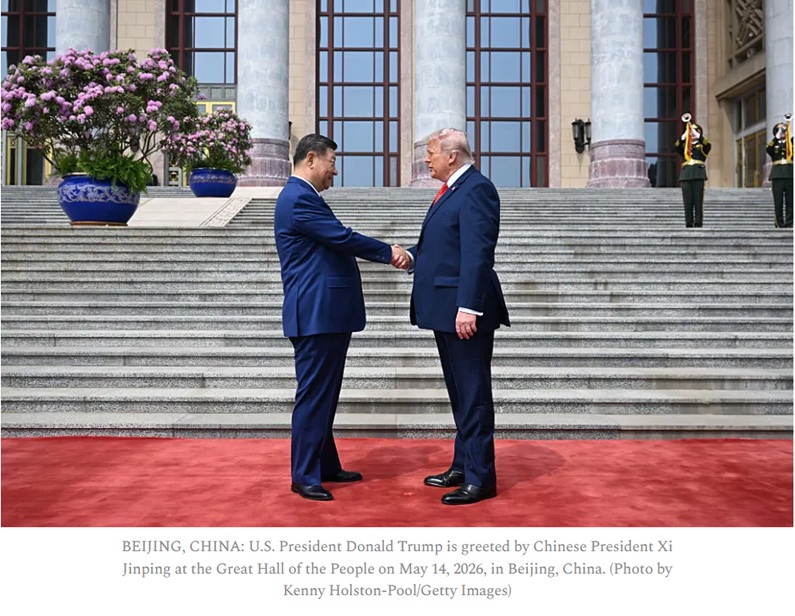
That Trump went, he altered the balance of negotiation. He nows plays a secondary role and dragged us into it.
In an earlier commentary, it was said no other president would meet with Chinese leaders as it was too much of a give away,
Former China director on the National Security Council Julian Gewirtz, who served under President Joe Biden, told the Washington Post reporters:
“Xi has done something Chinese leaders have been working toward for decades—bringing an American president to Beijing as an undisputed peer. Xi used the opulent optics of the visit to make clear to the world that China and the United States are the two dominant, equally matched superpowers. There is no going back.”
The Chinese media downplayed the importance of a visit from a U.S. president. As James Palmer of Foreign Policy noted, on the day Trump arrived, the main story on the front page of the state-run English-language newspaper China Daily was the visit of the president of Tajikistan the day before. The Chinese Communist Party newspaper featured Trump’s visit on page 3.
And Pres. Trump is too dumb to realize it. “Trump Returns from China after Giving Them What They Always Been After from the U.S,” Angry Bear
“The Velvet Rope in the Cell Block, The Bare Minimum Is a Dangerous Place, & Back to Reset,” Kareem Takes on the News
“Five Takeaways from the Trump-Xi Summit,” (WSJ)
Summary:
President Trump and Chinese President Xi Jinping held a two-day summit in Beijing in May 2026—Trump’s second state visit to China and the first U.S. presidential visit to the country in nearly nine years—producing no joint deal announcements but a shared declaration of intent toward “strategic stability.” The summit covered a range of high-stakes issues including trade, Taiwan, and the war in Iran. Trump touted “fantastic trade deals” and claimed China agreed to purchase 200 Boeing aircraft and more American oil, though China had not confirmed those purchases as of publication.
Xi warned that Taiwan is “the most important issue in U.S.-China relations,” while Secretary of State Marco Rubio stated that U.S. policy toward Taiwan remains unchanged. Both sides agreed Iran should never acquire a nuclear weapon and that the Strait of Hormuz must remain open. The summit concluded with Trump inviting Xi to the White House on September 24, 2026. Both leaders may also meet at two additional international gatherings later this year. The overall tone was described as a reset in relations, with Xi framing the new bilateral posture as “constructive” and driven by “measured competition.”
Kareem’s Take:
Trump and Xi both walked away from their recent summit calling the whole thing a “reset.” I’ll be honest: that word makes me nervous. It has a terrible track record.
You probably remember back in 2009 when the Obama administration tried that exact same move with Russia. Hillary Clinton actually handed the Russian Foreign Minister a physical prop, a big red “reset” button. The problem was, the translation was wrong. Instead of “reset,” the button said “overcharged.” Looking back at how things went with Russia, “overcharged” was probably the more honest description of the relationship.
Every time a politician says “reset,” I find myself wondering what version of reality we’re supposedly returning to. Are we going back to the state of affairs before the last disaster? Because if we’re resetting to the baseline of the last few years, that’s not exactly a win. We’ve been locked in a tariff war that’s driven up costs for every business and consumer on both sides of the Pacific.
If that’s the “reset,” then the word is just diplomatic cotton candy. You can’t fix a conflict between the two largest economies on earth with a catchy phrase.
I saw a report from the Economist Intelligence Unit that called the summit a success because it built a “guardrail” to stop tensions from spinning out of control like they almost did in 2025. Translated into plain English, that means: “The two most powerful countries on the planet didn’t start a war.”
Great. Give everyone a gold star. I’ll admit that averting a global catastrophe carries some weight, but statesmanship should have a higher bar than “we didn’t blow up the world today.” We deserve to know the difference between a pilot who keeps the plane from crashing and a pilot who actually flies us somewhere.
I called this the “Photo-Op Summit” on my Substack last week, and nothing that happened since has made me want to change that title. Trump came out declaring these “fantastic trade deals,” hundreds of Boeing planes, more American oil, more agricultural sales. But China hasn’t confirmed a single word of it. There was no joint agreement. No signed documents and no paper trail.
When there’s nothing in writing, the person who makes the loudest claim wins the news cycle. At that point, the press conference is the product. The only thing they actually delivered was ceremonial theater.
The most heartbreaking part of this theater, though, is the math regarding fentanyl. This is a drug that killed 80,000 Americans in 2024 alone, yet it got treated like just another item on a grocery list, sandwiched right between aircraft orders and energy deals.
The Brookings Institution has been documenting how this works for a while now: China treats fentanyl cooperation like a bargaining chip. They turn the flow on or off based on how well they’re getting along with Washington at any given moment. Think about the cold logic of that for a second. It means American overdose deaths rise or fall based on the temperature of a bilateral relationship. Try explaining that math to a family in Ohio burying their 24-year-old kid. I suspect that’s a conversation no one in that summit room is particularly eager to have.
We can keep calling these meetings “resets” as much as we want, but until we move past the photo-ops and start dealing with the actual human cost of these policies, we’re just pushing a button that is not connected to anything.
“The most heartbreaking part of this theater, though, is the math regarding fentanyl.” I doubt that China really gives a rat’s a** about it. They still remember the Opium Wars of the 19th century, which ended with China becoming subservient the West. The US took advantage of these wars to open up a Chinese port. China may even be experiencing a sense of schadenfreude.
The hegemon should take note–sometimes what goes around comes around…
John:
In all likelihood, they are laughing at him with a straight face. The article is correct in how Trump has given them a foundation, thinking he has put one over on them. Trump really had no business going to China. He should have had Marco go in his place who could arrange a meeting with Trump if certain things were accomplished. Trump gave up the prize by going.
“Reset” is a word akin to “reform.” Whenever I hear a politician use the word “reform,” I shudder. Politicians usually use the word when they want to talk about a “problem” without revealing their proposed solution.
A great example: “We must reform “entitlements.” Translation–gut Social Security and Medicare. Shudder.