
“Mr. Jefferson’s Lost Cause”: a book review
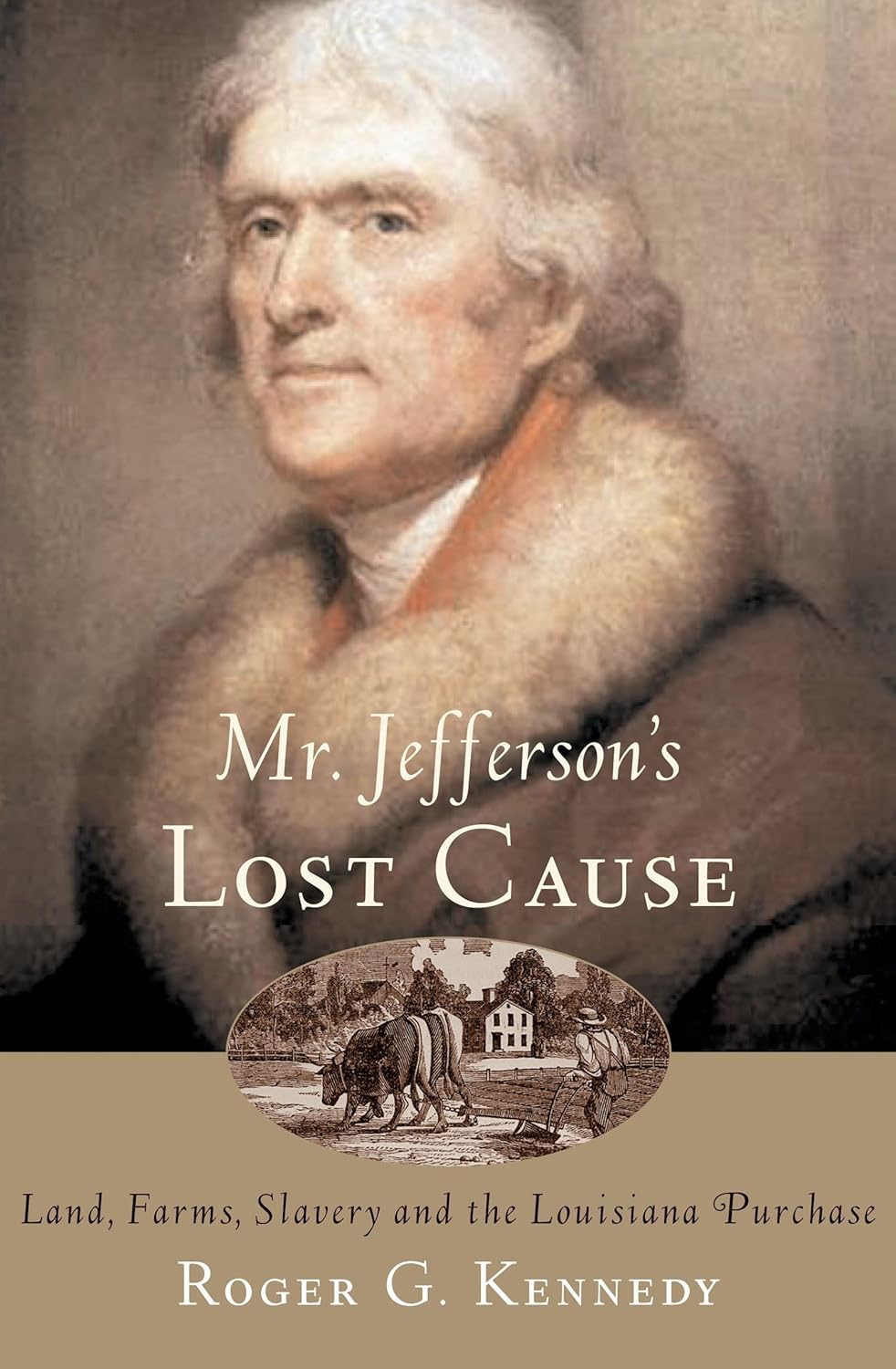
I just finished reading “Mr. Jefferson’s Lost Cause: Land, Farmers, Slavery, and the Louisiana Purchase” by Roger G. Kennedy. Most of the histories I’ve read have either taught me about events I hadn’t formed any prior impressions about or else confirmed and colored out my superficial understanding of those events. This book was different for me. I grew up thinking of Jefferson’s Louisiana purchase as being simply a real estate transaction occasioned by Napoleon’s need for cash, a kind of Founding Father’s Art of the Deal. I thought of it as an unalloyed good for the country. Kennedy convinced me that the real driver was soil exhaustion by tobacco and cotton planters in the east and the relentless push for virgin farmland to be put under cultivation by slaves of plantation owners. I confess that I never gave a thought to the fact that to effect this expansion, the actual, you know, Native American residents of the land had to be driven off. That was accomplished either by (1) forcing tribes to take on financial debts of tribe members to be paid off by land transfers or (2) military evictions. The land so acquired by the US government was then sold to wealthy planters, thus enriching the treasury.
Ironically, Britain ended up gaining financially from independence. They no longer had to field and finance an army to fight Indians; the costs of colonialism were transferred to the new United States. Instead, Britain exploited the newly liberated colonies economically by purchasing all the cotton they could produce and then selling it back in the form of finished textiles. This was a major driver for the plantation economy and its associated soil depletion and chattel slavery.
The concurrent acquisition of the Spanish territory of Florida—also intended for plantations—is described. And with the abolition of the African slave trade in the US in 1808, another valuable crop produced and sold on the eastern plantations were successive generations of legal home-grown slaves to be sold to westward-bound plantation owners. Overall, the sheer scale of greed, malfeasance and outright crime would warm the cockles of Donald Trump’s heart.
Kennedy emphasizes Jefferson’s versatility of conviction on slavery (he once advocated its abolition but later its expansion) and on land cultivation (he once valorized small sustainable subsistence farms but later promoted large-scale plantation farming). I was aware of the hypocrisy of the slave-owning author of the Declaration of Independence on the matter of “liberty,” but Kennedy examines this in microscopic detail. Yet one more mockery of MAGA; no wonder they want to cancel this history.
Along the way, Kennedy also shows how the economics and culture of the Southern plantation economy led the South to a destructive rejection of industry and manufacturing, ceding much of the nation’s growing wealth and trade to the North.
“The North had become able to manufacture nearly all its own needs and also to produce surplus food and fiber for both foreign and domestic markets. The South, by contrast, was still importing most of its tools, clothing, and luxury goods. Its obsession with cotton, produced in haste and by slave labor, depreciated its land, and thus reduced its ultimate power base.”
Kennedy shows how this both led to the Civil War and to the South’s ultimate defeat at the hands of an economically more powerful North.
The writing style here is quirky compared to other histories I’ve read. The author makes frequent wry asides about motivations of the characters and historical events are narrated in a droll, sardonic way. I found reading this book a little slow in parts, probably because there were more details than I was capable of digesting. Still, my eyes were opened to this episode of Manifest Destiny; I’m wiser for having read it.
Expansion of virgin land for plantations sounds like an ideological stretch. Outside of portions of the Louisiana and Arkansas, the vast majority of new plantation land over the subsequent few decades was achieved by driving out Cherokees, Creeks, Chickasaws, and Choctaws from Tennessee, Georgia, Alabama and Mississippi.
@rick,
That’s what I wrote, and what Kennedy documents.
“. . . to effect this expansion, the actual, you know, Native American residents of the land had to be driven off. That was accomplished either by (1) forcing tribes to take on financial debts of tribe members to be paid off by land transfers or (2) military evictions.”
By “Native American residents” and “tribes,” I was referring to Cherokees, Creeks, Chickasaws, and Choctaws. By “the land,” I was referring to areas that became modern-day Tennessee, Georgia, Alabama and Mississippi.
“Virgin land” wasn’t meant to imply that it was uninhabited, only that it wasn’t yet exploited and degraded by plantation agriculture.
The native depopulation of the south started early. The book Thundersticks, which I cannot recommend enough, points out that colonial trade with natives involved guns for skins in the north but guns for slaves in the south. Political and economic differences were already established by the time African slaves were brought in to replace vanishing natives.
Even now, the economic backwardness of the south is apparent. Friends of mine moved to Georgia, so I’ve been visiting that state and South Carolina lately. The area is amazingly underdeveloped. Only recently have the central cities of Charleston and Savannah started what elsewhere was early 20th century infill and urban expansion. The “rise of the Sunbelt” was about catching up.
A lot of the pre-Civil War war was fought in the frontier of the Louisiana Territory. The original south was agriculturally depleted and, dependent on cash crops, could not feed itself. During the Great Depression, farmers fondly remembered the golden era when the midwest grew prosperous providing food to the plantation south.
Yet what was done to the Pacific Northwest is so inconsequential as barely merit a mention. And in what may be one of those conspiracy theories so whacky as to whack all conspiracy theories there is a school of thought in Oregon history that Jefferson didn’t necessarily intend to a coast-to-coast empire, but rather a free and independent ally in the PNW analogous to the original thirteen.
That had not most of the able-bodied men been off to California with gold fever when the Army showed up and at the behest of east coast bankers declared the NW as we know it now, it wouldn’t have happened
The State of Jefferson is different, much more recent but having the same trickle-down resentment on those whose families have been around long enough to notice …
Ten Bears:
Why don’t you flesh that comment out a bit more. I would like to post a larger comment on Angry Bear and credit you and your site.
I read a similar book called “Forget the Alamo” which told the story of how the fight for Texas independence was all about slavery and cotton.
@Thomas,
Yes, Texas “independence” was about independence from Mexican prohibition against slavery, and the slaves were mostly to service cotton plantations.