
Metro areas, What is at stake for Black Americans
Looking at Black American employment in 10 major cities and what is at risk under the Trump administration. Unemployment was at record lows in the recent past. Trump’s anti-equity agenda could threaten the progress. Three charts and a short explanation for each explaining what is at stake for Black America.
~~~~~~~
The present administration (Trump) is advocating and putting into play a revisionist version of history erasing all acknowledgement of the racism, violence, and oppression creating persistent racial inequities and forever changing the demographic composition of U.S. cities. The Tr__p administration actions includes issuing a barrage of questionable executive orders bypassing the nations legislature turning back the clock on hard-won federal policies. Each of which have helped Black Americans attain many of the opportunities sought through the Great Migration and Civil Rights Movement of the 1950s and 1960s.
Call it was it is . . . Trump’s anti-diversity, equity, and inclusion (DEI) rhetoric and actions center white men as the primary victims of discrimination and calls into question the “merit” or qualifications of almost anyone else. He has used false narratives to justify eliminating the use of disparate impact liability and redirecting enforcement priorities at the Equal Employment Opportunity Commission and Office of Federal Contract Compliance Programs. Tr__p’s actions severely weaken the two agencies most responsible for making sure employers comply with anti-discrimination law.
The actions of the second Tr__p administration raise the risk of recession for the otherwise strong and resilient labor market Trump inherited. The (one) greatest casualty of a self-inflicted recession would be the labor market gains experienced by Black workers, including historically low unemployment and faster wage growth.
What is presented is a shorter summary of the Economic Policy Institute’s analysis of findings collectively detailing briefly what gains have been made and what issues still remain. The analysis finds evidence of relative economic prosperity and hardship across and within these 10 metro areas. The stakes associated with federal budget, job cuts, and anti-equity backlash reinforce the growing concerns of a coming self-inflicted recession by this administration and Congress.
~~~~~~~
An analysis of findings by the Bureau of Labor Statistics (BLS): the average annual Black unemployment rate in 2023 was a “record low” (5.5%), compared with an overall national unemployment rate of 3.6%.
Fig. A: In 2023, five of 10 metro areas (Washington, D.C., Miami, Atlanta, Dallas, and Philadelphia) outperformed the ACS-estimated national average of 7.2% for Black Americans. Across10 metro areas, Black unemployment ranged from a low of 5.6% (metro Atlanta) to a high of 10.4% (metro Chicago) in metro areas.
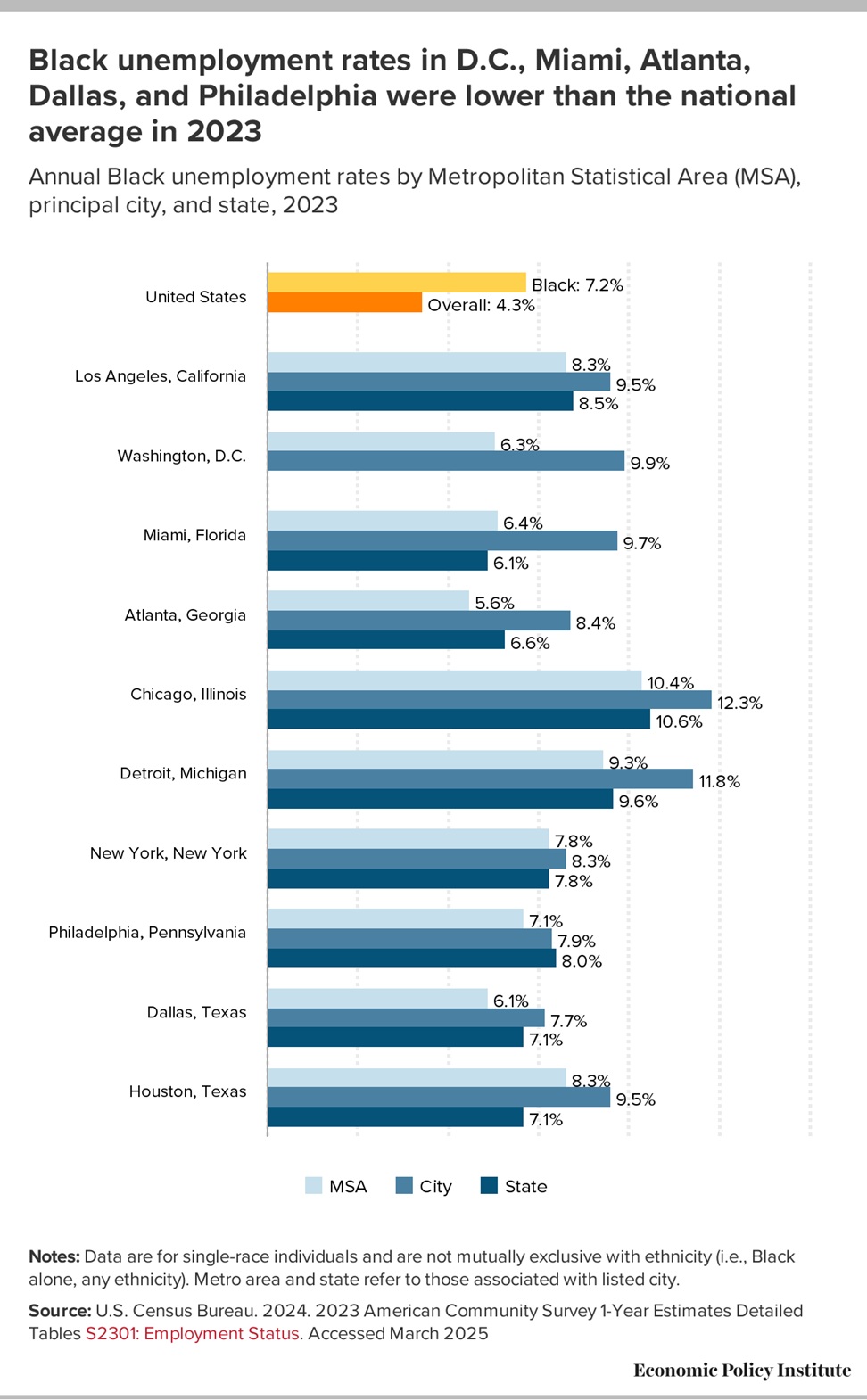
Fig. B: Metro area Black median household income exceeded the national median of $53,927 in all but two of the metros observed. The exceptions: Midwestern metro areas of Chicago and Detroit. The same places where Black unemployment was highest in 2023.
The Black resident incomes in metro Chicago and Detroit were lower relative to the national median and other metros. Their incomes were still higher than the median Black household in the states of Illinois and Michigan. Median Black household incomes in those states were also the lowest among the states observed for this analysis.
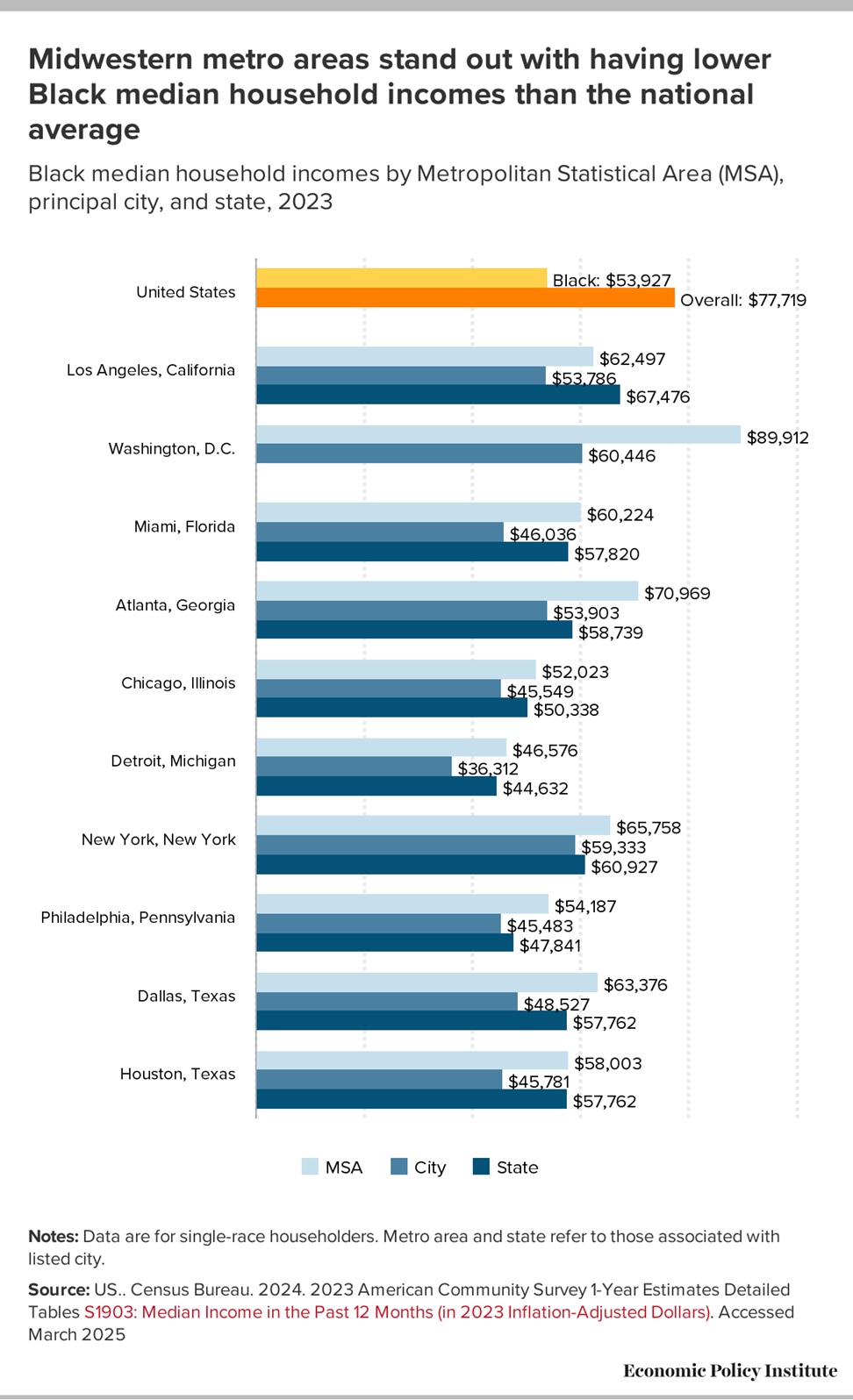
Fig C: Black median household income was highest in the D.C. ($89,912) and Atlanta ($70,969) metro areas. Metro D.C.’s Black median household income was also higher than the overall national median of $77,719. Black households in the New York ($65,758) and Dallas ($63,376) metro areas also had higher median incomes than the typical Black household nationwide.
Higher incomes and lower unemployment in metro D.C. and Atlanta are consistent with these places also having the largest shares of highly educated Black workers. The share of Black college graduates in the D.C. (40.8%) and Atlanta (36.2%) metro areas is above the share of Black college graduates nationally (26.2%). It is as high as the share of all college graduates nationwide. In contrast, the Detroit metro area had the lowest share of Black college graduates (20.8%). The high concentration of federal employment and related professional job opportunities in metro D.C. is a likely factor in attracting Black college graduates to the area.
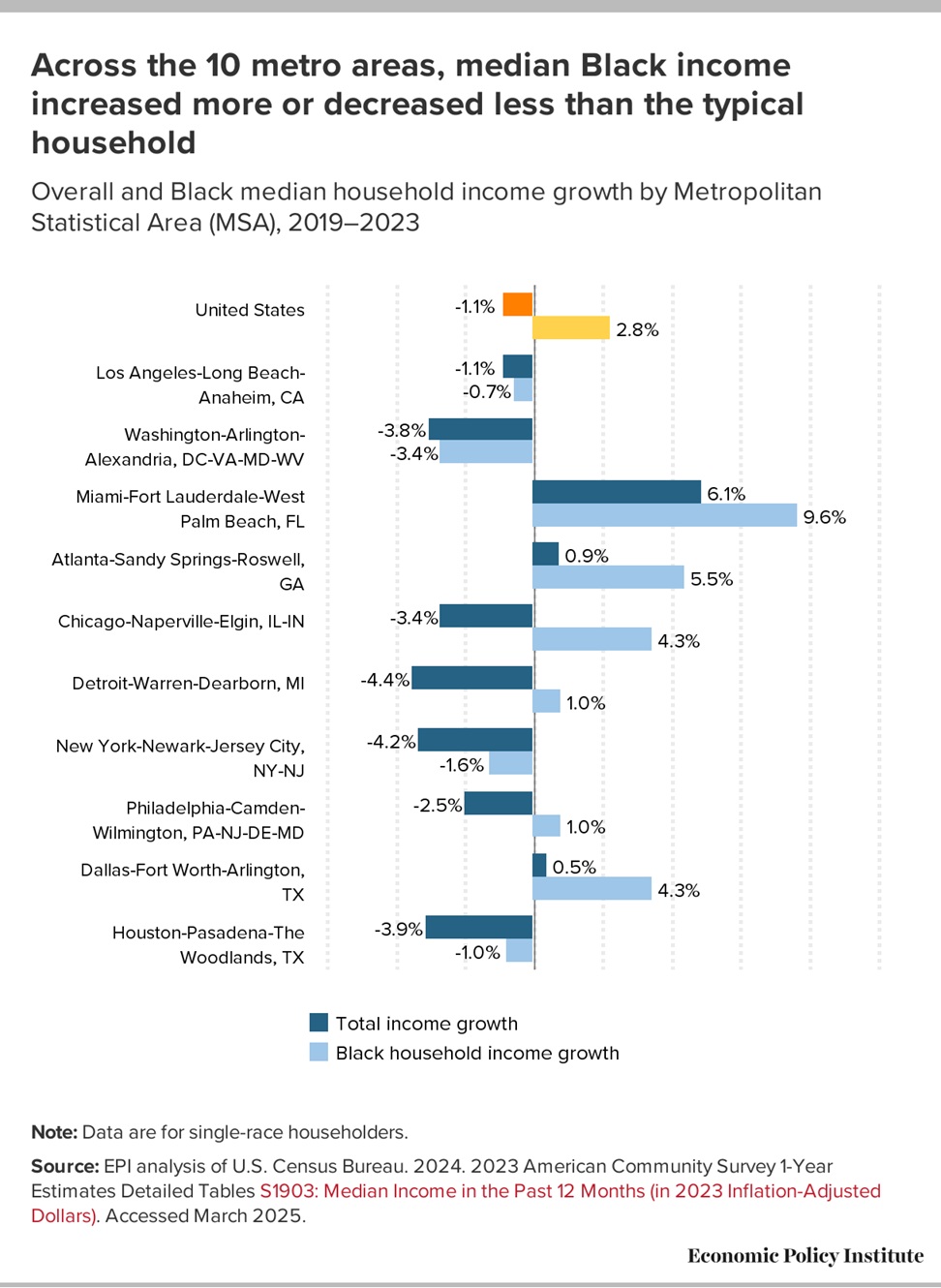
Strength of the 2023 labor market and rise in employment among Black Americans contributed to the growth in median Black household income. As show in Fig C overall real median household income declined 1.1% between 2019 and 2023. Black median household income grew by 2.8%. The spike in inflation during this period generally muted real income growth. However, increased employment of Black workers managed to counteract the negative impact of inflation on income (Moore and Maye 2023).
Black median income growth also outpaced total income growth in six of the 10 observed metro areas—Miami, Atlanta, Chicago, Detroit, Philadelphia, and Dallas. In places where real incomes declined, the decline was smaller among Black Americans.
“A tale of 10 cities: Metro areas signal what’s at stake for Black Americans under Trump’s anti-equity agenda,” Economic Policy Institute, August 14, 2025.