
Lowe’s and The Home Depot . . .
Weathering Q1 Storms and Looking to the Horizon
One always wonder how these mega hardware stores are doing in a not-so-great economy. I suspect the tariffs will impact some of the products. If anything, the on and off tariffs, 10% one day and 20% a week later must throw their planning off. Pay less and the pay more a short time later. Evaluating inventory costs must be difficult too. Very strange economy occurring to emerging and changing pricing impacts.
Key Takeaways
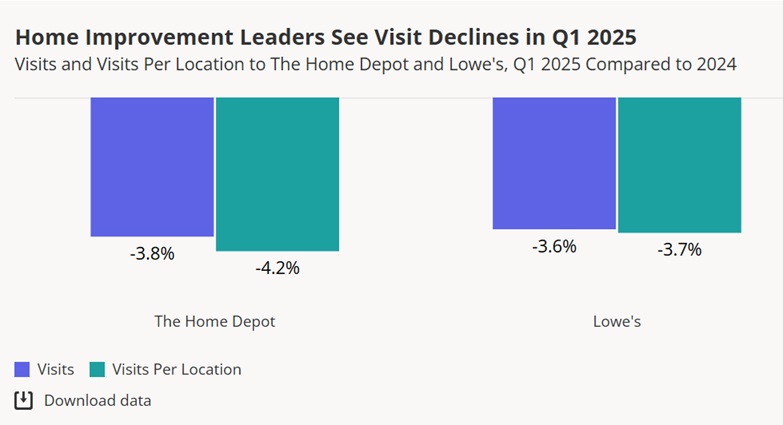
- In Q1 2025, year-over-year (YoY) visit gaps to The Home Depot (-3.8%) and Lowe’s (-3.6%) persisted due to a sluggish housing market and other economic headwinds.
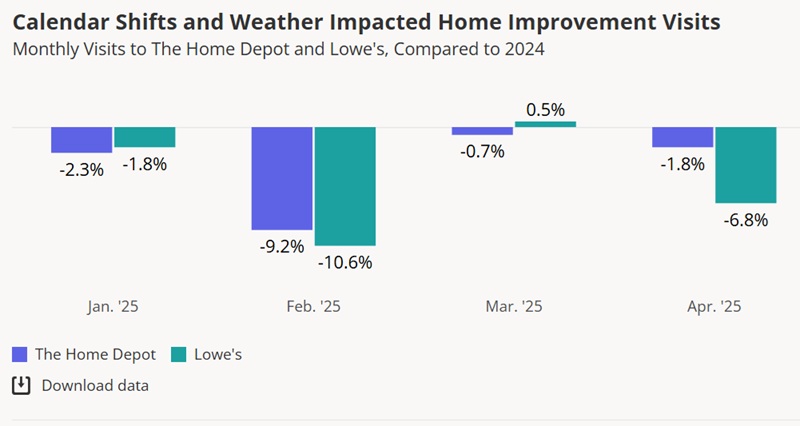
- Zooming into the monthly data shows that YoY traffic to the chains improved somewhat in March 2025 as consumers prepared for incoming storms.
- Although The Home Depot and Lowe’s had a partially overlapping audience, in Q1 2025, Lowe’s drove higher shares of traffic from rural segments and The Home Depot from strongly urbanized ones.
We (The Anchor) dove into the data to explore The Home Depot and Lowe’s recent foot traffic performance, audience profiles, and consumer trends shaping what lies ahead for the chains.
Q1 Traffic: Nothing to Write Home About
The home improvement space has seen YoY traffic lag for quite some time, as sustained challenges in the housing market and tight budgets have resulted in fewer home improvement projects. Despite these trends continuing in Q1 2025, YoY visit gaps to home improvement retailers remained relatively minor; The Home Depot received 3.8% less visits in Q1 2025 than in Q1 2024 while Lowe’s received 3.6% fewer visits.
Zooming in on monthly visits reveals more nuanced foot traffic patterns to The Home Depot and Lowe’s. February’s relatively dramatic declines in YoY visits were likely impacted by the comparison to 2024’s leap year. And in spite of severe weather, YoY traffic to the chains improved in March 2025 as consumers prepared their homes for storms.
Home Depot in 2025: Navigating Consumer Behavior and Market Challenges, VCG Store
Home Depot is closely monitoring how customers spend money in its stores, and the company recently flagged that it continues to notice a consistent pattern of behavior impacting sales.
In its second-quarter earnings report for 2025, Home Depot revealed that its U.S. comparable sales increased by 1.4% year-over-year, a slight improvement from the sales decline it saw during the previous quarter.
However, according to recent data from Placer.ai, Home Depot’s foot traffic in same-store locations decreased by 2.6%, compared to the same quarter last year.
“Our second quarter results were in line with our expectations,” said Home Depot CEO Ted Decker in the report. “The momentum that began in the back half of last year continued throughout the first half as customers engaged more broadly in smaller home improvement projects.”
Home Depot execs sound alarm on a growing customer problem
During an earnings call on Aug. 19, Home Depot Executive Vice President of Merchandising Billy Bastick said the company saw positive sales growth in 12 out of 16 merchandising departments, such as storage, bath, hardware, building materials, indoor garden, appliances, etc.
Big-ticket purchases in comparable stores also increased by 2.6% during the quarter. However, customers are continuing to avoid funding large home improvement projects.
“We continue to see softer engagement in larger discretionary projects where customers typically use financing to fund the renovation project,” said Bastick during the call.
During the call, Decker said challenges in the U.S. housing market are causing customers to put off these projects, and any improvement in mortgage and housing turnover rates can help reverse this startling trend.
Decker noted “a bit of a frozen housing market with 40-plus-year-low turnover rates, and even new starts are struggling a bit. So lower rates would certainly help. We don’t have a crystal ball on what that number is. When we talk generally to our customers, each of our sets of consumers and pros, the No. 1 reason for deferring the large project is general economic uncertainty.”
The average 30-year mortgage rate remains above 6%, and consumers are avoiding purchasing new homes. Existing-home sales declined 2.7% month-over-month in June, while total housing inventory decreased by 0.6%, according to a recent report from the National Association of Realtors.
The report also found that the existing-home sales price increased by 2% year-over-year in June, reaching $435,300, the highest ever.
“Multiple years of undersupply are driving the record high home price,” said NAR Chief Economist Lawrence Yun in the report. “Home construction continues to lag population growth. This is holding back first-time home buyers from entering the market. More supply is needed to increase the share of first-time homebuyers in the coming years even though some markets appear to have a temporary oversupply at the moment.”
Home Depot’s latest move may exacerbate concerning customer behavior
As Home Depot struggles to get customers to tackle large home improvement projects, the company has decided to announce a major change in its stores that shoppers may not like.
Due to the growing threat of President Donald Trump’s tariffs, Home Depot will raise its prices, a move that could potentially drive away price-conscious customers.
“It’s super important to remember that over 50% of our products are sourced domestically and wouldn’t be subject to any tariffs,” said Bastick during the call. “Now, some of the important goods, obviously, tariff rates are significantly higher today than they were when we spoke in May. So as you’d expect, there’ll be some modest price movement in some categories, but it won’t be broad-based.”
Many consumers nationwide have been reducing their spending to prepare to pay higher prices for everyday goods due to tariffs.
According to a recent survey from market research company Numerator, 86% of consumers are concerned about tariffs wreaking havoc on their finances.
As a result, 81% of consumers are adjusting their finances or shopping habits in response to tariffs, including delaying nonessential or expensive purchases, buying fewer imported goods, searching for sales and coupons, and switching to shopping at lower-priced retailers and discount stores.”
Bastick said that despite raising prices, Home Depot is focused on providing value to customers.
“I think it’s important to keep in mind as well our customers tend to shop for the entire project, and you think about a small flooring project, tile, the grout, bathtub, and vanity, and a bath project,” said Bastick.
“And so, we’re laser-focused on protecting the cost of the entire project. Our goal is to maintain the best value for our customers.”