
Recognizing Propaganda as Opposed to Reality
There is a constant tenor that people can do better by investing their funds elsewhere other than contributing to Social Security. In the short term that can be true as long as you have the funds to invest all the time and the economy does well. There are no guarantees in private investments and politics can impact it.
Private investing in the stock market can offer the potential for higher returns than Social Security over the long term. However, those investments come with higher risk and require active management (redundant alert). Social Security provides a guaranteed income, inflation protection, and insurance benefits, acting as a valuable safety net and a foundation for retirement planning
Policy Basics: Understanding the Social Security Trust Funds, Center on Budget and Policy Priorities
Hat Tip to a fellow writer . . .
You only have to look at Pinochet’s “pension reform” fiasco in Chile to see what will happen if Social Security gets privatized: “Chile’s justification for eliminating public pay-as-you go programs (like Social Security in the US) and sending workers into a privately managed system of individual accounts was twofold: First, private funds would grow more and compound faster due to better management, meaning more money for retirement; second, the change would keep down public costs.
Four decades later, Chile’s system hasn’t worked as promised or expected. The creators anticipated that the average worker would save enough to earn 70% of their salary in retirement; the reality has been closer to one-third. They thought the new system would expand the number of workers with retirement funds; INSTEAD NEARLY 40% OF CHILEANS HAVE NOTHING TO FALL BACK ON. RATHER THAN IMPROVE THE LIVE OF CHILE’S ELDERLY, MOST PENSIONERS LIVE ON LESS THAN THE MINIMUM WAGE, WITH WOMEN HIT HARDER THAN MEN.”
https://www.cfr.org/article/chiles-failed-pensions-are-neoliberalisms-badge-shame
@John,
Milton Friedman supported Chile’s pension reform, which privatized the social security system. He visited Chile in 1975 and provided advice to the Pinochet regime on implementing economic reforms, including the pension system. Friedman’s ideas, particularly those from his book “Capitalism and Freedom,” heavily influenced the Chilean model of privatized social security.
Of course, Friedman’s dead but Chileans are still suffering from his legacy.
John:
That is painfully obvious. You do not have to look much further than our own nation.
Yes, indeed. How Pinochet’s Chile Became a Laboratory for Neoliberalism | The Nation
“The defenders of neoliberal policies have to contend with the uncomfortable fact that their approach was first implemented by a mass-murdering tyrant. They must acknowledge that their intellectual heroes in the University of Chicago’s Department of Economics transmitted these programs to Pinochet directly and that they were forced on the Chilean people by a group of Chilean economists, the so-called Chicago Boys, who had trained at the same university.”
There is an old joke that has circulated in Latin America for decades:
Q: Why has there never been a coup in the United States (until now?)
A: There is no US embassy in Washington.
That said, Trump has no need for a US embassy in Washington to implement Pinochet’s devastating policies.
Not that I think anything is in the works, but it’s not a bad idea to keep in mind that SS benefits are not yours as a contract. Consider a private pension. The payouts are not dependent on the next generation investing into the plan. Companies have been dropping pensions for a couple decades now….this process is reaching completion, with very few firms offering classic pensions. No new employee funds are entering the plans, but their pensioners get their pensions if the funds are well invested. Not that I expect it, but if younger workers decided en masse that they hate the system and elect a Congress willing to let them out of it, we’ll beneficiaries will be in an enormously bad spot, because in spite of what Dale told us for years, we don’t pay for our own benefits; younger workers do. That younger worker was me for 40+ years, so I don’t feel bad about this, but it’s a risk.
Bullshit. Social Security is a contract I entered into with the US government in 1968 when I went down to the Post Office, signed the paperwork and got my social security number ~ I pay into it for forty-five (45) or fifty (50) years and it will pay me back. It is a contract and no amount of smoke and mirrors will change that
@Ten,
Please post a link to the contract I signed for Social Security. I can’t recall ever seeing such a contract.
I do remember that every paycheck I’ve gotten since I was a work-study in college had SS payments automatically withheld, but I don’t recall a contract stipulating that amount. And I don’t recall a contract for how much my benefit check would be. A projection, yes, but not a contract.
“I pay into it for forty-five (45) or fifty (50) years and it will pay me back.” If you die before you start claiming benefits, SS won’t pay you a penny. Your spouse can elect to collect your benefits, but only if they give up their own. Unlike my 403b and Roth IRA, which will be inherited by my wife on top of her own 403b, Roth IRA and social security benefits.
Joel:
You can be exempted from SS withholding for certain legal reasons. There is a small death benefit and there are survivor benefits. If your benefit is greater than your spouse, they can take yours instead of theirs. Granted, it may not be similar to your normal pay.
SS is not a legal contract per se where you have standing for benefits. It can be eliminated. It can pay you less which may occur in 2030-something. However, I would think of it as more of a political agreement between the government and citizens to provide for legal citizens stipend based upon funds withheld and remaining.
There are ramifications for falsifying.
It is not simple.
@Bill,
When I was on an NRSA postdoctoral fellowship, I was exempted from SS withholding. I also filed quarterly withholding for income taxes.
Yes, SS is *not* a contract. That was my point. If you die before you apply for benefits, neither you nor your heirs get anything. If you live to 100, you’ll get a better-than-average return. “Political agreement” works for me.
Joel:
I have worked via contract also. Done similar as to what you did and paid the employers amount also. Ten Bears belief is personal amongst many of us. Unfortunately, the gov and private enterprise can inflict upon us all.
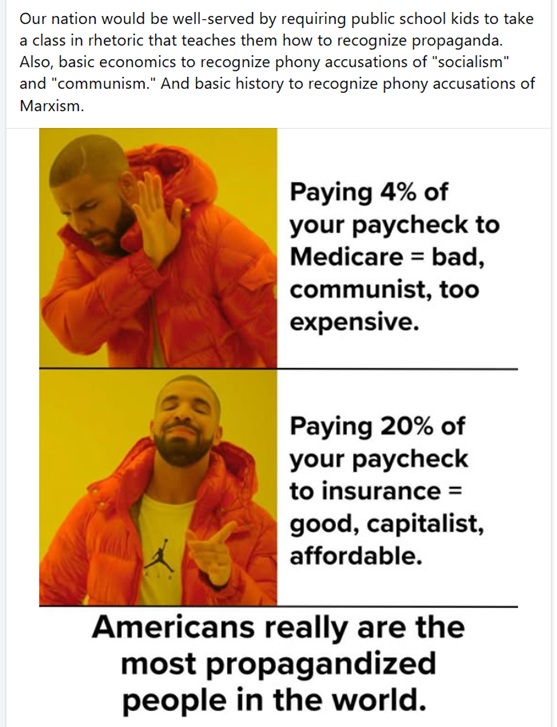
While the message is important, the numbers in the graphic do not represent good analysis. The 4% for Medicare is wrong. 20% is bound to be correct for someone, but as someone who has exchange based insurance I can tell you that the actual numbers have a huge range.
And one payment is for future services and the other for current, so the comparison is apples to oranges – downright bad analysis.
@Arne,
The message is what’s important. The details aren’t. Your comment reminds me of ammosexuals who dismiss gun control because someone doesn’t know the technical definition of an AR-15.
I most assuredly did not dismiss the message.
I do claim that the details are important.
Arne:
I looked at such also. And you are correct.
The issue here is America pays way too much for commercial healthcare and also insured by commercial healthcare insurance. Do you have Medicare Supplemental Healthcare Insurance? There are differences there also. For years we have had AARP United Healthcare Supplemental Plan N. We took a larger increase this last year and I had enough. Called up the people that do the scans for the various Plan packages for Medicare. By switching to a different carrier we cut our Supplemental Plan N by more than 50%. How does AARP United Healthcare do this?
there is a big difference in what is taken out of your check for Medicare and the statement by the author of the piece. And people complain about government taking that minute amount. At the same time they will not bitch about the cost of healthcare and the insurance.
If you want to see some anger? Watch when the Covid coverage for healthcare goes back to everyone paying more for insurance at 400% FPL as compared to 600% of FPL. Tr__p and Republicans do not care. Is the number wrong? Yes. The real issue is they don’t mind paying more to commercial interests as compared to the Gov.
I am 64. I am leaning towards a G plan rather than an N plan. Thoughts?
One of the things I learned while trying to understand my Medigap options is that the premium will increase every year. As I consider it, I am becoming part of a pool of people my same age and medical costs and therefore insurance premiums will keep going up until I die. Thus my recognition that one number does not explain the range of people’s experience.
@Arne
Medigap Plan G vs. Plan N: Which Is Best?
Arne:
Medicare Plan N is a supplemental policy that typically has lower premiums. In return, you pay the Part B deductible, excess charges, and some copays for doctor and emergency visits. Plan N has been popular since it was first introduced in 2010. Also called Medigap Plan N, this option was created for consumers who like paying a lower premium in exchange for taking on a small annual deductible and some copayments.
Plan N covers the Part A deductible.
All Medicare Supplement Plan N policies are the same, no matter which insurance company you choose. Plan N is available in many states from various well-known insurance companies.
You can look here too: Medigap Plan G vs. Plan N: Which Is Best?
There is no reason you can not change companies from year to year. There is no differences between Plan N at each company or Plan G from each company. You are shopping Price. I do not know why AARP was so much more expensive than other place offering insurance plans.
I have your email. I will send you the name and email address for a person and company to talk to when you are ready. We cut our cost by half for the same plan. What prompted me was the increase this year. For me, I can go to the VA also.