
Healthcare Coverage as a Government Responsibility?
Interesting piece as taken from Gallup about healthcare coverage and who should be responsible for it. Most adult Americans believe the government should be directing a healthcare program for the citizens of the United States. That being said, all individuals would be covered.
The article did not break it down by citizen or noncitizen. In all likelihood, noncitizens would be covered. Overall, I believe you will find Democrats having a more favorable view than Republicans on who should have access to Healthcare.
Size and not the share, of the U.S. immigrant population is at a record high. Immigration is an important contributor to U.S. population growth. A growth which has slowed in the past decade due to falling birth rates. Amid the demographic slowing, immigration accounted for the entire growth of the total U.S. population between 2022 and 2023—the first time this has happened since census data collection on nativity began in 1850.
There were 47.8 million immigrants (MPI) residing in the United States (2023), according to the latest American Community Survey (ACS). Of them, nearly three-quarters were in the country legally as naturalized citizens, legal permanent residents (LPRs, also known as green-card holders), or holders of temporary visas.
I envision healthcare to be a major concern for the United States.
~~~~~~~
More in U.S. See Health Coverage as Government Responsibility
Sixty-two percent of U.S. adults, the highest percentage in more than a decade, say it is the government’s responsibility to ensure all Americans have healthcare coverage. The figure had slipped to as low as 42% in 2013 during the troubled rollout of the Affordable Care Act’s (ACA’s) healthcare exchanges. It has been as high as 69% in 2006.
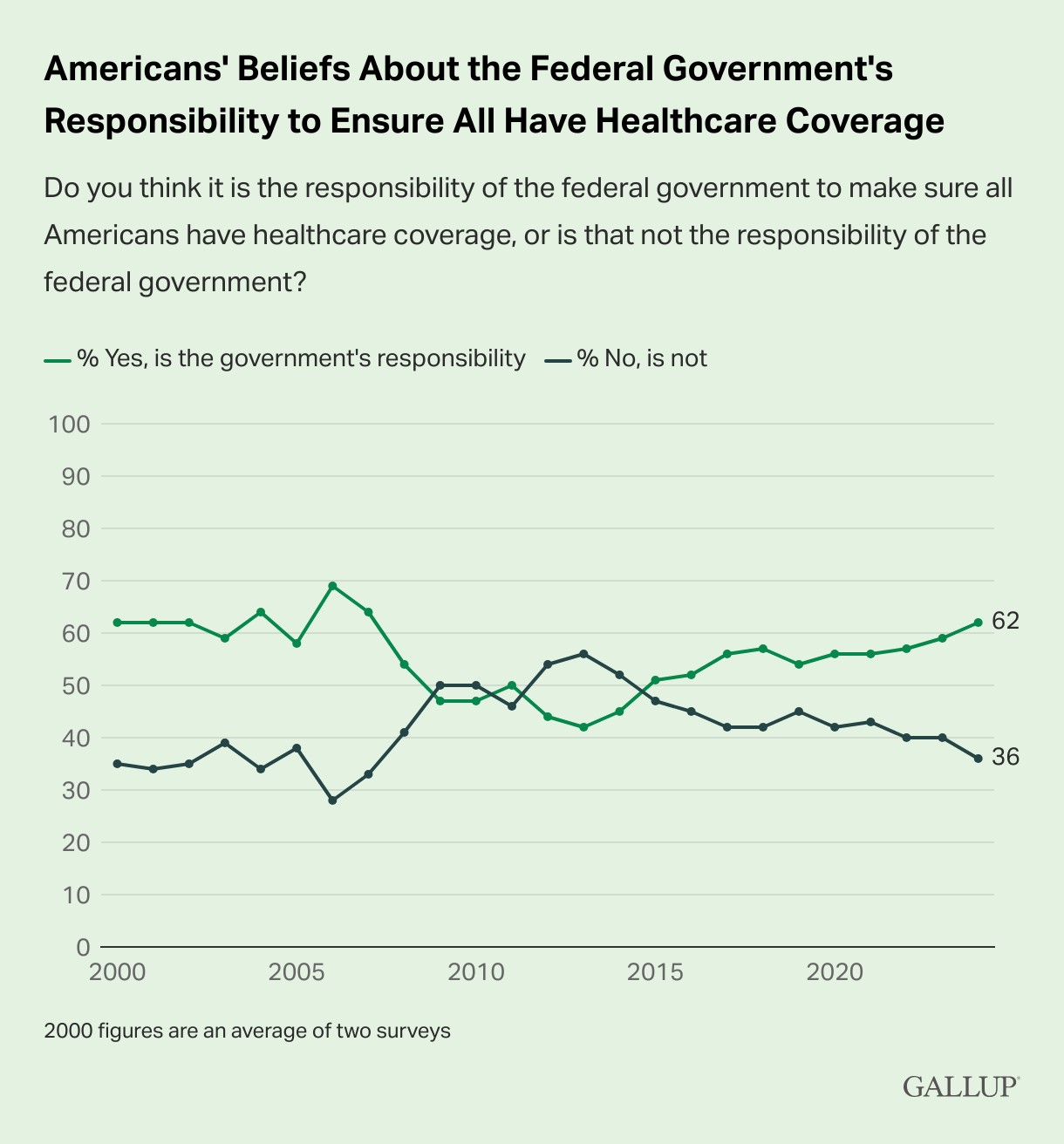
The results are based on Gallup’s annual Health and Healthcare survey, conducted Nov. 6-20. The same poll finds fewer Americans than in the recent past rating U.S. healthcare coverage and quality positively.
Between 2000 and 2008, consistent majorities of Americans believed the government should make sure all people in the U.S. have health coverage. That changed during Barack Obama’s presidency, as he worked with a Democratic Congress to pass the ACA (also known as “Obamacare”) to increase health coverage in the U.S., sparking opposition by some Americans to a larger government role in healthcare.
By 2009, U.S. adults were divided on whether the government was responsible for ensuring healthcare coverage for all Americans, and from 2012 through 2014, majorities did not believe the government should have that role, as support among independents and Republicans waned. Public opinion shifted back to seeing healthcare access as a government responsibility in the latter years of Obama’s presidency, and this has been the prevailing view since.
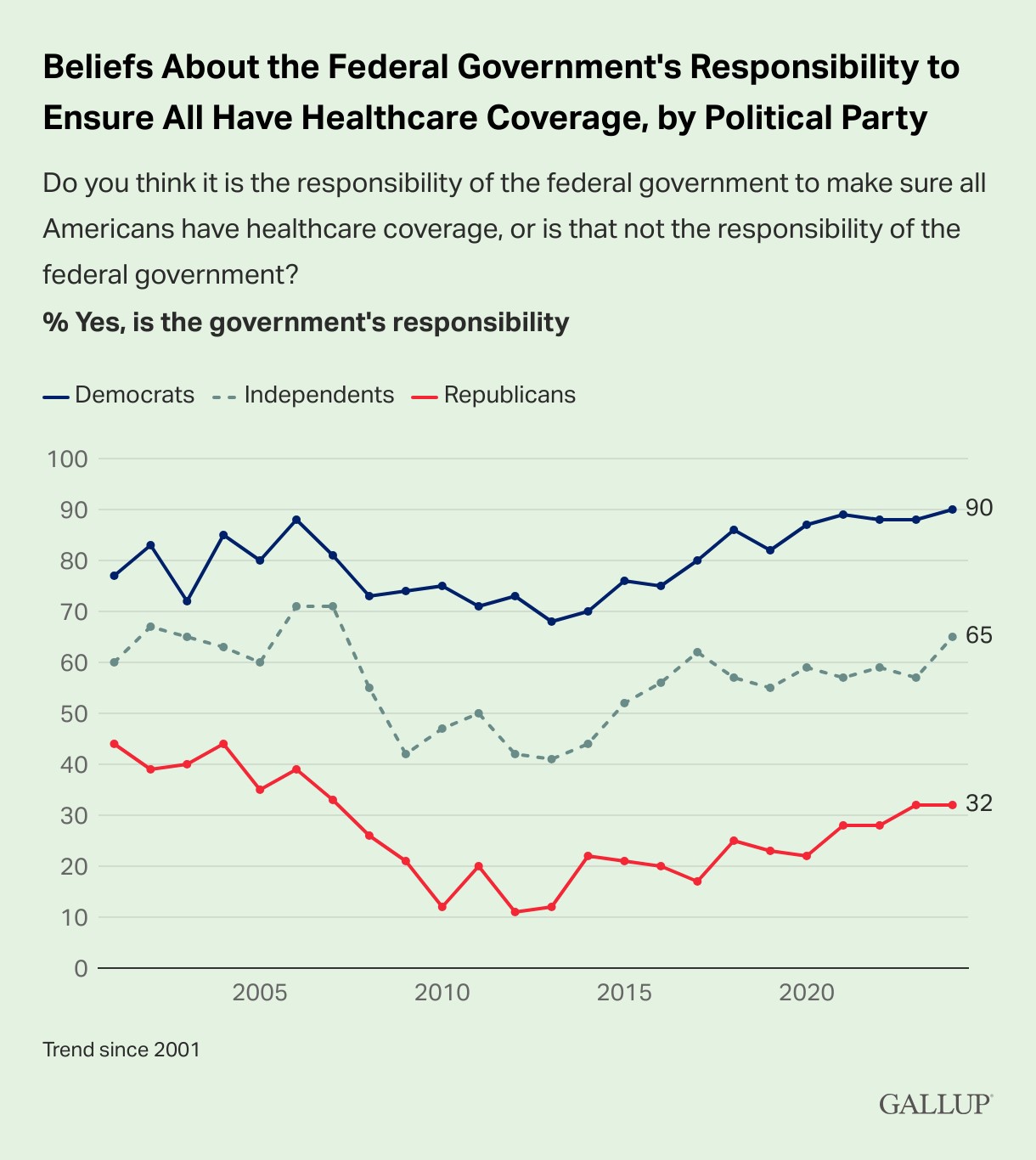
More recently, agreement that the government has a responsibility to ensure healthcare coverage for all Americans has increased among independents and Republicans. While a minority of Republicans hold this view, the 32% who do so is up from 22% in 2020. The percentage of independents who believe the government is responsible for ensuring health coverage, 65%, is up six points from 2020.
Large majorities of Democrats have consistently believed the government should make sure all Americans have health coverage. The 90% of Democrats who now say the government should ensure health coverage for all is the highest Gallup has measured for the group to date. The high points for Republicans and independents were registered in the 2000s: In 2001 and 2004, 44% of Republicans said the government was responsible, while 71% of independents, in 2006 and 2007, expressed that opinion.
Public Now Divides on Government vs. Private Healthcare System
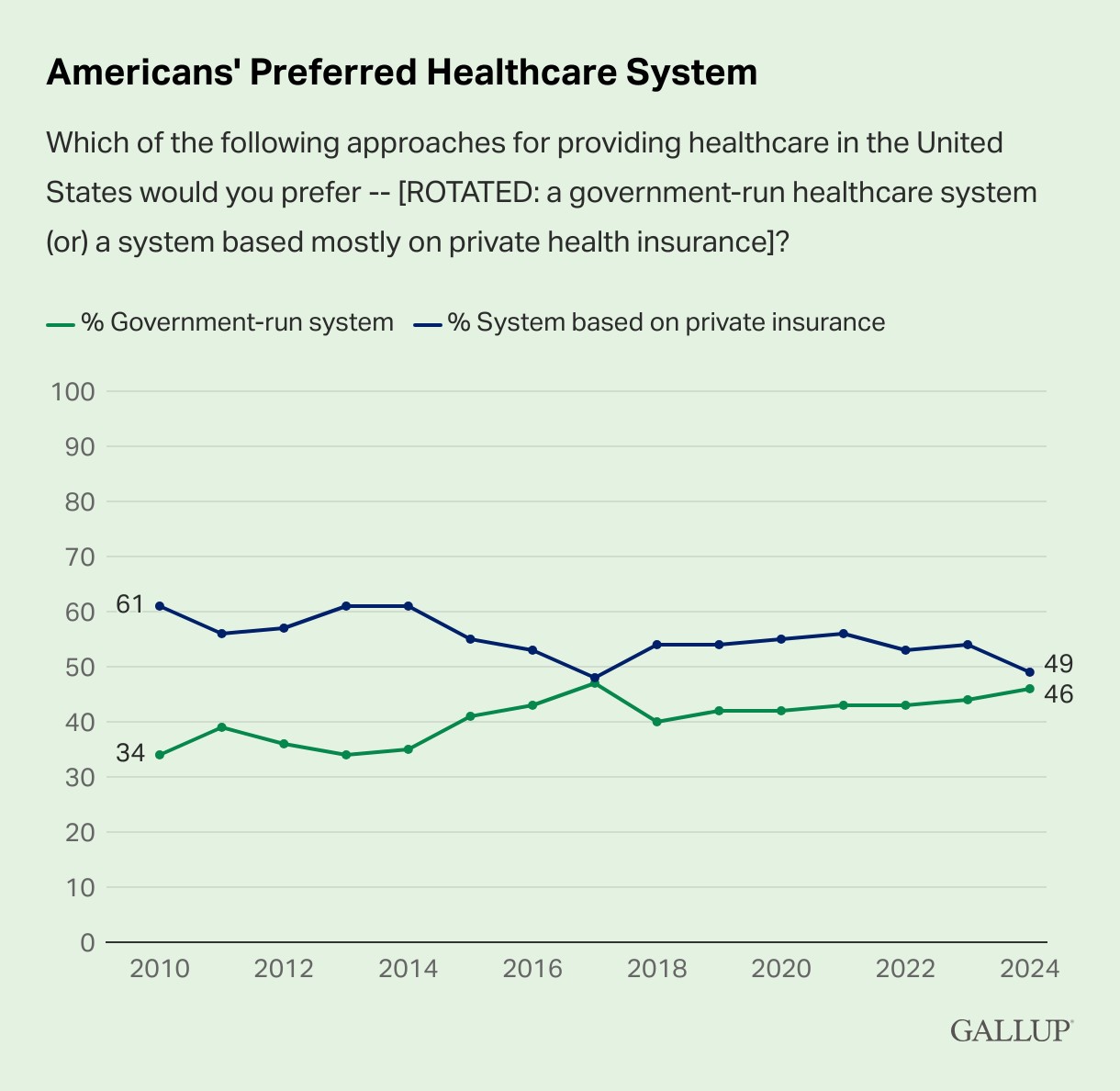
Apart from asking whether the government should ensure people have healthcare coverage, Gallup measures public support for a government-run U.S. healthcare system, such as those in Canada, the United Kingdom and elsewhere around the world.
Americans divide about evenly on this question, with 46% saying the U.S. should have a government-run healthcare system, while 49% are in favor of a system based mostly on private health insurance. Only in a 2017 survey were Americans as closely divided as they are today. In most years, majorities — as high as 61% — favored a system based on private insurance.
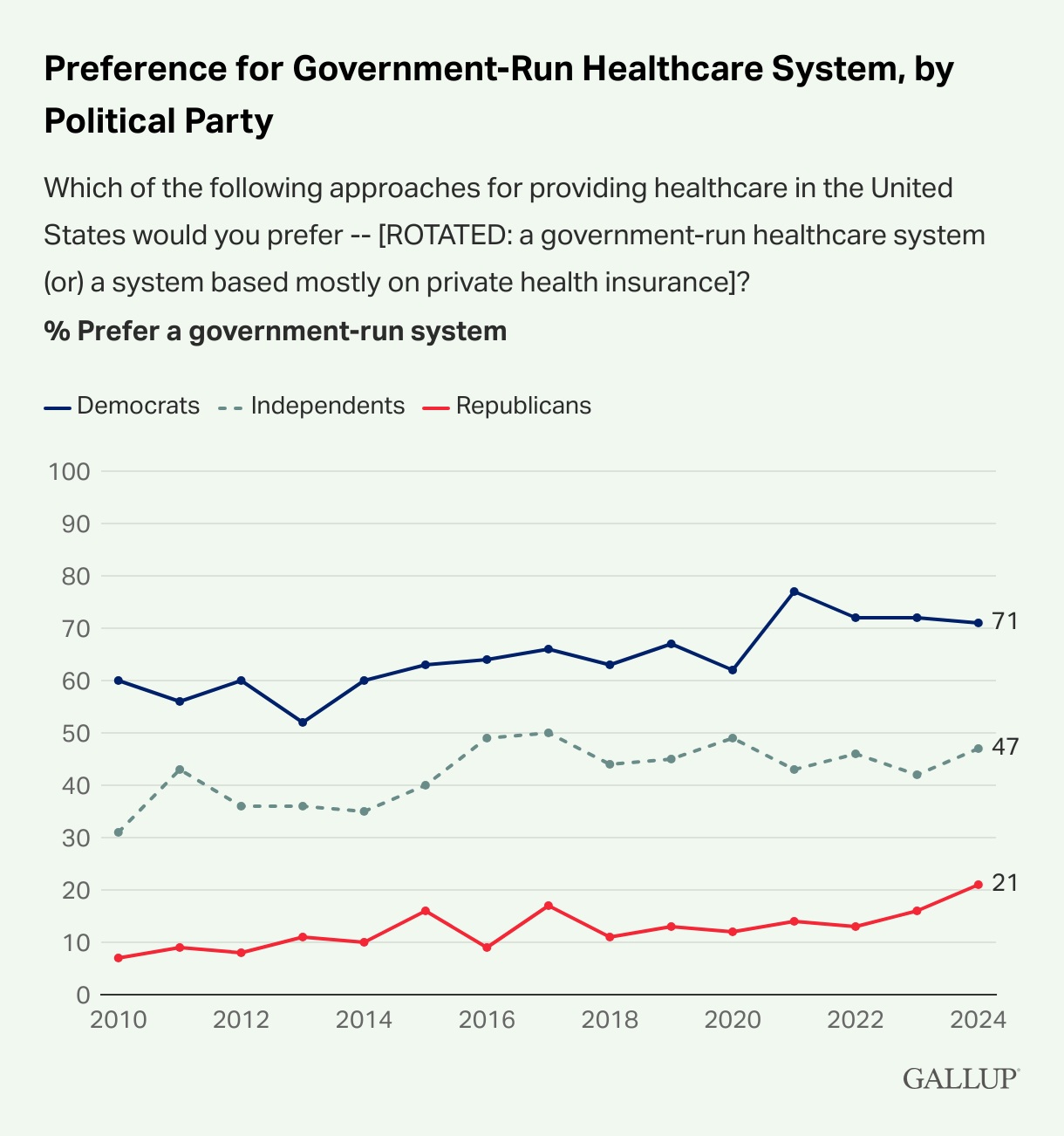
Democrats and Republicans hold opposite views of the best approach to providing healthcare — 71% of Democrats favor a government-run system and 20% a private system, while 76% of Republicans favor private insurance and 21% a government-run system. Forty-seven percent of independents want a government system, and 49% a private one.
Republicans’ current support for a government-run system is the highest they have expressed to date, up from 12% in 2020. The percentages of independents and Democrats wanting a government system are on the high end of what Gallup has measured since 2010, but not the highest.
Obamacare Approval Near High Point
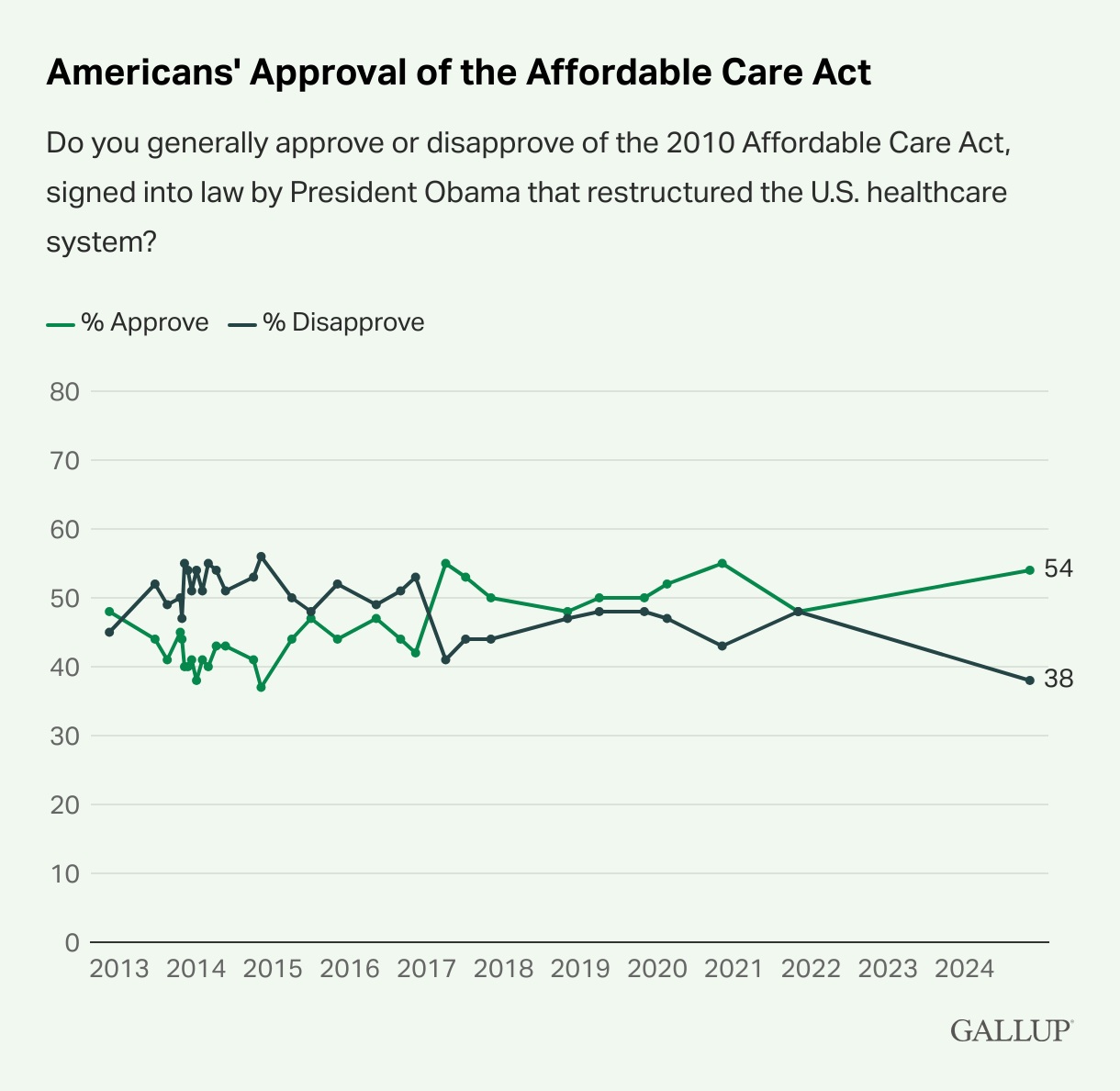
Fifty-four percent of U.S. adults approve of the ACA, essentially tying the record-high 55% readings in April 2017 (during Republican-led attempts to repeal the law) and November 2020 (after Joe Biden won election as president). Approval has generally been 50% or above since Obama left office in 2017, but the law was far less popular during his tenure, ranging from 37% to 48% approval.
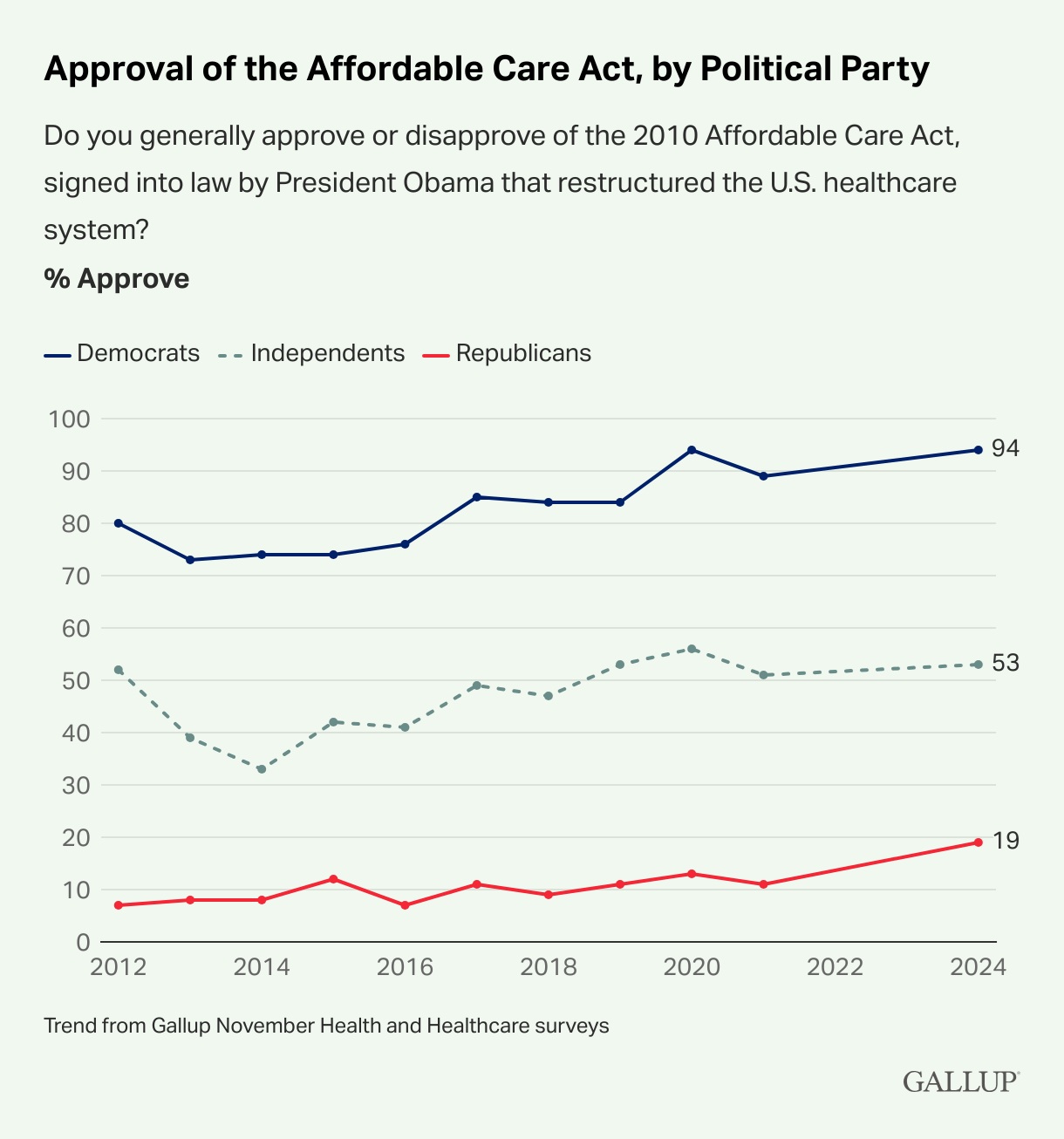
Ninety-four percent of Democrats and 19% of Republicans approve of the law, both highs for those groups. Fifty-three percent of independents approve.
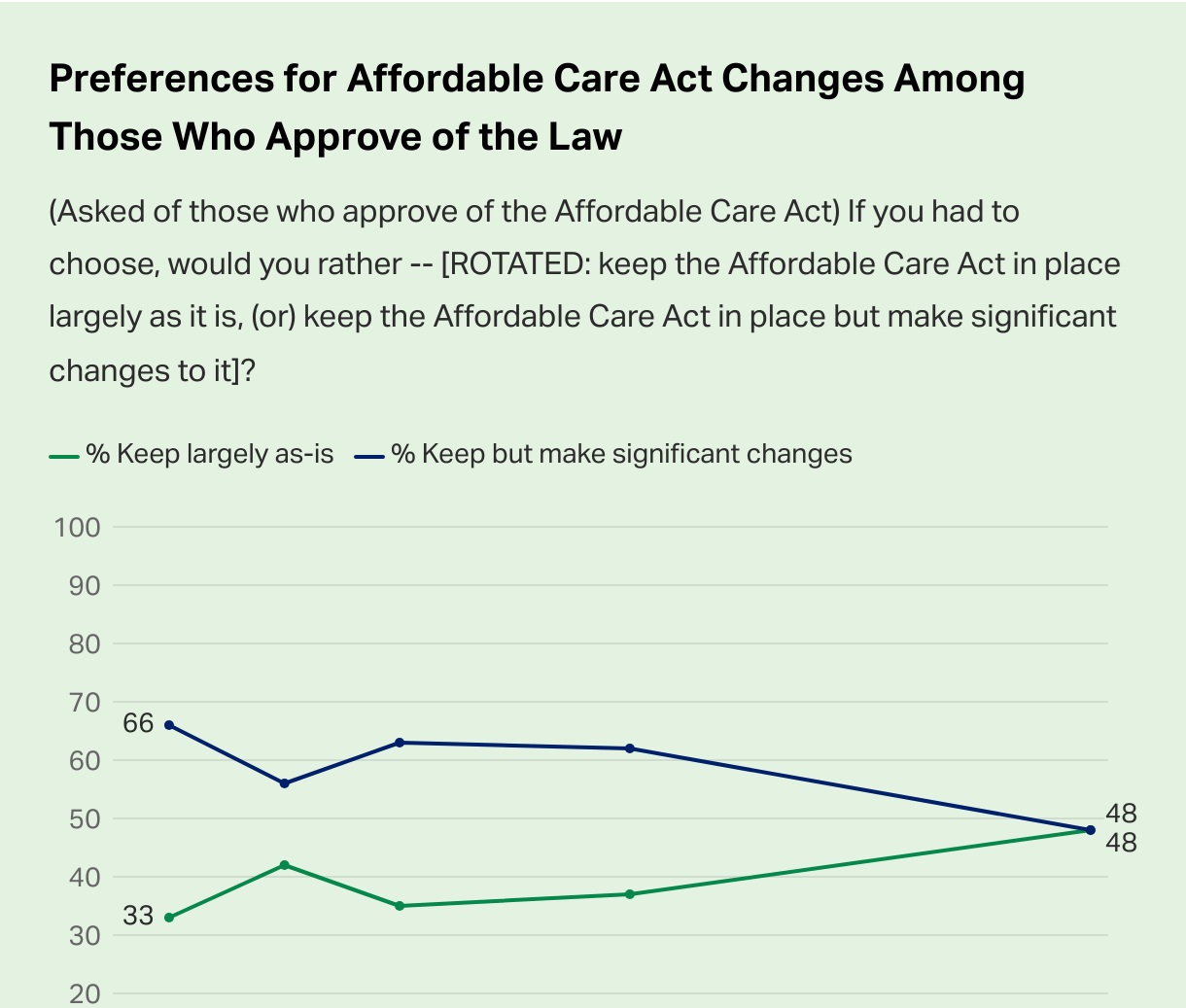
Those who approve of the ACA divide evenly between wanting the law kept in place largely as it is (48%) and keeping the law but making significant changes to it (48%). This is a shift from the past, when larger shares of those who approved of the law wanted changes to it than do now.
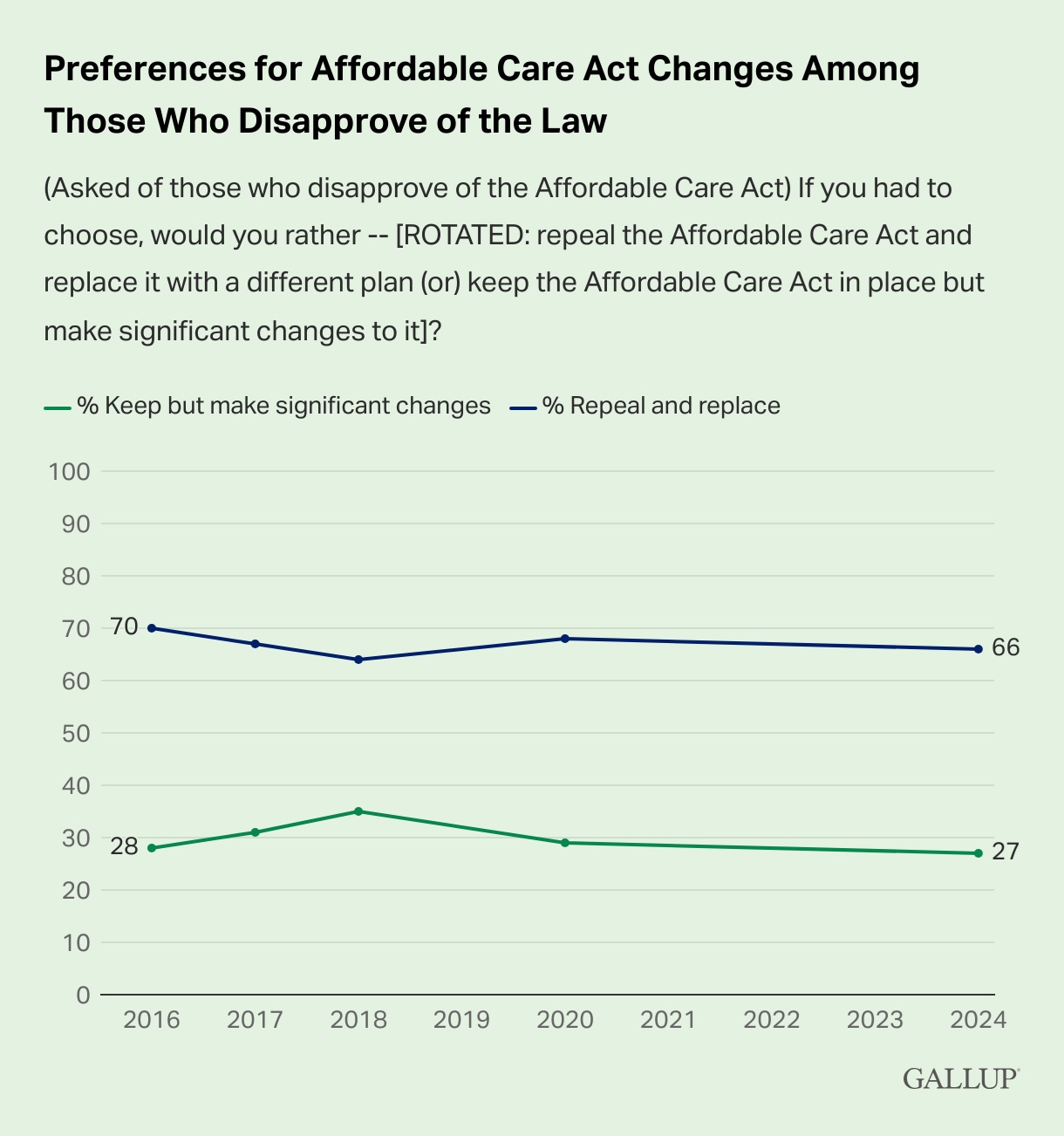
Among those who disapprove of the Affordable Care Act, most would prefer that it be repealed and replaced with a different plan (66%), as opposed to keeping it in place but making significant changes to it (27%). Disapprovers — who are mostly Republicans — have consistently wanted the law repealed, which President Donald Trump and the Republican-led Congress attempted to do in 2017 but were unsuccessful.
The Bottom Line
Trump’s plans for healthcare in his second administration are unclear, but making a second attempt at repealing the Affordable Care Act could be a daunting task. Public support for the law is as high today as in Trump’s first term. At the same time, Americans are even more likely today to agree with the driving principle behind the ACA — that government should ensure all Americans have coverage.
During his September presidential candidate debate with Democratic nominee Kamala Harris, Trump remained critical of the ACA and said he had “concepts of a plan” to replace it. His lack of a firm plan for healthcare suggests the issue may not be a high priority for him, in contrast to issues, such as immigration and trade, that he made more specific policy proposals about during the campaign.
More in U.S. See Health Coverage as Government Responsibility
How popular is ACA really? I recall that the vision of some of the most critical “founders” was that the structure would first encourage and the pretty much compel businesses to drop their plans and use the money to increase compensation to employees to then buy on the ACA markets. I don’t see this happening. Maybe it is just very slow. Further, I kept reading here that it’s expected that a significant number of covered customers will drop out once the temporary extra premium subsidies expire. Polling aside, it seems to me that the employment based sector has looked at this for more than a decade and decided not to go there and volume heavily depends on making the prices very cheap. It might be polling better but somehow I think it missed on what was hoped for. I had sort of expected that the Trump 1 tax cuts would boost the conversion away from employer plans to ACA….lower tax rates and the employers’ tax incentives go down. That’s true of employee compensation, too, but the headaches of just adding the same money to paychecks is minor compared with managing an insurance vendor. ACA is firmly part of the overall system, but less transformative than hoped for I’d say.
@Eric,
How popular is the ACA really? Recent polling indicates that roughly six in ten adults hold a favorable view of the ACA.
https://www.kff.org/affordable-care-act/poll-finding/5-charts-about-public-opinion-on-the-affordable-care-act/
I am somewhat in Eric’s camp on this one. The current popularity of the ACA is likely to diminish—and some predict its demise–if the subsidies are allowed to expire at year end. Republicans have been warned by their pollsters that failure to reauthorize the subsidies will result in significant mid term losses, because unlike the Medicaid cuts the effect will be felt before the midterms. Whether that moves them remains to be seen.
Personally, I thought the ACA did not go far enough because the most logical way to control costs is with single payor systems. The problem with single payor as experienced in Great Britain and which the recent Medicaid cuts in this country demonstrate is that what the government gives it can take away. Politically, the takers may pay a price but only after the fact.
@Terry,
The ACA was a kluge to try to rescue millions of uninsured without single-payer. Let’s not make the perfect the enemy of the good.
Although the evidence I’ve seen says the ACA is way more popular than Donald Trump, far too many people don’t understand that the problems with the ACA are caused by our for-profit healthcare system.
“. . . the takers may pay a price but only after the fact.”
Which is why the Medicaid cuts were scheduled to begin after the 2026 election.
My remarks are mainly for the ACA market part of the law. It’s not getting repealed. It polls better than in the past. But the expectations that it shrinks going forward seem higher than it grows. That’s odd is kind of my point, not really the poll numbers. Commercially they offered a special, temporary low price to increase volume. You normally do that believing the value of the product or service becomes clear and many/most of the new volume sticks around at “normal” prices. That could happen, but there is a good deal of expectation it won’t work that way.
There are still a lot of people around who remember the pre-ACA days. Lifetime limits on coverage, even through employer group plans. Pre-existing conditions. Delaying approvals until the patient had died. Dropping kids off coverage before they had a chance to get their own jobs with employer coverage. And that was just the folks who had insurance. If you didn’t, you avoided doctors who might diagnose something that would be a pre-existing condition when you finally could afford to buy that first policy.
It seems obvious that a healthy population is better than a sick or injured one. And the only way to care for everyone is to get the government to do it. Single payer probably rather than a national health service, but either is better for everyone than the patchwork we have now.
@Jane,
“Pre-existing condition” is what we used to call “medical history.”