
How much has Gasoline Prices Increased and Why. Explained in a Simple Manner . . .
Mostly informational . . . I subscribe to the New York Times. I do have access to some rather unique articles (in the NYT) such as this one which gives prices per gallon of gasoline by state. The data for the map was obtained from AAA by the New York Times,
Map: How Much Have Gas Prices Risen Across the U.S.? The New York Times
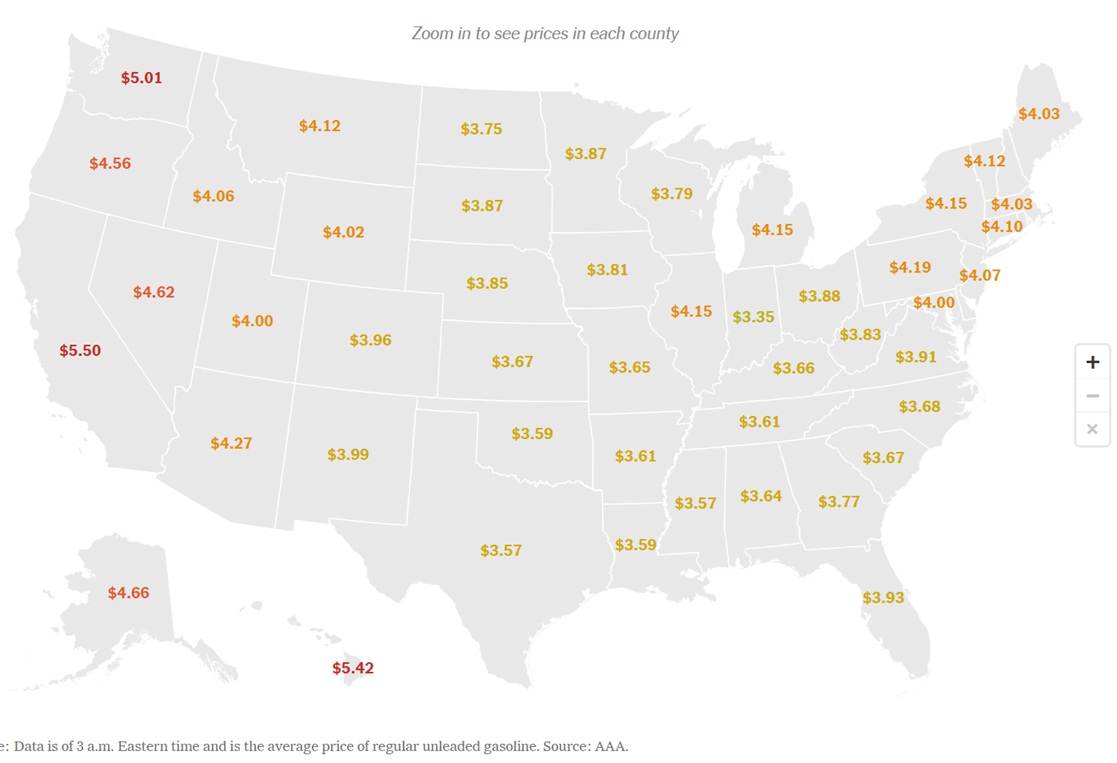
After the U.S.-Israeli attacks on Iran began in February, the price per gallon of regular gasoline has incrementally increased day by day or week by week. I have seen it fluctuate here in Arizona. Then to, the price of gasoline has fluctuated with any threat be it economic or war.
The increases at the pump are not the same from state to state. Even if there was no Tr__mp instilled threat of war or stable oil and gasoline supplies, there would still be price fluctuation. As the NYT piece explains such differences in states could be due to local and state taxes even if global energy supplies are stable. In California, where drivers typically pay the most for gas in the country, a gallon of regular unleaded has cost (on average) well over the national rate, according to the AAA motor club. Taxes are probably driving the cost in California. In Oklahoma or Kansas, a gallon of gasoline is usually well under California’s pricing.
The wide range is also due to regional differences in taxes. Even with a large capacity from extracting oil, the United States is a net exporter of petroleum products. There by, the United States has to import millions of barrels a day of those commodities to refine, and typically mix with our own domestic crude.
The cost of those imported barrels of oil is vulnerable to shockwaves in the global market. In the end, it is not a simple issue of control of prices and inventory domestically. There is more to it than simply pumping oil and corporation appear to be adjusting prices based upon local taxes/costs and national threats rather than costs of acquiring the oil.
As the Times suggests: “Refining and distribution by big energy companies and taxes account for most of the rest, which is why prices vary regionally. Station owners have a little wiggle room to set the price they charge and is usually just a few cents per gallon. There is a need for better control of costs and clarity amongst the refineries.
Other Detail:
AAA Fuel Prices: National Average is Moving Higher
Maps: How Much Have Gas Prices Risen Across The U.S.? – The New York Times
In California we have a summer blend gasoline and a winter blend gasoline due to the high risk of places like LA, San Diego and the Bay Area, surrounded by hills on the inland side backed by hot dry places and facing the ocean on the ocean side, having smog trapped over them for extended pariods of time (doesn’t happen so much in the winter.) This site “The Difference Between Summer-Blend and Winter-Blend Gasoline” says the average price differential (summer higher than winter) can be as much as 15 cents/gallon, which I don’t notice so much since my main car is an old Chevy Spark electric. The site also says that summer driving demand itself can increase prices by 5-15 cents, so that gets you to maybe 20-30 cents increase in CA from these factors alone.
Of course, thanks to Trump, that’s merely a contributing factor to this year’s gas price increase here.
https://ycharts.com/indicators/california_retail_price_of_gasoline – a week out of date – had us at $4.39 at the beginning of last August, $4.10 in mid-January, and $5.31 a week ago – while AAA shows the one-week increase to today as 14 cents.
John Bowman: The Graph to your link. For some reason, I am not being allowed to update your comment showing the Graph.