
Reducing Food Insecurity
Reducing Food Insecurity Among Children in the U.S.
Econofact
Lisa A. Gennetian and Diane Schanzenbach
The Issue:
Adequate access to healthy nutrition is a key component for children’s development. Children need food to grow and show up to school ready to learn. Yet in 2023 (latest data available) almost one in six children in the United States lived in house-holds that experienced food insecurity, meaning that at some point during the year they lacked the resources to acquire a healthy, balanced diet. A patchwork of public and non-profit programs provides nutrition assistance to a large number of children and helps buffer them from food insecurity. The programs play a vital role in reducing the most severe forms of food insecurity and hunger for children in the United States and have been shown to result in long-term benefits.
The Facts:
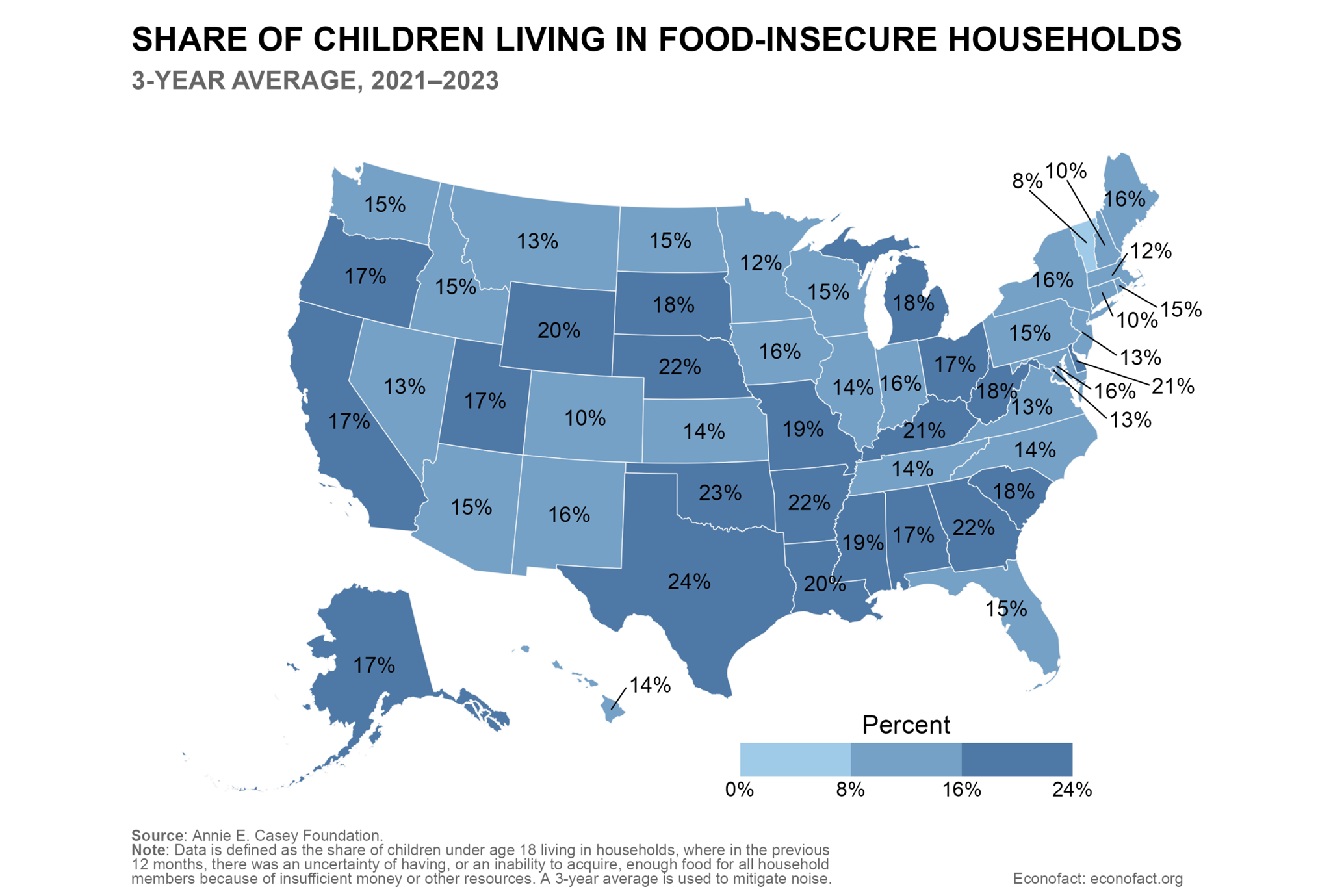
Households with children experience higher levels of food insecurity than the U.S. average. Nearly 18% of households with children experienced food insecurity at some time in 2023, compared with 13 percent of U.S. households overall. That is, they lived in households that experienced times during the year during which they were uncertain of having (or unable to acquire) enough food to meet the needs of all their members. The share of children living in food-insecure households varies widely across states, ranging from a high of 24 percent in Texas to a low of 8 percent in Vermont (see map). Differences in sociodemographic characteristics, local economic conditions, as well as state differences in social safety net programs, among others, account for the variation across states.
Very low food security, a more severe hardship than food insecurity, also impacts U.S. children. 5.4 percent of households with children had very low food security – a measure more closely related to hunger, in which a family’s eating patterns have been disrupted and food intake reduced because of lack of resources to purchase food. In most cases, adults within a household with very low food security forego their own food intake to provide for their children, which means that there are more children living in households with very low food security than children who experience very low food security themselves. In 2023, 1.2% of children in the United States, or 841,000 kids, had very low food security.
Food purchases make up a substantial share of household income particularly among households with low income. Low-income households with children have little slack in their budgets, and on average nearly 75% of their spending goes to necessities including housing, food, transportation, utilities and cellphone service. When low-income families with children have more money to spend and whether it is in the form of food benefits or cash such as the Child Tax Credit or Earned Income Tax Credit; they spend more on food and are less likely to experience food insecurity. Several programs provide food and nutrition assistance to households with children and reduce the risk of hunger and food insecurity.
The Supplemental Nutrition Assistance Program (SNAP) is the largest food support program in the country and helps a large share of families afford food. Nearly 20 percent of U.S. children live in households receiving SNAP, and their households receive an average benefit of $574 per month. SNAP helps families afford the groceries they need, reduces food insecurity, and plays an especially important role during times of economic retraction and recovery when households experience job or earnings loss. Children in SNAP-recipient households show improved long term metabolic health, better performance in school, and fewer behavioral problems. During COVID, SNAP benefits were temporarily higher and these higher benefits reduced food insecurity even further among households with children. Innovations in delivery of food assistance benefits have improved efficiency, including digital delivery and options to use food benefits across different types of vendors. SNAP benefits are distributed monthly through an Electronic Benefits Transfer (EBT) card, which functions like a debit card. Recipients can use the EBT card at many supermarkets, farmers’ markets, and online stores, to purchase eligible food items.
School meals also provide an important supplement to the nutrition children receive at home. 58% of all U.S. public school children participate in the school lunch program, and 30% participate in school breakfasts. Nearly three-quarters of those participating in the school meals program receive them at a free or reduced price, either because their family income qualifies for the subsidy or they attend a school that has implemented universal free meals. Evidence finds that free school meals improve a range of learning outcomes, including test scores, attendance, and discipline. It also reduces the use of local food banks. Historically, summer vacation has left a gaping hole in nutritional support for children. In 2023 Congress made permanent the summer benefit program known as “Sun Bucks” that provides a one-time summer food benefit of around $120 per student. Such benefits also have been shown to reduce food insecurity. In 2025, 37 states plus Washington D.C. and many Indian Tribes opted to participate in Sun Bucks.
WIC, the Special Supplemental Food Program for Women, Infants, and Children, provides nutritional support targeted to children at the youngest ages. The period from conception through the first years of life is critical for brain development. Lack of adequate resources during this developmental stage can have negative long-term consequences on employment, education and mental health (see here). Over 2 in every 5 infants under age 1 in the U.S. receive WIC benefits, which provide vouchers for infant formula and baby foods. Receipt of WIC benefits is associated with reductions in pre-term births, low birth weight, infant mortality and reductions of health conditions that put young children at risk such as anemia; these improvements translate to lower health care costs (see here and here). Despite evidence that participation in WIC is associated with better childhood diets, participation of eligible children drops as infants grow older and transition to the child package. The benefits provide monthly vouchers for set quantities of specific goods such as milk, juice and eggs plus a $26 voucher for fruits and vegetables. Hence, participation rates are lower (about 25%) among children ages 1 through 4 than for infants. While 4.4 million children receive federally subsidized meals in child care settings, for many children there is a period between when they age out of WIC eligibility at age 5 and when they start elementary school and can access subsidized school meals.
Having access to more resources leads to better diet quality. Food assistance programs support children’s development by both reducing hunger and improving the quality of their diet. These programs often provide education and information on the ways in which dietary choices can support children’s development. Moreover, existing evidence indicates that when families have access to more resources they increase their spending on food purchases and consume more nutritious foods. For instance, a 2016 study that provided families with an increase in SNAP benefits found that they increased their consumption of vegetables and healthy sources of protein, while decreasing consumption of fast foods (see here).
Faith-based and community-based organizations play an important role in supplementing and delivering food to households and children at nutritional risk. While these organizations are important for providing emergency relief, they cannot replace the scope of the network of Federal programs. Eight percent of households with children report receiving groceries from a food pantry in 2023, and about 40 percent of households receiving help from food pantries have children. These families turn to food pantries when they run out of money for food or otherwise are not eligible for or enrolled in other assistance programs.
What this Means:
Food assistance programs specifically earmarked toward subsidizing household food costs such as SNAP and WIC have positive effects on infant health and school achievement and reduce behavioral problems in school, promoting a range of health and educational benefits in the short- and long-term. Nutrition support programs vary in terms of how they provide benefits (e.g. vouchers, quantities of groceries, prepared meals), to whom they provide benefits to (e.g. families, young children, school children), and where those benefits are used (e.g. school, grocery stores). There is ample evidence these programs reduce poverty and food insecurity. Nonetheless, access to nutritious foods remains uneven for many households with children, particularly when food assistance programs cannot quickly respond to changes in prices of basic foods. The recent announcement that the federal government will no longer track food insecurity and hunger will make it harder to assess what needs improvement and what is working well in the safety net.