
Favoring the Status Quo
Don’t need much of an explanation to introduce this piece . . . Who gets to decide?
“How US Policymaking Institutions Reinforce Inequality and Favor the Status Quo,” Roosevelt Institute
The Powers:
The policymaking institutions established by the US Constitution are extreme in their capacity to impede policy change. Four characteristics explain why: (1) a large number of veto players, (2) the Senate filibuster, (3) Senate malapportionment, and (4) the difficulty of amending the US Constitution.
Scholars who compare policymaking institutions across countries have developed the concept of “veto players” to describe one dimension of structural bias toward policy stasis. A veto player refers to an institution or actor in the policymaking system with the power to get in the way of policy change.
The US Constitution establishes four electorally generated veto players. Each of the two chambers of Congress is a veto player because a policy change cannot happen without the approval of both legislative chambers. The third veto player is the president, since their approval is required for policy change, unless there is an extraordinarily large majority willing to override a presidential veto in both chambers of Congress. Veto overrides are rare, in part because presidents are hesitant to exercise veto authority if they know they don’t have sufficient support in Congress for the veto to be upheld, and Congress often modifies legislation prior to passage to make it acceptable to the president. Since 1789, only about 3 percent of legislation approved by Congress has been vetoed by the president, and Congress has successfully overridden those vetoes less than 5 percent of the time.2
But there is a fourth player that holds veto capacity in certain types of decisions: the states. The Tenth Amendment of the US Constitution specifies that powers not given to the national government belong to the states. In those domains, the states can prevent action. The states also act as critical veto players in the constitutional amendment process, which requires three-fourths of all states to ratify a proposed change in order for it to go into effect.
Among the world’s high-income countries with long histories of democratic competition, the US is an outlier in terms of the number of veto players.3 Two countries in this group have three veto players—Switzerland and Australia—but the vast majority have only a single veto player either because their governments are unitary, their subnational units have minimal independent power, they have an effectively unicameral legislature, or they have a parliamentary system with no independently elected veto-wielding executive. Some examples of single–veto player systems are the United Kingdom, Austria, Norway, and Sweden.
Having a higher number of veto players complicates policymaking and is likely to slow down or entirely prevent policy change. In systems with large numbers of potential veto players, policy change can still occur when consensus is high, which has happened during some periods of US history (such as the New Deal era). But given the current degree of partisan polarization, consensus is rare.4 Additionally, the proliferation of veto players and the resulting fragmentation of the policymaking system provides countless entry points for interest groups, making it relatively easy for groups seeking to maintain the status quo to exert decisive influence.5
~~~
The filibuster in the US Senate is perhaps the most widely known characteristic of the policy process that heightens the need for consensus. Not only is the consent of two chambers required to enact new laws—an unusually stringent requirement for policy change as compared to other countries—but the upper chamber’s de facto voting rules (which are not constitutionally required) are supermajoritarian for many policy proposals. This is the result of the 60-vote requirement to force a Senate vote on legislation that is subject to the filibuster. In terms of its practical application, previous work by the Roosevelt Institute has demonstrated how the filibuster often benefits corporations and harms worker interests.6
On top of the proliferation of veto players and the Senate’s supermajoritarian norms, representation in the US is drastically malapportioned, especially in the Senate. States with smaller populations are dramatically overrepresented, with a person residing in the smallest state (Wyoming) having 60 to 70 times more voting power than someone living in the largest state (California) in recent decades.7 There is even some degree of malapportionment in the House, since each state is guaranteed at least one representative regardless of population. The malapportionment consequences of this requirement have intensified over time: In states with more than one representative, the number of people represented by each House member has ballooned. Today the US has one of the highest ratios of population to lower-chamber representatives in the world.
Finally, changing the US Constitution, which would be required to make most fundamental changes to reduce status quo bias, is comparatively difficult.8 Small minorities can block constitutional amendments in the US with ease.9
The challenge of policymaking is a well-known reality, and even a much-lauded feature of the US system. What is less well-known is how this status quo bias affects the political economy. We turn now to addressing this question, giving particular attention to how the balance of power across groups is affected by American policy structures that encourage stasis.
Status Quo Bias Benefits the Current Winners
Who wins when policy remains unchanged? In short, those who are already privileged by the current status quo. Hierarchy exists along multiple dimensions in the US, including class, race, and gender. And hierarchy along some of these dimensions is extreme when compared to other advanced democracies. It is well-known that economic inequality in the US is, by most measures, the highest of any advanced economy. Over the past four decades, economic inequality in the US has essentially risen nonstop. The top 1 percent currently receives over 20 percent of all national income. Wealth inequality is even more extreme, with the top 1 percent holding nearly 35 percent of aggregate wealth.10 The white supremacist system that undergirded slavery and Jim Crow remains clearly visible in various forms of racial inequality.11 And while gender inequalities in education and income have narrowed, wage gaps have not closed, and many of the relative gains made by women simply reflect losses among men.12
On one level it is clear that fundamentally altering existing hierarchy requires significant changes to the economic and political structures that produced them. One simply cannot expect existing inequalities to magically vanish when policies, markets, and political institutions remain static. Comparisons across countries with varying levels of status quo bias show that redistributive efforts via taxes and transfers are less common in countries with more veto players versus those with fewer.13 Existing hierarchies were produced by existing structures, so stasis protects these disparities and those who benefit from them.
But the benefits of status quo bias to those presently at the top of the economic and political system don’t stop there. Policy inaction is likely to not just protect existing hierarchies, but create inequality-exacerbating feedback loops that intensify as inequality increases.14
The reality is that even when policy remains unchanged, the effects of policies can shift with changing economic and social conditions.15 And these shifts most often deepen rather than relieve existing hierarchies. One of the simplest examples of this process at work involves the federal minimum wage, which has been stuck at $7.25 per hour since 2009. When the raw value of the minimum wage is maintained over time, its real value decreases. If the $7.25 hourly federal minimum wage had kept pace with inflation, the minimum wage in 2025 would be nearly $11 per hour.
A more complex example of a similar process can be found in the (lack of) regulation around new products or technologies. For instance, maintaining an existing financial regulatory framework that does not account for a new financial product can allow players in the sector to amass incredible levels of profit and compensation. Though an unchanged regulatory framework may contribute to lower inequality or to stability in the financial sector until a disruptive product or sector comes along, these favorable effects from the regulatory framework may have the opposite result when a disruption occurs. An example of such a dynamic at work occurred when credit default swaps became common practice and the proliferation of mortgage-backed assets both contributed to massive income increases in the finance sector and paved the way for the 2008 economic crisis. Lack of regulation in an economic sector can also contribute to massive sectoral growth and, potentially, economic inequality across and within sectors. Yet when a sector is stable and well-developed, regulation can shield incumbent industries from competition, thereby allowing them to achieve near-monopolistic profits.
Notably, economically powerful actors are often most interested in avoiding or minimizing policy change, perhaps because the status quo enabled them to build their wealth in the first place. Consider the policy process in response to the 2008 financial crisis: In the wake of the crisis, the financial sector wanted to blunt the impact of the Dodd-Frank regulatory package—the legislation that increased transparency and accountability in the financial system and introduced new consumer protections. Although Dodd-Frank was eventually enacted, certain financial actors worked to ensure specific carve-outs, exempting them from this enhanced regulation. Though status quo bias in the US system did not totally prevent policy action in the instance of extraordinary economic crisis, it nevertheless minimized the breadth of the reform by failing to include provisions for dismantling financial mega-institutions, for instance, and by limiting the scope of financial services providers subject to the new rules. Because powerful economic actors had substantial voice within the policymaking process and only needed to impede policy action in order to shield their interests, numerous types of financial services—including mutual funds, venture capitalists, indexed annuities, hedge funds, and insurance companies—escaped significant changes in their regulatory environments. Some even managed to gain lucrative privileges in the midst of the reform process.16
As economic outcomes become more unequal, these economic disparities create unequal political power, which serves to entrench and even exacerbate inequality. Doing little to nothing—which is the default in the US system—leaves existing inequality-inducing systems and policy structures in place. And those already at the top of the heap are well-positioned to protect themselves from potential policy interventions, not only because they have the resources to fight policy change across multiple policymaking institutions and across both legal and geographic venues, but because the institutional logic is itself biased toward stasis. As a result, they can easily leverage their economic power to produce the political power necessary to preserve their economic position. In contexts of high economic inequality, status quo bias is elite bias.
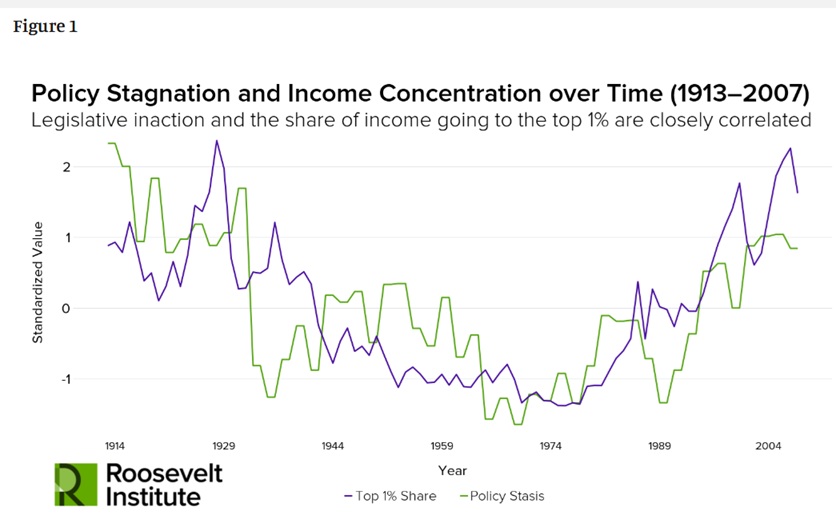
If we examine the relationship between policy stagnation and income concentration over time, we see patterns that are consistent with this claim. In Figure 1, we plot government inaction (policy stasis) and income concentration in the US.17 We measure income concentration as the fraction of total market income, including capital gains, that goes to the top one percent of tax filers. We measure policy stasis by analyzing legislative productivity—defined broadly as the amount of policy made by the legislature and signed into law by the president during a congressional term—throughout the history of the US Congress. Unlike typical measurements of legislative productivity, however, which either consider all public laws enacted by Congress and weigh them equally, or focus just on blockbuster legislation, the dataset we use in Figure 1 combines the two approaches by weighing all enacted legislation by importance. Importance, in turn, is captured via lists of legislation identified by historians and political scientists. By taking the weighted average of multiple measures of important legislation and general measures of legislation, we can generate an index, an indicator of how much policy action is happening at various points in time. To then illustrate policy inaction, a measure of legislative productivity at any given point in time can be inverted, as is depicted in Figure 1.
The data in Figure 1, which begins in the early 1900s and spans nearly a century, shows a clear and robust18 correlation: When policy stasis increases, inequality rises; when policy action increases, inequality falls.
Further statistical analysis suggests this pattern isn’t just coincidence. If we estimate more rigorous models of the relationship between policy stasis and inequality, we find that government inaction makes inequality worse, and growing inequality, in turn, makes government even more hesitant to act. In other words, the two reinforce one another, creating a vicious cycle. This finding does not prove causality and it by no means suggests unicausality. In other words, institutional and policy shifts in the latter half of the 20th century likely also contributed to policy stasis. What we are arguing is that rising economic inequality appears to be both a cause and an effect of policy stasis—one among many, but still a critical one for understanding how we got to our current political moment.
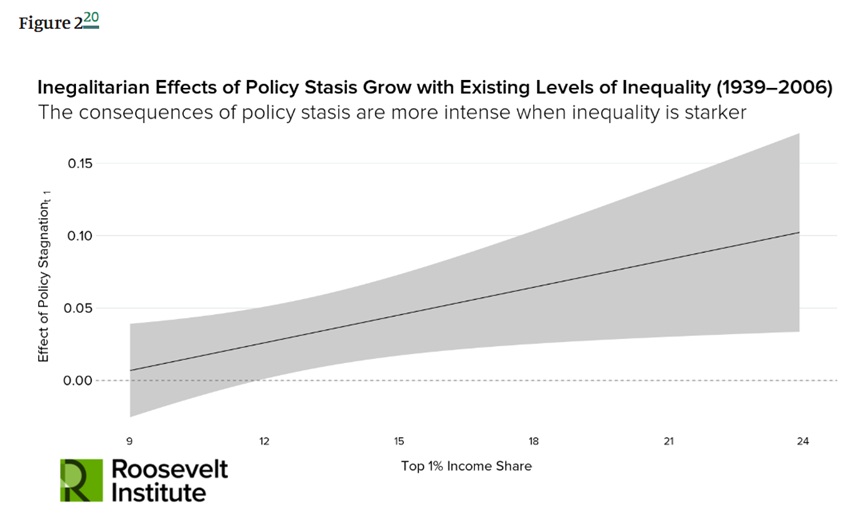
Figure 2 sheds further light on the relationship between policy stasis and income concentration by taking into account existing levels of inequality in the US between 1939 and 2006. Controlling for a range of possible explanatory drivers, including partisan control, specific monetary, tax, and regulatory policies, and socioeconomic factors,19 we find that the effect of policy stagnation on inequality varies depending on the existing level of income concentration. That is, when inequality is relatively low, government inaction doesn’t have any statistically discernible effect on income concentration; inaction simply preserves an already relatively equitable distribution of income. But when inequality is at moderate to high levels, the picture changes dramatically: Policy stasis drives inequality higher by protecting the advantages of those at the top. In these moments, aggressive policy action is needed to curb rising inequality, as doing nothing doesn’t keep things “neutral” but instead deepens existing economic divides. In other words, in the absence of government taking action, the status quo tends to perpetuate itself when wealth is highly concentrated. Policy gridlock, in these instances, effectively works as a shield for the rich, locking in their advantages.
This finding points to something that many accounts of rising inequality tend to overlook. Discussions of distributional outcomes usually focus on proximate causes, such as which party controls government, whether the minimum wage has kept pace with productivity, and the declining power of labor unions. While these variables surely play a role in mounting inequality and must be addressed, our finding suggests that prior to these factors is an institutional structure that shapes who gets what in the American economy and whose consequences grow more severe the longer inequality is permitted to rise.
Only proactive policymaking aimed at tackling the antidemocratic features of our institutional structures has the potential to disrupt this cycle and create a more level playing field. But as we discuss next, not only is policy action exceedingly difficult given our institutional configuration, but even when policy change does manage to work its way through the system it often favors the wealthy at the expense of ordinary Americans.
Bipartisan Policymaking Is Increasingly Focused on Elite Economic Interests
That the US policymaking system is biased toward the status quo does not mean that new policy is never enacted. In fact, even in a polarized environment with institutions requiring extraordinary levels of consensus, policy activity still happens. And despite a common perception that bipartisanship is dead, most enduring policy changes are produced through bipartisan cooperation.21 It therefore becomes important not only to identify how structural policy stasis shapes the balance of power between competing economic groups, but also to examine how the need for bipartisanship in the policy process changes who is more likely to get what they want when policy change does happen.
Without the ability to enact major new policies, legislators may seek to produce other visible accomplishments. In practice, this may mean concentrating on relatively uncontroversial and low-stakes measures—such as maintaining existing institutions or carrying out administrative upkeep—rather than tackling divisive economic reforms.22 Post offices continue to be named, resolutions honoring constituents remain common, and Congress focuses on short-term spending bills. Even if the volume of legislative activity looks comparable, the substance tends to shift: Policy efforts are more likely to focus on routine functions, rather than ambitious, substantive action. This kind of limited policymaking stops short of outright paralysis, but it also fails to deliver the transformative change needed to challenge deeply rooted inequalities that only benefit the wealthy.
The configuration of the interest group system also plays a significant role in determining the kinds of issues that make it onto the agenda and the policy outcomes that emerge. Two developments stand out: Rising economic inequality has given those with substantial wealth greater capacity to exert political influence at the same time that the decline of organized labor has weakened a key institutional voice for working- and middle-class Americans. Although affluent actors have long had strong advantages in shaping policy, their leverage has grown even more as unions have lost strength. These shifts have also pushed politicians to lean more heavily on affluent donors, which in turn leaves them more vulnerable to upper-class influence in policy priorities and preferences, especially when it comes to economic policymaking.23
Even when Congress isn’t passing bold new laws, bipartisan dealmaking—in which cross-party concessions occur through a negotiation process—still happens. The key question is: What kinds of laws actually get passed? In today’s political climate—marked by rising inequality, sharp partisan divides, and weakened influence of working-class groups—compromise on the part of policymakers tends to focus less on big, substantive policies and more on issues that either protect elite interests or avoid major economic change. Even some of the most ambitious pro-worker federal legislation in recent memory falls prey to this dynamic by preserving elite interests and avoiding major economic reforms that would fundamentally rebalance power toward ordinary Americans. The Infrastructure Investment and Jobs Act of 2021 was a substantial piece of legislation that made major investments designed to help a broad swath of Americans, but there was plenty for big construction firms, telecommunication and transportation companies, manufacturers, and other major corporations to like in the bill as well. The CHIPS and Science Act of 2022 won support from both parties, in part by including substantial subsidies for private industry and to support US manufacturing.
We can see this shift in lawmaking toward the interests of economic elites if we examine how the share of income going to the top 1 percent relates to lawmaking across three areas over time: (1) economic policy, like taxes and spending; (2) the basic functioning of government, such as budgets and civil service rules; and (3) crime and immigration.
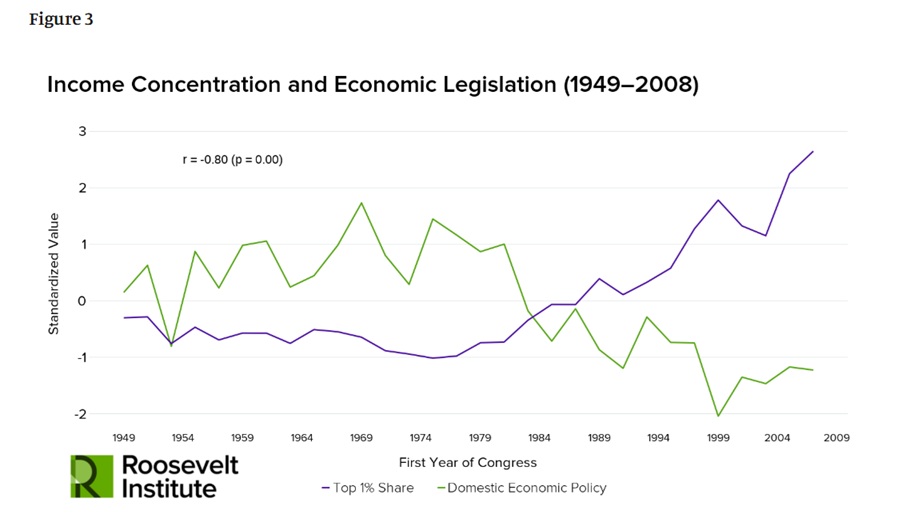
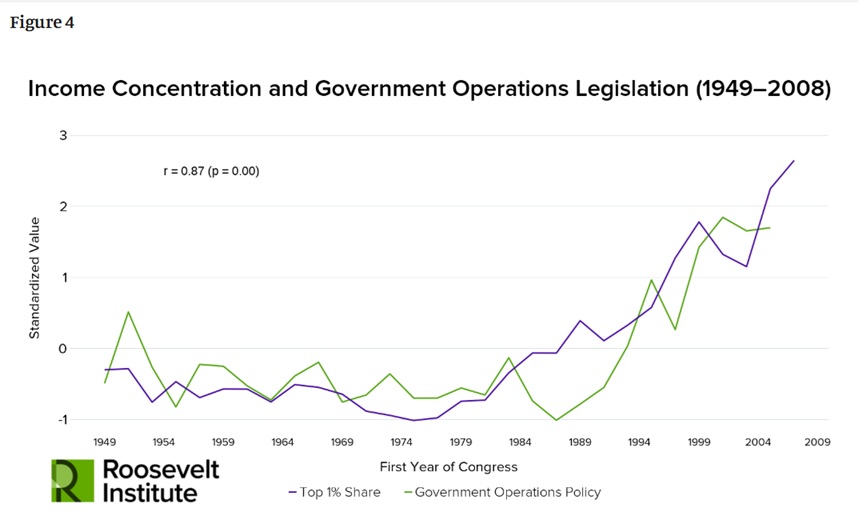

The results, shown in Figures 3 through 5, are striking. Figure 3 reveals a significant negative relationship24 between income concentration and domestic economic policymaking. That is, when inequality is higher, Congress passes fewer major economic laws—the kinds of policies that could reshape how wealth and resources are distributed. Instead, as Figure 4 shows, when inequality is high lawmakers tend to focus their policy action on matters related to government housekeeping, passing bills concerned with funding procedures, procurement, appointments, and oversight, for example.25 These are important tasks, but they do not change people’s economic prospects.
At the same time, as illustrated in Figure 5, rising inequality is linked to more policymaking on crime and immigration—issues that often capture public attention but do not challenge the economic status quo, at least not in a way that helps average Americans.
The evidence points to a clear trend: When inequality is high, lawmakers shy away from passing measures that could significantly alter the economic balance. Instead, much of their legislative work turns toward routine government functions that, while necessary, have little impact on economic outcomes. They also devote attention to high-profile topics such as crime and immigration, which can draw public focus away from inequality itself. Looking at policy through this lens shows that even though bipartisan cooperation doesn’t disappear in times of deep inequality and partisan divide, the kinds of issues that attract cross-party agreement shift. Legislative activity persists, but it is less likely to challenge the existing economic order.
The extraordinary difficulty of enacting policy change in the United States produces a system with a strong bias toward the status quo. As our economy has become more unequal, the status quo bias has concentrated both economic and political power in the hands of a small set of elite actors. Building a more inclusive economy and democracy will require reforming the rules of the political system itself so that democratic majorities can translate preferences into policy.
Conclusion: Elevating Institutional Change on the Progressive Agenda
The US policymaking system makes broad consensus essential for policy success, which in turn makes progressive policy change much more difficult in the US than in many other countries. Even when policymaking is successful, it is likely to be tilted toward the interests of economic elites given existing power imbalances.
Those who wish to reshape the American economy in ways that would produce more broadly shared prosperity must also consider fundamental reform of US policymaking institutions as a core part of their agenda. Just as importantly, those who are committed to wresting our democracy out of the hands of oligarchs and putting democratic institutions on more stable footing must pay attention to economic inequality.
The status quo bias and various rules of the game that undermine majoritarian policy processes in the US, if left as they are, create a major handicap not only for progressive policy change but for a functioning democracy.