
Population Growth and Change
The changing population i terms of older versus younger people or labor will or could have a significant impact on the United States. If you remember, Angry Bear had posted on the issue several times. One of those commentaries was “300 Million and Counting” by Joel Garreau (written in 2006). Replacement rate then was at 2.01. Today’s replacement rate is ~1.63.
Will we need younger citizens as the baby boomers pass onward? More likely than not, as Labor input will still be vital and as such adds value to a product. Immigration is one way to add to the Labor pool. I will add more of this as I think about it. I need to stop for a while.
“Population Growth Is Slowing. What That Means for the Budget,” Peter G. Peterson Foundation
Why Does Population Change Matter for the Federal Budget?
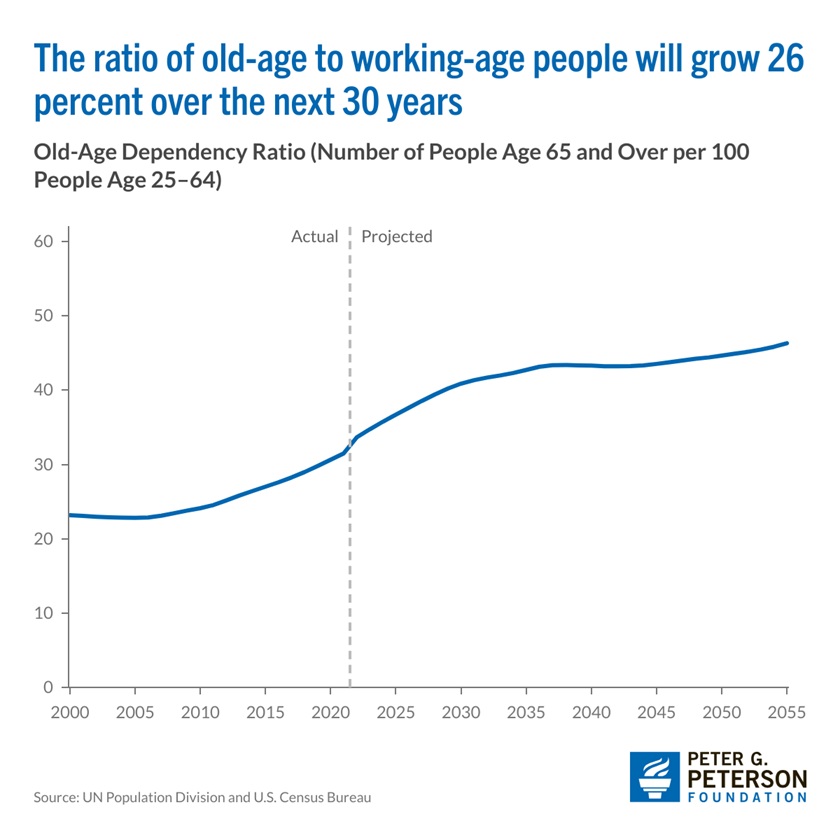
As natural change restrains population growth, the U.S. population will grow older, on average. An older population means that the ratio of people 65 and older to working-age people (25–64), called the old-age dependency ratio, will be larger. In 2025, the Bureau projects there will be 37 people age 65 or older for every 100 working-age people; by 2055, that ratio will have grown to 46 people age 65 or older per 100 of working age (an increase of 26 percent). As the old-age dependency ratio increases, it will pose a greater fiscal and economic challenge for the United States by putting pressure on programs like Social Security and Medicare as well as on the labor force, which could make economic growth more difficult.
A Slowdown in the Labor Force Could Strain Economic Growth
Reduced population growth could affect the U.S. labor force and put pressure on economic growth. Because the labor force is a subset of the population, a declining growth rate tends to signal a declining labor force participation rate. That is important because labor force growth is an integral component of economic growth.
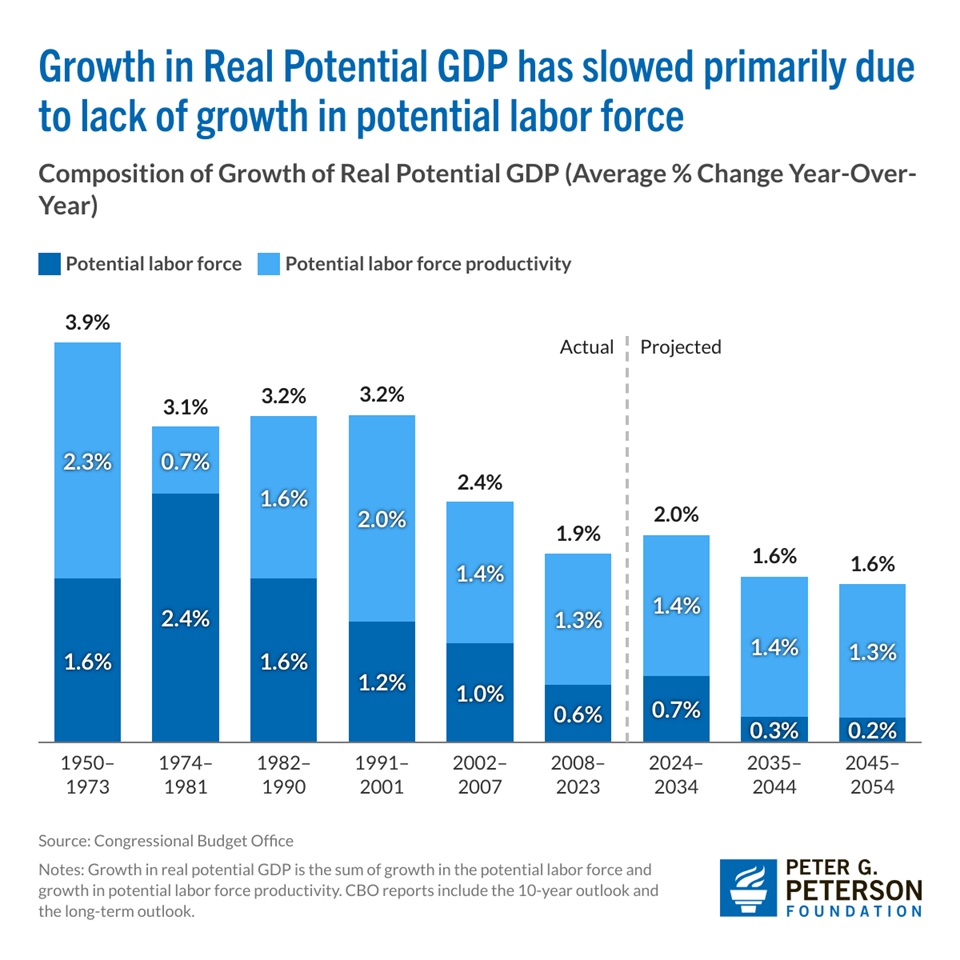
From 1950 through 2007, growth in the potential labor force accounted for roughly half of all growth in real (inflation-adjusted) potential GDP (a measure of the maximum sustainable output of the economy). From 1983 to 1993, the labor force grew by an average 1.5 percent each year and real GDP grew at an average annual rate of 3.4 percent. However, since the late 2000s, growth in the labor force has diminished — and with-it growth in real potential GDP. From 2013 to 2023, the labor force grew by half of the earlier rate (0.7 percent, on average) and real GDP rose by an average annual rate of 2.3 percent (a full percentage point lower than in the 1983-1993 period).
The Congressional Budget Office projects that growth in the potential labor force will continue on that trajectory, remaining lower over the next 30 years. Slower population growth, diminishing fertility rates, and generally restrained immigration have contributed to the slowdown in potential labor force growth, and that could lead to the U.S. labor force beginning to decline in the next few decades. In the upcoming decade (until 2035), the labor force and GDP are projected to grow at smaller rates than historical averages — 0.6 percent and 1.8 percent, on average annually, respectively.
In fact, the Census Bureau projects that 2054 will mark an inflection point for working-age people in the United States, when the number of people ages 18 to 64 will — for the first time — begin to decrease. That could put a strain on economic growth as less labor is available and, as a result, make growth even more dependent on gains in productivity. In all, an aging population with slower labor force growth could worsen pressures on the budget as revenues are restrained.
The Aging of the Population Will Put Pressure on Social Security and Medicare
Social Security and Medicare are the largest programs in the federal budget, accounting for just over a third of all federal outlays in 2024. Spending on the programs will increase as the population ages and the number of individuals age 65 or over grows. Further, both Social Security’s Old-Age and Survivors Insurance (OASI) and Medicare’s Hospital Insurance (HI) trust funds are financed through payroll taxes, which ties funding for the programs to wages.
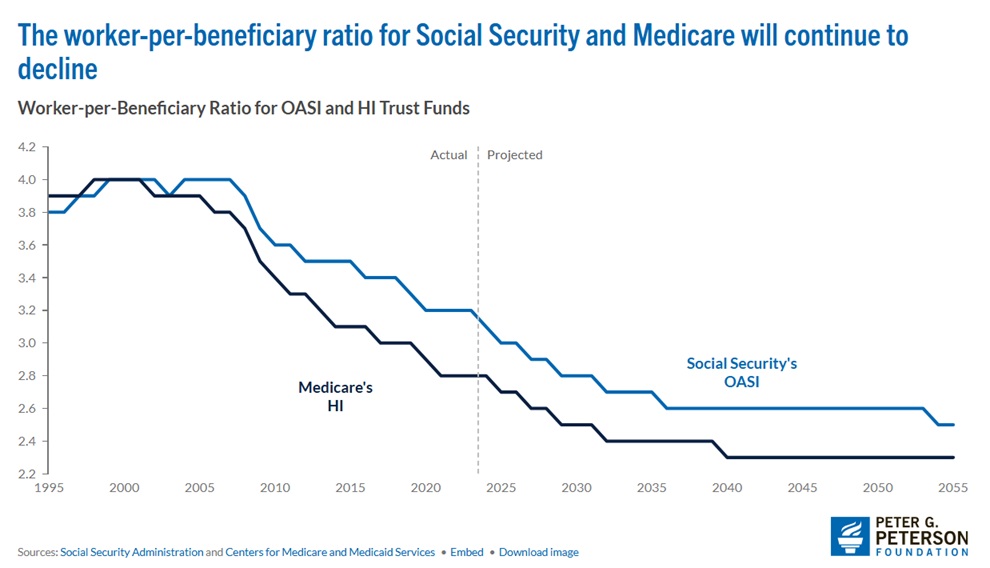
As the number of retirement-age individuals accelerates and growth in the working-age population slows, the ratio of workers to beneficiaries will decrease. As a result, the federal government’s ability to continue to finance those programs through traditional means will become more daunting. In 1995, there were about four covered workers for every OASI and HI beneficiary. Both the Social Security Administration and the Centers for Medicare and Medicaid Services project that in 2025 there will be about one less worker for every beneficiary. Over the next 30 years, the worker-to-beneficiary ratios are projected to again decline by about one worker for both programs, leaving only two covered workers for every beneficiary. The Social Security and Medicare trust funds are already facing depletion in the near future, and the aging of the population will only continue to put pressure on the financing of the programs.
Conclusion
Over the next 30 years, the United States faces an aging population and a slowdown in population growth. Understanding how demographic challenges contribute to the United States’ fiscal challenges can help policymakers adopt fiscally sustainable policies. Adopting policies now that strengthen social programs for the future is a responsible, forward-looking approach to those challenges, and a menu of options are currently available that can solidify the United States’ fiscal and economic outlook.
Population Growth Is Slowing — What That Means for the Budget