
Alabama Pushes Through a Change in Voting Districts and SCOTUS Says Ok
Rather than saying no, SCOTUS allows Alabama to realign voting districts thereby disenfranchising minority Americans
“Shame and the Supreme Court”
Civil Discourse with Joyce Vance
Tuesday was primary day in Alabama. There were contested races in both parties. The marquee gubernatorial race drew significant interest, with more than five candidates competing on the Democratic side, led by former Senator Doug Jones. Senator Tommy Tuberville easily led a three-candidate field on the Republican side. There was also a fierce battle for Tuberville’s open Senate seat, with multiple contenders in the race. Other contests on the ballot included several congressional races. Following the Supreme Court’s decision in Milligan three years ago, Democrats held two of the state’s seven congressional seats.
Everything was set months ago. Then the Supreme Court decided Callais, undoing progress made under Section 2 of the Voting Rights Act, which prohibits voting practices or procedures that discriminate on the basis of race. To add insult to injury, the Court rushed to allow the rollback of the very progress the conservative majority had previously signed off on—on the eve of Alabama’s primary election.
The Supreme Court has permitted white voters to benefit from a ruling in precisely the same way it has used the so-called Purcell principle to deny Black voters the benefit of changes in the law: by speeding the ruling into effect. It allowed uncertainty to permeate the process. Even Republicans, including former Alabama House member and longtime political commentator Steve Flowers, conceded before Election Day that confusion could depress turnout.
“I think there will be low turnout for two reasons,” Flowers said, identifying the first as “the redistricting thing has confused people.”
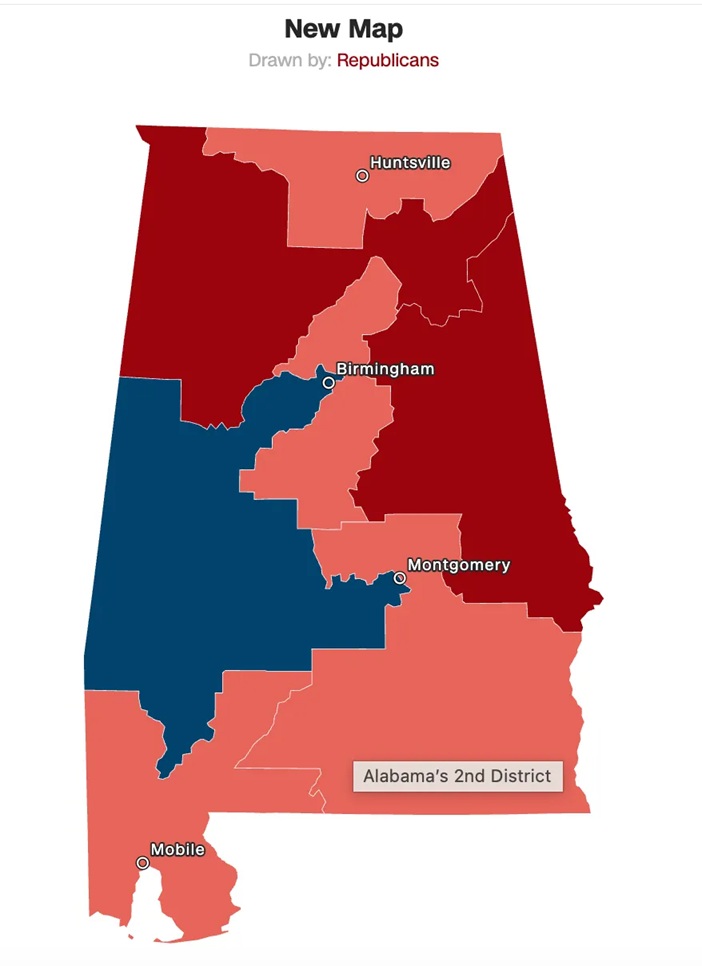
Alabama rushed to adopt a map that would gerrymander the second Black opportunity district—the district the Supreme Court had only recently ordered the state to create—out of existence. In response, the Black voters who had been plaintiffs in the lawsuit that led to the creation of the second district returned to the Supreme Court, asking it for a stay to prevent a change in maps so close to the election. The Supreme Court ruled against the plaintiffs’ request in less time than it would have taken to fully read their moving papers. The justices then remanded the case to the panel that heard Milligan, two Alabama district judges and an Eleventh Circuit judge, for a decision consistent with Callais.
The panel did not issue a hasty ruling; the matter is still pending. It has been meticulous and careful in its work all along. Perhaps, when the judges rule, they will simply conclude that Callais compels them to overrule their earlier decision and permit Alabama to return to using maps that leave Black and brown voters with a realistic chance of electing their preferred candidate in only one of the state’s seven congressional districts.
There is another possibility. Justice Sotomayor noted it in her Callais dissent: “As with all vacaturs of this kind from this Court, the District Court remains free on remand to decide for itself whether Callais has any bearing on its Fourteenth Amendment analysis or if its prior reasoning is unaffected by that decision.” In other words, the panel could conclude that Callais does not change the outcome in Milligan. The panel found evidence that the Alabama Legislature intentionally discriminated on the basis of race, which could arguably place this case on a different legal footing. But even if that happens, the process is already underway, with the legislature able to move quickly to use maps that discriminate against Black voters.
The Purcell case gets mentioned frequently in discussions about voting rights, and it is worth taking a moment to examine it more closely. Purcell v. Gonzalez concerned a 2002 Arizona ballot initiative approved by Arizona voters. Proposition 200 required voters in Arizona to provide proof of citizenship when registering to vote and identification when casting a ballot on Election Day.
The Supreme Court explained that Proposition 200 didn’t “necessarily result in the turning away of qualified, registered voters by election officials for lack of proper identification.” That was the case because these voters could cast conditional provisional ballots, and so long as they returned and provided identification within five days, their ballot would count. Furthermore, voters without identification could instead vote early, when no identification was required, because “The State has determined that, because there is adequate time during the early voting period to compare the voters’ signatures on the ballot with their signatures on the registration rolls, voters need not present identification if voting early.”
This was back in 2006, before the Supreme Court gutted Section 5 of the Voting Rights Act in Shelby County v. Holder. Arizona was a “covered jurisdiction,” so it had to submit its new plan to either a court or the attorney general for preclearance before it could put its new measure into effect. It submitted to DOJ and the AG cleared it. That’s how the Purcell case came to be.
A group of plaintiffs that included Arizona residents, Indian tribes, and various community organizations sued. They sought a preliminary injunction to prevent the ID measure from going into effect, but the district judge denied their request. The plaintiffs then appealed to the Court of Appeals and asked for an injunction that would block the use of the new procedures in the upcoming election. The Court of Appeals granted the injunction.
The Supreme Court stepped in, removing the injunction and allowing the stepped-up measures for identification to be used in the upcoming election. “Court orders affecting elections, especially conflicting orders,” they wrote, “can themselves result in voter confusion and consequent incentive to remain away from the polls. As an election draws closer, that risk will increase.” So, they concluded in the case at hand, “In view of the impending election, the necessity for clear guidance to the State of Arizona, and our conclusion regarding the Court of Appeals’ issuance of the order, we vacate the order of the Court of Appeals.” Voters had to comply with heightened identification requirements in the upcoming election, even as the Court acknowledged it could make it more difficult to vote.
The unanimous decision in Purcell is now routinely cited for the proposition that federal courts should not issue last-minute injunctions or change election rules close to an election because doing so creates uncertainty, disrupts election administration, and risks confusing voters. It wasn’t until 14 years after it was decided, in 2020, that the Court used the phrase “Purcell Principle” in a Wisconsin case about delayed mail-in ballots during Covid. They wrote that “federal courts should ordinarily not alter the election rules on the eve of an election.” But clearly, that principle applies only when white voters stand to benefit. Purcell is apparently a double standard, not a legal standard; one that only applies when “non-Black” voters’ interests are at stake.
What happens at the Supreme Court doesn’t stay at the Supreme Court. It shapes who votes, whose rights are protected, and whether the rules apply equally to everyone. If you value careful analysis that goes beyond the headlines and explains what the Court is actually doing—and why it matters—I hope you’ll keep reading Civil Discourse. There is nothing more important right now than being part of a community that is committed to country over party and facts over membership in a cult of personality. If you aren’t already, I hope you’ll become a paid subscriber and support this work.
We’re in this together,
“Disenfranchising” is pretty clearly an incorrect description of what Alabama is doing. Voting is an individual right, not a collective one. It was racist beliefs that the vote did have a collective character that was the cause of enacting the VRA. If a voter can vote on equal terms with other Alabamans then the voter is not disenfranchised. This districting fight has nothing to do really with the right to vote. You don’t have to look back that far really to see that even the Georgia voting reforms – which actually impacted how voting occurs – never had the “Jim Crow” impact on Black voters (or non-Black voters, for that matter) that critics said it would. It also a bit of a head-scratcher that anyone would attribute low turnout to districting issues in the same post that the Governor’s race and the open Senate seat resulting because the incumbent Senator is running for Governor are highlighted as the “marquee” offices to be voted on.
The legal issues on timing seem valid and this is a struggle between Republicans and Democrats. But nobody is getting disenfranchised. People who might have voted for a winning candidate now might vote for a losing one. But the data will show that there will be an offset to that the other way and, in any case, voting for a non-winner is not unique to minority voters at all and never is thought of as a disenfranchisement for other groups. This is proper, since voting is not a group activity.
A last observation is that Wisconsin Democrats would very much like to redistrict Milwaukee county in a manner to consciously lower the Black voter fractions in state assembly districts, specifically west of I-43 and north of I-94 and on into the three adjoining counties. The current districts resemble the districting Alabama had under the old system but if an advantage is to be had by diluting the Black vote, well that’s fine I guess.
Eric:
The topic is Alabama. By crowding Black Americans into one Congressional District, Alabama eliminates a Congressional District represented by a Black American. We are not discussing Wisconsin.
“The latest SCOTUS ruling, issued late Tuesday, cleared the way for Alabama to use a congressional redistricting map that favors Republicans and white Alabama by eliminating one of the two existing districts where voters had elected a Black Democrat to Congress.”
It is pretty simple, plainly done, and overt discrimination as ok’d by a nineteenth century SCOTUS. Purposely crowding a people of different origins, monetary wealth, or color into one district to purposely eliminate a representative similar in origin to them for a majority representative is no discrimination? Who would have thought? Just Alabama Republicans and you.