
Wealth and High Income Taxation
Taxing Wealth and High Incomes, Econofact
– by Christopher Towe
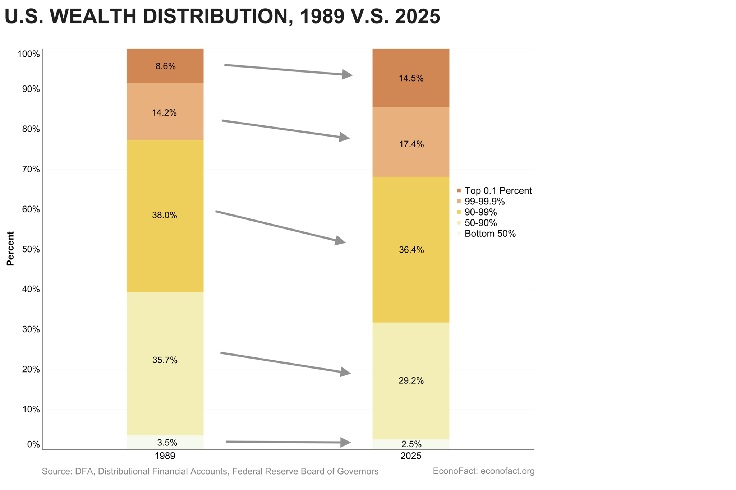
What you are seeing here is the growth in the percentages of citizens who make up upper income brackets. In this case, we are looking at the 1 tenth of 1% of the population and hold 14.5% of the wealth in the United States and the growth of their wealth since 1989. There are reasons for this growth outside of an expansion of the population of this group. Their wealth has almost doubled (shy by a few percent). Portions of the wealth is taxed at a lower percentage.
Saying this in another way so we understand what Econofact is portraying: “1 percent of Americans own as much wealth as the total wealth held by the bottom 90 percent.” There is a link in this one which will take you to more detail.
Taxing Wealth and High Incomes
Income and wealth inequality have widened steadily since the mid-1970s. The United States is now considered one of the most unequal countries among its OECD peers. Currently, the wealthiest 1 percent of Americans own as much wealth as the total wealth held by the bottom 90 percent. At the same time, U.S. billionaires are estimated to pay a smaller share in taxes than the average American; roughly 24 percent compared with 30 percent. This has generated a political backlash – for example, in November California will vote on the 2026 Billionaire Tax Act, a ballot initiative that would impose a one-time 5 percent tax on billionaire wealth. This Weekend Reading describes policies to tax high income and high wealth.
Supporters of a wealth tax argue that it could help reduce inequality while generating additional public revenue. But there are challenges associated with the implementation of a wealth tax, as outlined by Christopher Towe in The Wealth Tax Debate. These include legal and administrative barriers and the risk that wealth will be moved out of the reach of tax authorities. Towe suggests that reforms within the existing tax system may be more practical and effective than implementing an entirely new wealth tax structure.
The issue of taxing wealth will become even more important in the next decades. In a new EconoFact Explainer, How Should the U.S Tax the Great Wealth Transfer? Bill Gale and John Sabelhaus discuss the increase in net wealth that can be bequeathed from 270% of GDP in 1997 to 465% in 2021.
Almost all of this accrued to households aged 55 and older and three-quarters of the increase went to the wealthiest ten percent of households. Many wealthy individuals can reduce or avoid taxes through legal loopholes and planning strategies. Gale and Sabelhaus expand on Towe’s point of reforming the existing tax system, such as through changes in the estate tax, closing the loophole on unrealized capital gains, and an inheritance tax. These changes could raise substantial revenues and could contribute to addressing federal deficits and the large federal debt which is currently about 100% of national income.
Gale and Sabelhaus discuss how the upcoming transfer of wealth to the heirs of the wealthiest Americans will (under the current tax system) maintain family dynasties and expand absolute wealth differences among households in the recipient generation. Limited intergenerational changes in wealth have been a notable feature of the American economy, as discussed by Steven Durlauf in “How Much Does Income Change from One Generation to the Next”. He notes that the United States demonstrates lower levels of economic mobility than many other high-income countries. While it could be that children of the rich and wealthy have more inherent skills and abilities, an interesting analysis of intergenerational wealth suggests this is not a primary reason. Sandra Black, Paul Devereux, and Kaveh Majlesi disentangle the nature vs. nurture sources of intergenerational wealth in How Does Wealth Beget Wealth? Evidence from Sweden. Analyzing the wealth of adopted children, their biological parents, and their adoptive parents. They find children with wealthy parents benefit not just from good genetics but, more importantly, from growing up with more advantages.
Related to the issue of taxing wealth is the taxation of high incomes. Gale discusses this in the podcast “How the tax system favors the very rich and what to do about it”. He points out that while the tax rate on income is generally progressive, this is not the case for the very highest income households whose income largely comes from capital gains, dividends or pass-through income rather than wages. Kimberly Clausing also addresses this issue in “Taxing the Rich.” She emphasizes taxes on capital are an important component of effectively taxing wealthy households.
The political debates about how taxing high incomes and wealth, and the likely consequences for inequality and fiscal sustainability, need to be informed by good analyses (like the ones discussed here) to make new policies equitable and effective.
There is a longer version to this piece which can be found here. “The Wealth Tax Debate,” Econofact.