
Data Centers and Water
Not sure why. They are building in Arizona. I would think Arizona would be one of the last places to build a data center as water is not abundant, There are water issues here. Surface water is drying up.
It’s no secret Arizona is worrying about its water. The Colorado River is drying up, in part due to climate change, and groundwater aquifers are running dry. Some of the state’s biggest industries are suffering as a result. Farmers are ripping up cotton and alfalfa fields. Some home developers have been blocked from building new subdivisions.
A state with hydrologic woes of this magnitude would seem an unlikely place to attract new factory-scale industries. These industries have substantial water appetites, Over the past year this what is exactly happening. So-called hyperscale tech companies like Microsoft and Meta have swarmed in to build the data centers fueling the artificial-intelligence boom, and the Taiwan Semiconductor Manufacturing Company has spent billions of dollars on a factory complex outside Phoenix. This rapid development has triggered fears the industry will suck up the finite water supplies available to residents of Phoenix and Tucson. Grist
So far, however, these predictions have not come true.
Citing ‘Irreversible Harm,’ 100+ Groups Urge Congress to Reject Rushed Data Center Approvals
Congress must not let Big Tech block oversight and hide data centers’ real harms from the public, including their immense energy and water use, dangerous pollution, and rising local costs,” said one campaigner.
Brett Wilkins @ Common Dreams
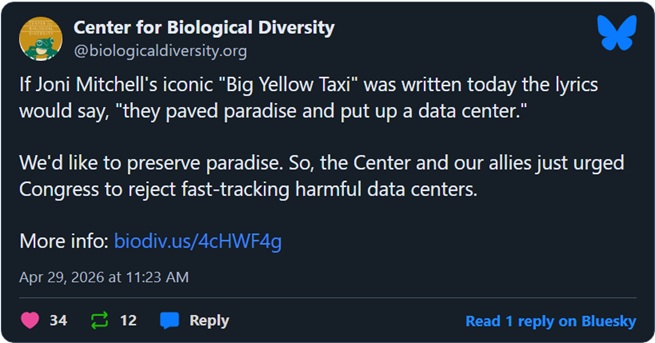
Nearly 120 civil society groups on Wednesday urged US lawmakers to reject Republican-led efforts to fast-track approval of artificial intelligence and conventional data centers, including by slipping provisions for these facilities into permitting reform legislation or “must-pass” bills.
Fossil fuel companies “are pushing to fast-track data center build-outs while ignoring the impacts on communities and the environment,” the groups said in a letter to congressional leaders. “Proposals disguised as ‘commonsense’ reforms would weaken the National Environmental Policy Act (NEPA), the Clean Water Act, the Clean Air Act, and the Endangered Species Act, while also stripping residents of their right to participate in decisions affecting their health, water, and air.”
“Congress cannot allow these industries to externalize costs while claiming progress,” the letter states. “Lawmakers must prioritize public health, environmental sustainability, and community resilience, and reject rollbacks that hand corporations unchecked control over land, energy, and local resources.”
The groups further called on lawmakers to eschew inclusion of data center provisions in “must-pass” legislation such as appropriations bills, the National Defense Authorization Act, Water Resources Development Act, and Farm Bill.
“Our democratic process was sidelined when our most powerful leaders both elected and unelected championed a data center while community voices were shut out,” said LaTricea Adams, CEO and president of Young, Gifted & Green, a national civil and environmental justice group that signed the letter.
Young, Gifted & Green is one of the frontline groups fighting Colossus, an enormous Memphis data center operated by Elon Musk’s xAI to train its Grok AI chatbot using over 100,000 Nvidia H100 graphics processing units. The NAACP and Southern Environmental Law Center are suing xAI for alleged violations of the Clean Air Act related to the massive facility.
“What happens in Memphis can happen in cities and states across the country,” Adams said. “We need the US Congress to do its job now to preserve and protect our rights as constituents and fight for our democracy.”
The letter’s signers include 350.org, the Center for Biological Diversity, CodePink, Food and Water Watch, Friends of the Earth, Greenpeace USA, Oil Change International, Third Act, Turtle Island Restoration Network, Waterkeeper Alliance, and more than 100 other organizations.
The groups’ letter comes as more and more communities are successfully opposing the proliferation of data centers across the nation. In Maine, state lawmakers recently passed legislation that would have enacted the nation’s first statewide moratorium on AI data centers had Democratic Gov. Janet Mills not vetoed the move.
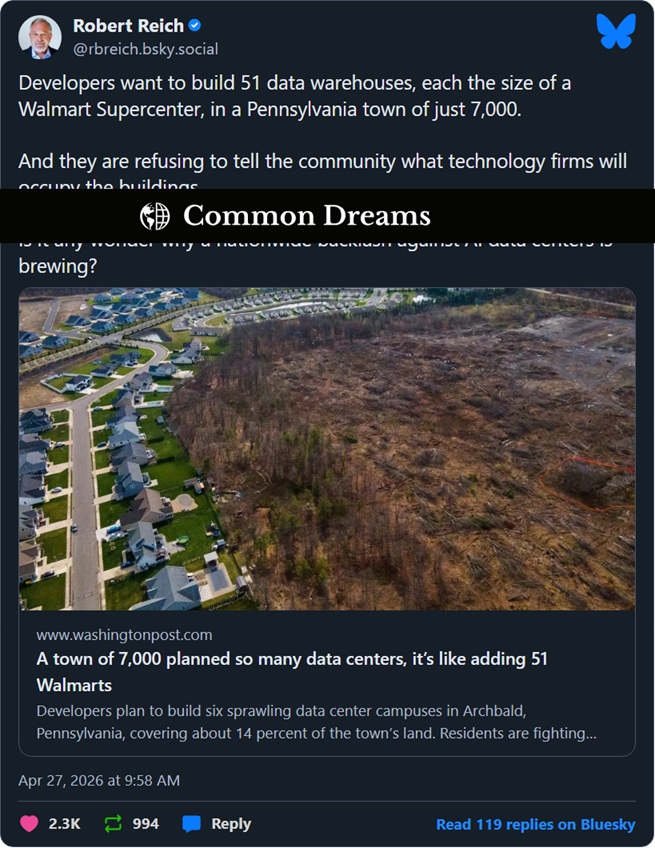
At the federal level, Sen. Bernie Sanders (I-Vt.) and Rep. Alexandria Ocasio-Cortez (D-NY) last month introduced a bill for a national moratorium on AI data centers “until strong national safeguards are in place to protect workers, consumers, and communities, defend privacy and civil rights, and ensure these technologies do not harm our environment.”
Center for Biological Diversity senior climate and energy policy specialist Camden Weber said in a statement Wednesday that “Congress must not let Big Tech block oversight and hide data centers’ real harms from the public, including their immense energy and water use, dangerous pollution, and rising local costs.”
Adding: “Data center giants spend consumers’ money to gut regulations, buy up utilities, and avoid accountability, enriching billionaires while shifting risks to everyone else. Members of Congress are supposed to represent their communities, not strip the people who elected them of the power to protect themselves from these massive operations moving into their neighborhoods.”