
Restoring Faith in America’s Healthcare?
One year later and I am still listening to someone who had worms in his head . . . or did have them or one that was dead. It i difficult to listen to him. While there was no chance of him winning the presidency, he did run for the spot. I can only imagine. He did get ~750,000 votes for the presidency. He did not cause Kamala to lose. It was the approximate three million votes that did not happen in 2024 but did in 2020. Dave Leip keeps accurate counts for each election.
“Palace Tremors, RFK’s Health [S]Care in ER, & Frederick Douglass Carries the Freedom Banner,” Kareem Takes on the News
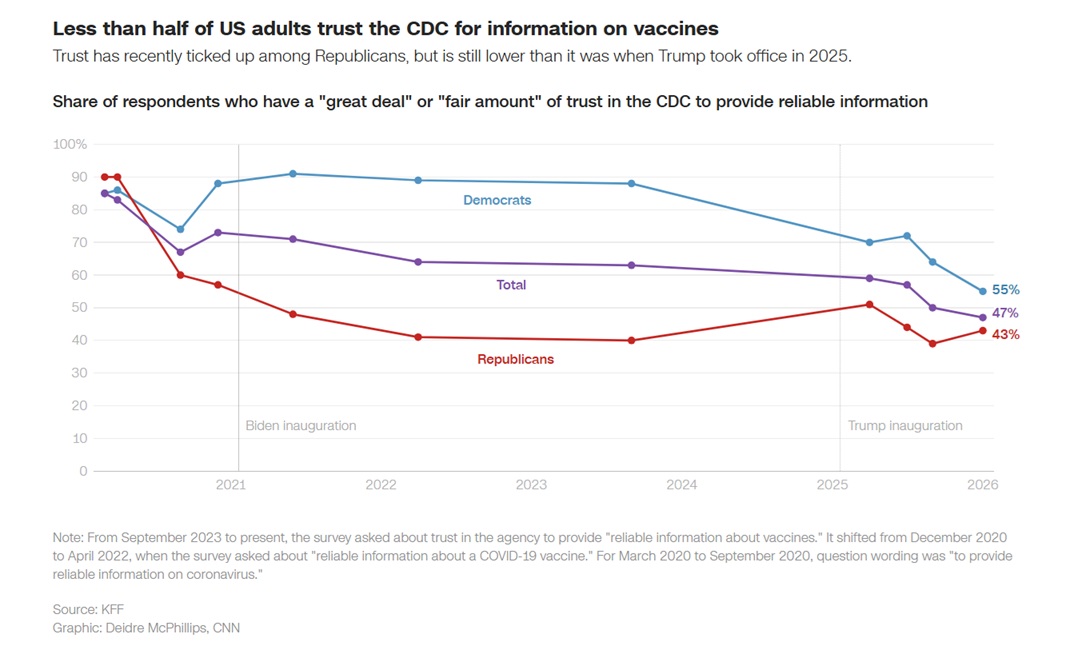
“Trump promised RFK Jr. would ‘restore faith in American health care.’ A year in, trust has plummeted” (CNN)
“Our public health system has squandered the trust of our citizens,”
Summary: One year after Robert F. Kennedy Jr., was sworn in as Secretary of Health and Human Services, polling shows public trust in government health agencies has fallen sharply, the opposite of what President Trump promised. On February 13, 2025, Trump pledged that Kennedy would “lead our campaign of historic reforms and restore faith in American health care.” According to data from the health policy and research group KFF, trust in the CDC as a reliable source of health information has dropped from 59% in April 2025 to 47% as of February 2026, with declines recorded across both political parties. His own trust rating stands at 37%, with only Trump scoring lower at 30% as a source of health information. Kennedy’s first year included the firing of all 17 members of the CDC’s vaccine advisory panel, a reorganization targeting approximately 20,000 HHS employees, three measles deaths, a reduction in routinely recommended childhood vaccines from 17 to 11, and the departure of two CDC directors. HHS spokesperson Andrew Nixon attributed declining trust to the Biden administration’s “inconsistent guidance” and said Kennedy, “is leading the most transparent HHS in history.” Public health experts quoted by CNN expressed concern that the damage to institutional infrastructure and vaccine confidence could worsen.
My Take:
Every now and then, a political moment hands us a ruler and says, “Go ahead and measure what we’ve done.” That’s what happened here. The administration didn’t have to set a clear benchmark. They could have kept things vague. Instead, they promised to “shake things up,” or “challenge the establishment.” They told the country that Kennedy would restore faith in American health care. And once you make a promise that specific, the public gets to check your work.
Six years ago, according to KFF, about 85% of Americans trusted the CDC on vaccines. Today, fewer than half do. That’s not a partisan talking point, as some would want you to believe. That’s the administration’s own report card.
And it’s not a good one.
Now let’s be honest: there’s a real audience for what Kennedy promised. A lot of people feel like doctors haven’t listened to them, or that pharmaceutical companies have too much influence over health policy. Those frustrations are real. I’ve spent enough time talking to people in communities across the country to know that distrust doesn’t come out of nowhere. But taking that frustration and turning it into a message that leaves people less protected…that’s where the harm begins. If you tell people that everything they’ve ever been taught about health is a lie, most won’t suddenly trust you more. They’ll just trust everyone less. A wrecking ball doesn’t become a renovation tool just because you paint it a different color.
That brings us to the CDC’s vaccine advisory panel, all 17 scientists fired on the same day. These are the people whose job it was to review vaccine evidence, the folks who made sure decisions were grounded in data rather than vibes. Kennedy fired them and then published an op‑ed titled “HHS Moves to Restore Public Trust in Vaccines.” That’s the kind of logic that would be funny if the stakes weren’t so high. As Dr. Sean O’Leary from the American Academy of Pediatrics put it, it’s like firing all the air traffic controllers and replacing them with people who don’t believe in flying.
This whole situation reminds me of Elia Kazan’s 1957 film A Face in the Crowd. Andy Griffith plays Lonesome Rhodes, a nobody who becomes a political kingmaker by pretending to be the only honest man in a corrupt world. Kennedy taps into that same energy, the crusader fighting the establishment. And for people who feel ignored or betrayed, that message hits hard. But in the movie, Lonesome Rhodes eventually gets exposed. In real life, Kennedy keeps getting exposed too, and somehow the damage keeps spreading anyway.
And then there’s the South Park moment. Kennedy posted a clip of the show to promote new dietary guidelines. Let’s ponder this for a moment. He used South Park to promote his vision of health..a show that has spent decades mocking everything, including public health officials. Meanwhile, children were dying of measles. And trust in the CDC dropped to 47%. And the show goes on.
I’ve spent a lot of my life talking about social responsibility. One thing I’ve learned is that you can’t treat human lives like “the cost of doing business.” That phrase belongs in boardrooms, not in conversations about preventable deaths. MMR vaccination rates have already fallen, leaving nearly 300,000 children at risk. You can’t trade children’s lives for political wins. Those aren’t equivalent currencies.
There’s no shortcut for what comes next. Rebuilding trust is a long, steady climb. Better messaging won’t fix the problem. You can’t build credibility on rubble and firing 20,000 people overnight without understanding that what you did is how you created the rubble in the first place. Trust has to be earned back one decision at a time. And the doubts that Kennedy has planted about vaccines will take years to undo, no matter who sits in the big chair.
I’ve played on teams where trust is everything. You can’t win championships if the locker room doesn’t believe in the system, the coach, or each other. Public health works the same way. When trust breaks, the whole team suffers. And right now, the country is paying the price for decisions made by people who’ll probably be out of office long before the consequences hit them personally.
Ha! The comment got published then disappeared.
@Eric,
I spammed your comment because it was off-topic. The topic isn’t Harris or the 2020 election. The topic is RFK Jr and America’s healthcare. Posting off-topic comments is hijacking the thread. Hijacking the thread is trolling. We don’t allow trolling here, and trolls are spammed.
I deleted your off-topic comment above for the same reason.
joel
this is a friendly comment from someone who agrees with you mostly. I don’t know how badly off topic comments hurt a site like this. my own feeling is that we out here can ignore “off topic” and on rare occasions learn somethng from them, and it is dangerous to stop the people we disagree with from presnting their point of view. I have learned to recognize the present provider of “off topic” to be someone probably not worth listening to, so unless he is is providing me with a chance to make my own brilliant comments, i just scan quickly and ignore. i think it may be a good idea for us to avoid the appearance of censorship.
@coberly,
I’m not worried in the least about the appearance of censorship. Trolls are the death of comment threads. I’ve been on many blogs over the past 20 years and seen it first hand. As long as I’m a moderator on AB, I intend to avoid that pitfall. People who consider it censorship are free to start their own blogs and implement their own policies.
Off-topic doesn’t mean I disagree or have a different point of view. There have been numerous comments I disagree with that I allow. Off-topic means hijacking the thread to a topic that isn’t related to the post.
Eric has been warned several times.
Joel,
fair enough, I hope, I have seen blogs where the not necessarily off topic, but purely lunatic, comments make any real conversation nearly impossible, so you are probably right. but do try to avoid the appearance of censorship. and do try to remain open to off topic that may lead to an unexpected solution to what the real topic was all about.
Keeping with my theory they’re publishing conspiracies so outlandish as to lump valid lines of inquiry as conspiracy, hence outlandish. I had a hard time trusting the gov’t before
Three card monte …
@Ten,
Outlandish *is* the point. RFK Jr and his minions aren’t interested in health or healthcare, they’re interested in sowing distrust in expertise and evidence.
Ten, and Joel,
you might be interested in scerpts about “the death of truth” in my post with AI about lies about SS.
sorry i cannot see the print size here will enough to correct my many typos. AI is really good at understanding what I meant.