
Billionaires Became $1.5 Trillion Richer
This is a nice piece explaining what is occurring with a small percentage of the US population. There is more to this than what is here. The tax breaks accumulated for those of the upper one percent are the result of Trump’s manipulation of tax laws. For example, Households with incomes in the top 1 percent will receive an average tax cut of more than $60,000 in 2025. As compared to an average tax cut of less than $500 for households in the bottom 60 percent, according to the Tax Policy Center (TPC) (an alternative source). As a share of after-tax income, tax cuts at the top (for both households in the top 1 percent and the top 5 percent) are more than triple the total value of the tax cuts received for people with incomes in the bottom 60 percent.
~~~~~~~
“U.S. Billionaires became $1.5 Trillion Richer in TRUMP’S First Year”
Americans tor Tax Fairness
Even as families struggle with unaffordable healthcare, housing and groceries, billionaires are flourishing in Donald Trump’s America: their total wealth jumped by over a fifth (22%) during 2025, rising from $6.7 trillion to $8.2 trillion, according to a new report from Americans for Tax Fairness (ATF) based on Forbes data. The number of billionaires also increased, from 814 to 935. And because of a gaping loophole, it’s possible none of their wealth growth will ever be taxed.
“It turns out the members of Billionaires Row at Donald Trump’s inauguration were right to celebrate his swearing in, since it meant a trillion and a half dollar increase in their class’s collective fortune,” said David Kass, ATF’s executive director. “Because of the Republican failure to renew premium tax credits, the cost of healthcare has skyrocketed this year for millions of families. Meanwhile, ordinary Americans cannot afford a decent place to live and every trip to the supermarket induces sticker shock. We could address the affordability crisis if billionaires paid their fair share of taxes on their wealth-growth income–thankfully there’s a bill in Congress from Sen. Ron Wyden (D-OR), Rep. Steve Cohen (D-TN), and Rep Don Beyer (D-VA) that would require them to do just that.”

Source: Americans for Tax Fairness analysis of Forbes data
The concentration of wealth reflected in the latest numbers is breathtaking. The world’s richest man, Elon Musk, is now worth over $700 billion, or more than the entire Forbes 400 list of richest Americans in 1997 (unadjusted for inflation). The 14 wealthiest billionaires at the beginning of 2026 are worth more than every American billionaire combined from as recently as 2020.
Under current law, the wealth growth of billionaires can escape taxation completely, even though it is their most important form of income. Unless they sell the underlying assets, the current recipients of that growth owe nothing. When the assets are inherited, those wealth gains simply disappear for tax purposes.
The Billionaires Income Tax introduced last year by Sen. Wyden and Reps. Cohen, and Beyer would annually tax the wealth growth of America’s ultra rich. Tax on publicly priced assets like stocks and bonds would be due each year; that on hard to appraise assets like private businesses and fine art would still be due only at the profitable sale of the asset, but with interest charged for the tax-free years. The plan–which would also apply to non-billionaire households with over $100 million in income three consecutive years–would raise over $500 billion in revenue over 10 years.
“Jaime Dimon Says Rich Should Pay More to Fund Low-Income Tax Cuts… Cutting taxes for lower-income Americans would improve their upward mobility, health and lives overall, and CONTRIBUTE TO GROWTH of the US economy — even if doing so means raising taxes for wealthier people…
“This is, I think, as much of a no-brainer policy as any I’ve ever seen,” Dimon said Friday at a panel discussion in Washington hosted by the Bipartisan Policy Center. Tax reductions for lower-income people would be used for food, taking care of children and education. “
https://news.yahoo.com/dimon-says-wealthy-pay-more-170741322.html
What a concept!!!—boosting economic growth by taxing the wealthy, whose propensity to spend their income is relatively low, and redistributing it to people who need it and spend it. Steve Roth has been all over this issue for more than a decade. But where have mainstream economists been? Yes, I may be seen as bad, bad, bad for personally attacking mainstream economists…but try googling the issue, and you will find that it’s a fact that there is almost nothing about the positive growth benefits of taxing the wealthy.
@John,
“But where have mainstream economists been?”
Google is your friend. Prominent economists advocating for higher taxes on the wealthy include Joseph Stiglitz, Thomas Piketty, Gabriel Zucman, and Emmanuel Saez, who argue for wealth taxes or higher top marginal income tax rates (like 70%) to combat inequality, fund public services, and ensure fairness, with proposals often targeting the richest 1% with progressive rates on assets and income.
Yes, numbers of economists and Democrats do advocate higher taxes for a variety of reasons.
What’s missing–and what is quite possibly the most potent argument for higher taxes on the wealthy-is that it can CONTRIBUTE TO GROWTH of the US economy. Dimon notes this, but mainstream, liberal economists don’t. By googling, you will rarely find anyone talking about it…even though Jaimie Dimon (perhaps in an unguarded moment) called it a no brainer!
Instead, what happens is that Republicans constantly promote tax cuts by alleging that the resulting growth will be so strong that the tax cuts will pay for themselves. Democrats react by saying, “no, tax cuts won’t pay for themselves.”
IOW the argument gets framed around tax cuts, and–if you believe George Lakoff–Republicans generally win the tax cut debate.
Why would Democrats not counter by saying, “Actually, it’s TAX INCREASES ON THE WEALTHY THAT PROMOTES GROWTH.” Why pull punches? Because it might hurt the feelings of your donors?
Most Americans continue to favor raising taxes on corporations, higher-income households https://www.pewresearch.org/short-reads/2025/03/19/most-americans-continue-to-favor-raising-taxes-on-corporations-higher-income-households/
Why not also point out that it’s good for the economy?
Here a short piece of a much longer article:
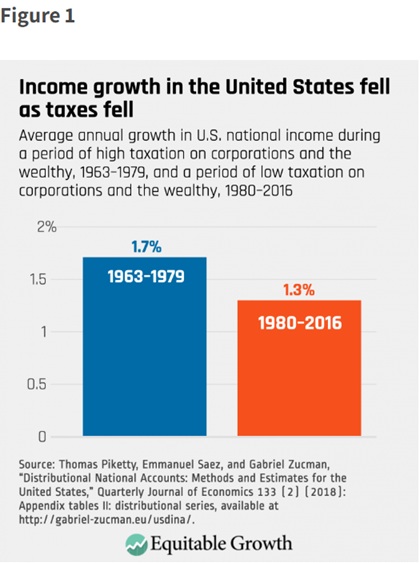
it is clear that the U.S. economy grew more slowly after top rates were drastically lowered than it had grown previously.
The Congressional Research Service also finds that broad empirical data are the opposite of what neoclassical models predict. The U.S. national savings rate, for example, declined in the 1980s after taxes on capital dropped, and it again declined after capital tax cuts in the 1990s and 2000s; neoclassical models predict the opposite would happen.
Also:
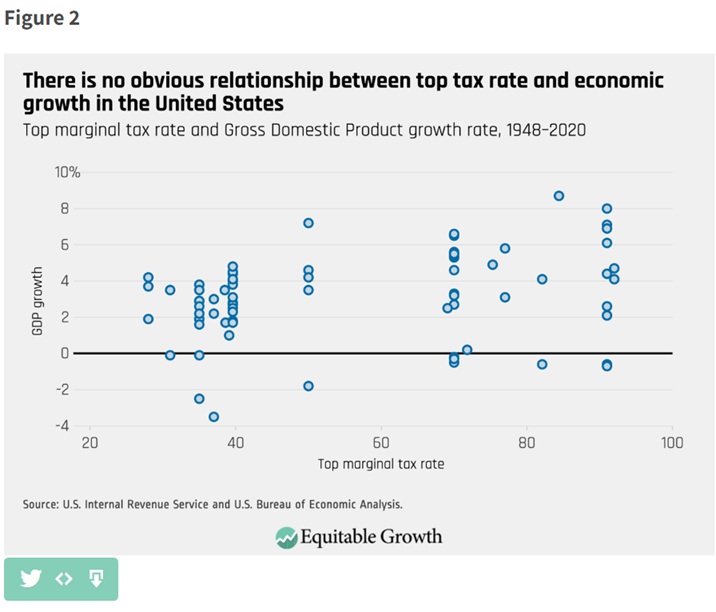
There is no Obvious relationships between the Top tax Rate and Economic Growth
In fact, over time, high top rates are correlated with higher economic growth for most Americans, according to research from University of California, Berkeley economist Emanuel Saez. His research on the effects of the Obama administration’s 2013 tax increases on individual taxpayers making more than $250,000 per year concludes that they were efficient at raising revenue and “the top tax rate increases of 1993 and 2013 do not seem to have hurt overall economic growth, quite the contrary.”
The relationship between taxation and U.S. economic growth “The Washington Center for Equitable Growth”