
Tariffs and Prices
Short commentary on what is going on with US prices. With Trumpian on and off policies, economic stability is difficult to maintain.
Pulled this graph from a Tax Foundation article from October 21, 2025. “Trump Tariffs Raising Prices for Consumers, New Evidence Shows.” As you can see. prices did increase for domestic product just as soon as the tariffs went up on imported products. Following the imports were domestic products which could increase if perchance the imports impact the cost of domestic. If there was no impact, then domestic business could be accused of taking advantage.
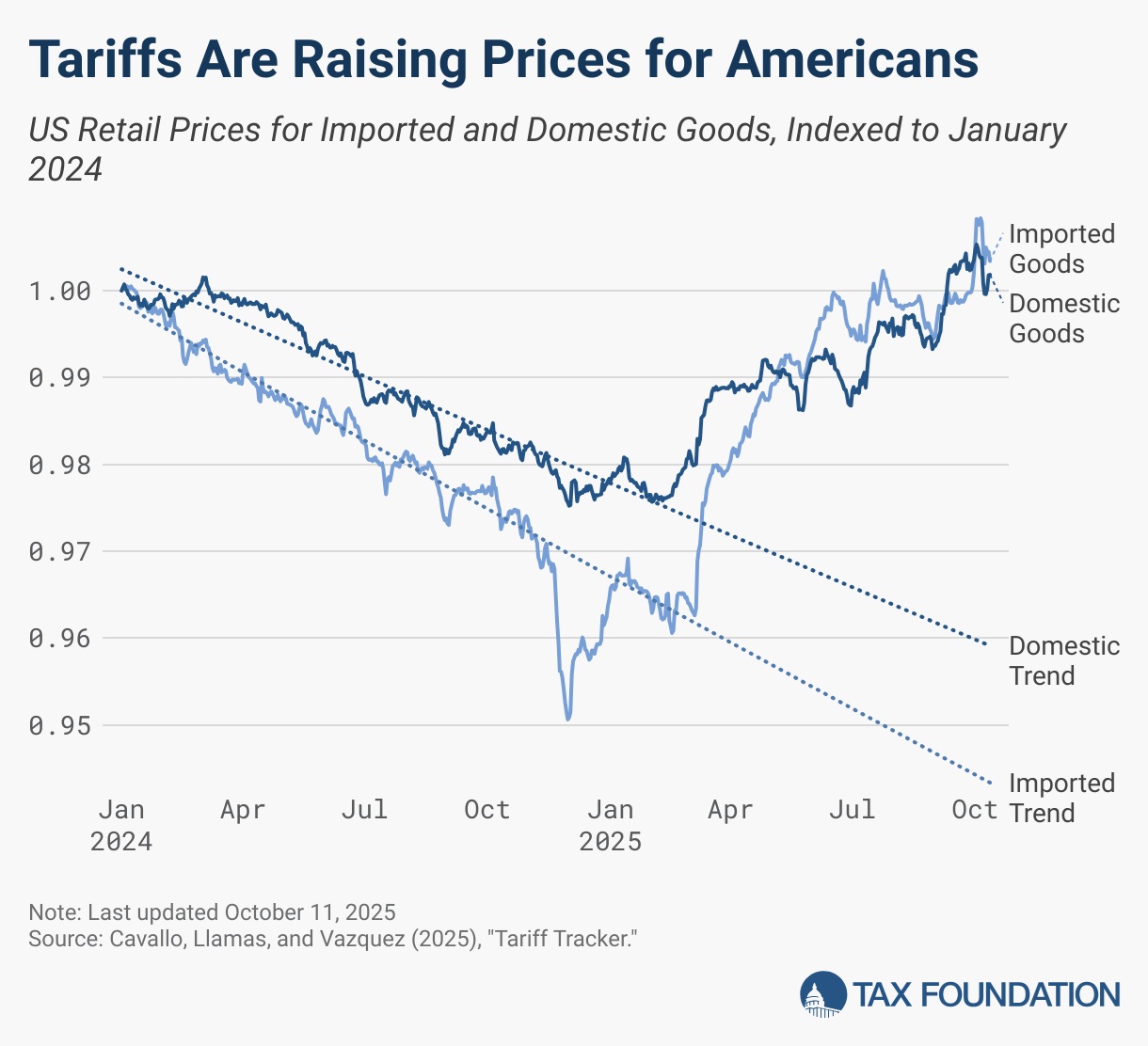
To assess the impacts of the tariffs on retail prices of both domestic and imported goods, a team of Harvard economists has been tracking retail prices using real-time barcode data. The latest data through early October show that tariffs have raised retail prices on average by about 4.9 percentage points relative to the pre-tariff trend, 6.0 percentage points for imported goods and 4.3 percentage points for domestic goods. Several goods have experienced notably large price increases, including apparel (8.99 percentage points), coffee and tea (7.5 percentage points), cameras (7.5 percentage points), household textiles (6.2 percentage points), and furniture (6.5 percentage points).
While these effects are not small, they are more modest compared to the overall tariff rate increases we have seen. There are a few reasons why this is the case.
One is the general uncertainty regarding the overall tariff regime. With President Trump frequently changing tariff rates in both directions, firms may adopt a “wait-and-see” approach before making changes in their overall pricing strategy. This is consistent with the survey evidence from this summer, which generally found that US businesses in the short run were more likely to absorb some of the tariffs.
Further complicating matters is the pending November Supreme Court decision on the tariffs, which could lead to the IEEPA tariffs being overturned and IEEPA tariff revenue refunded to taxpayers.
Another reason for only small price increases so far is that some firms may operate on a contract basis and have already locked in their prices for the year. For example, farm equipment is typically leased on a yearly basis so that these suppliers can smooth out their demand around crop cycles or insulate themselves from bad weather events.
Finally, some firms have preexisting inventory from which they were drawing down, so their retail goods on the market were stocked prior to the tariffs taking effect. President Trump and those in his administration have insisted that consumers are not bearing any of the tariffs. But the latest data show exactly the opposite. If the Supreme Court rules that the IEEPA tariffs may remain in place, we should expect even more price hikes heading into this holiday season and early next year.
“Trump Tariffs Raising Prices for Consumers, New Evidence Shows,” Tax Foundation
There is really nothing surprising about this. Corporate price gouging has been going on for years. And it is reflected in the dramatic increase in profit margins, which hovered around 2% from 1950-1975. By the 2010s they had risen to 10-12%. Now they are about 18%. Corporate America now has a convenient excuse to “goose” prices on domestic goods and increase margins even more.
https://fred.stlouisfed.org/series/A466RD3Q052SBEA
Absent a supply chain excuse, ample hysteric publicity about tariffs and their impact on imports (a mere 14% of the US economy) convinced consumers to expect higher prices, which has happened. Corporate America–the folks who actually set prices–were more than happy to respond to what consumers had been carefully prepared to expect.
https://fred.stlouisfed.org/series/MICH
Sure, increased tariffs deserve their share of the blame, but corporate greed merits a huge dose of public hysteria and blame for the affordability crisis. The more that commentators and economists deflect blame onto a portion of the problem and away from the central issue, the more Corporate America will be empowered to continue to price gouging and extract profits for us.
“Profit per unit of real gross value added” is not a meaningful overall metric in a economy which has off-shored most of its manufacturing and now relies on efficient supply chains, e-commerce, and big-box retailers like Walmart, Target, and Costco, none of which add any gross value at all.
See for comparison US Retail Industry Sales And Profits Trends, 2001–2022: Steady Growth which shows that retail profit margins have been in the 2.8-3.9% range since 2002, with a couple of exceptions both high and low.
US Retail Industry Sales and Profits
John:
No Direct Labor value added to the products being sold.
I tried to add the pic to your comment. It would not allow me to do it. Here is the image I believe you want. I also changed your internet addy to a linked Title.
Thanks! Should have done that myself, of course, I’ll do better next time.