
“We Should Really Reduce National Productivity!“ (?%#&@#??)
Are these people crazy?
Steve Roth
Wealth Economics
This BlueSky bleet really raised my eyebrows. Check out the whole thread.
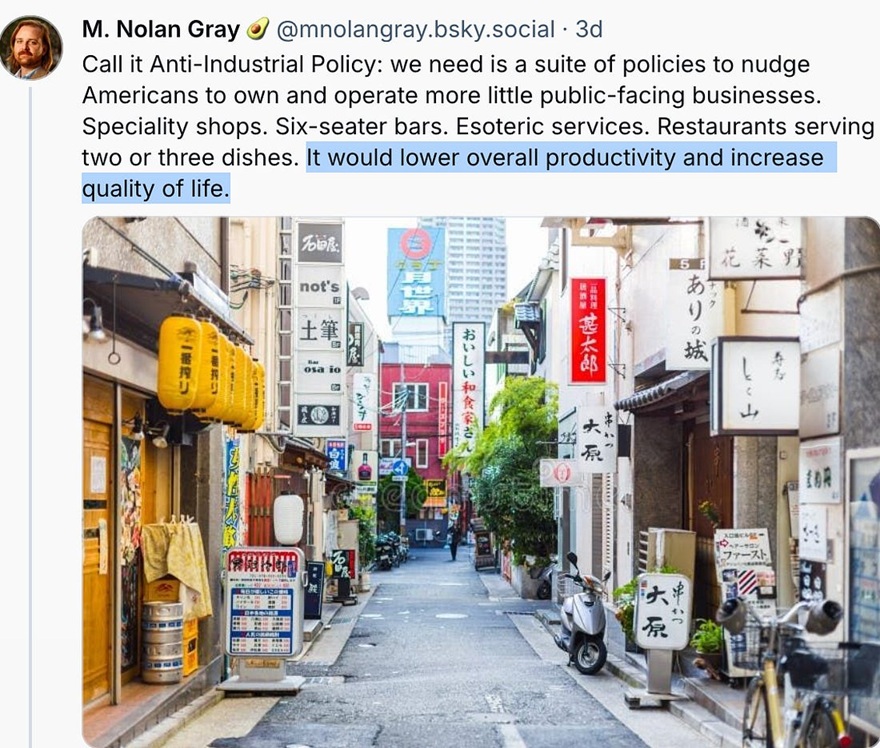
I think my gentle readers will guess that I share these sentiments. But the thing that raised my eyebrows was the explicit suggestion that we should lower national productivity. Many economists would see that as economic insanity and anathema. Any such proposals must come from people who don’t understand something so simple as compounding interest.
Our imaginary economist’s gaping disbelief, in turn, shows what happens when your models, formulas, and understandings come to be the only “real world” you can even see. You’re a fish inside a small, self-constructed fish tank (shared only with your own reflection), and you’re like [crabby old man voice], “What’s this stuff you call ‘water’?”
What “productivity economics” folks tend to lose sight of is the fundamental real-world construction of these productivity measures — how they’re assembled, and what assumptions and practices are embedded in their foundations.
The basic productivity formula is simple: production ÷ hours worked. If people produce more, or work less, productivity is higher. The real devil’s in the details of “production.”
First, nobody can measure production, or “output.” There’s just no unit of measure to sum up drill presses + massages + lines of code produced. So what they measure, the real-world thing that they’re observing, is spending on final goods. Then they assume, “if people, firms, and government spent $20T on final goods and services, $20T in stuff must have been produced.” Fine. Understandable. But also understand that’s an estimate based on unspoken “value” assumptions that you might want (need) to interrogate.
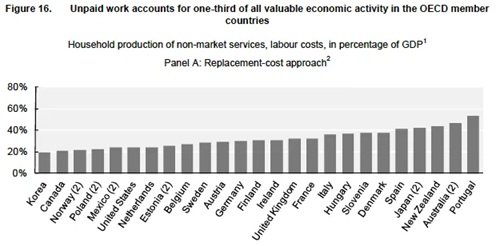
Next, they only measure stuff that’s sold commercially. So if you produce dinner for your family or for homeless people, it doesn’t count as production. Including “home work” in “output” would increase measured output by 25% or 30%++.1
But even that doesn’t count what’s highlighted in the Bluesky post: “quality of life.” That term itself suggests that this thing/stuff can’t be measured quantitatively. People do try, constructing measures and indexes based on yet more assumptions. And more power to them. Post-enlightenment, numeric information tends to “crowd out” or “trump” non-numeric — for very good reasons, but often to extremes.
What About Trade?
Admittedly a bit of a digression, but more quantitatively, and related to today’s very topical trade discussions: The bleet’s proposal would reduce exportable output. We’d be producing more for domestic “consumption” (much of that “output” unmeasurable, but in any case). This sort of smacks of “autarky,” another bugaboo word for economists, but we’re definitely not talking “zero trade” here. A less curséd word would be “self-sufficiency.” Economists, and the public and politicians more generally, are generally pleased with that concept.
The general idea is to direct the economic system more toward delivering the needs, wants, and desires of the country’s residents, vs focusing on what other countries want. Put that way, it doesn’t seem crazy.
Which I’ll just comment on from personal experience. When a partner and I were running a thriving, modest business (~$10M, 8-10 employees plus us, tens of thousands of customers), occasional competitors cropped up. There was a big temptation (more for my partner than for me) to turn our focus toward the competitor, deploying our scarce attention, time, and resources away from just running and building the best gosh-darned business and offering the best gosh-darned products we could.
My general approach was to beat competitors by doing a better job than they did. And also, when they did a better job than we did on some aspect, unabashedly steal their ideas (nothing illegal/immoral, just what we saw them doing), and do those thing even better than them.
In my own mind, that all eventually condensed into one rather homely saying:
“Just stay home, and stick to your knitting.”
It worked for me. We spent nine years building that (great!) business, then sold it for a very pretty penny.
I wish I could convince the Vladamyr Putins and Donald Trumps of this world to follow that mantra.
Just stay home and stick to your knitting.
Imagine what Russia would look like today if Putin had done that.
1 See my old 2012 post here, and preceding 2009 post linked therein.