
Whether we Know it or Not, we are in Trouble Too
The one thing which comes to mind (for me)? War, conflict, etc. is not a business transaction where one side pays for the others help. No quid pro quo. You are either in or you are not in when it comes to battling an aggressor style opponent. If the side you are on, and you are not assisting loses, then you will lose. There is much to lose if they lose.
Herr Tr__p is trying to make this into a business transaction. The time may come . . . Krugman’s perspective.
Decline and Fall of the American Empire
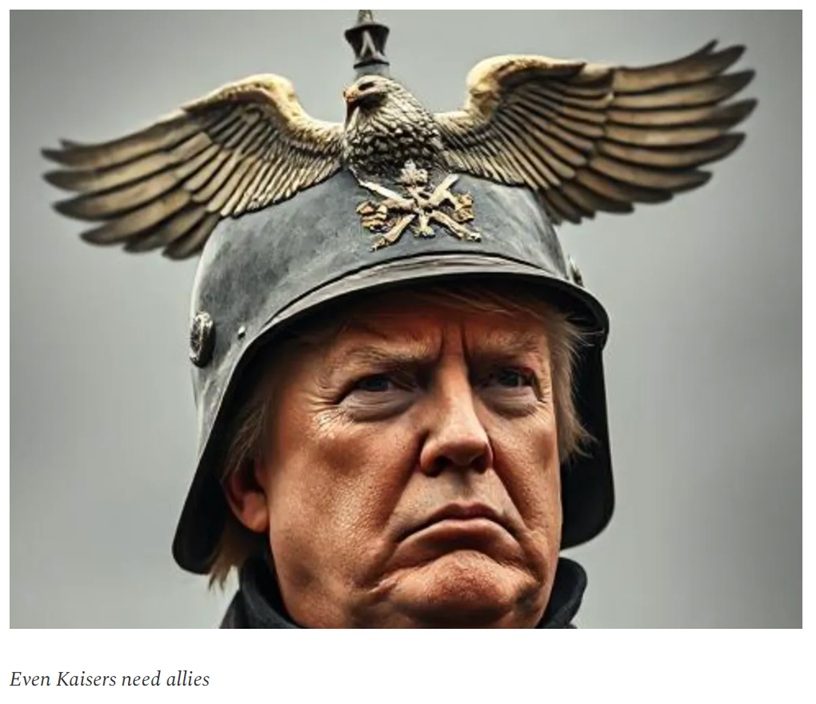
Alliances were what made us great.
Last Saturday I posted a conversation with the military historian Phillips O’Brien, much of which was devoted to the war in Ukraine and what has passed for U.S. diplomacy the past few weeks. But we also talked about his new book War and Power, and I was struck by one of his points: The importance of having good allies.
Last Saturday I posted a conversation with the military historian Phillips O’Brien, much of which was devoted to the war in Ukraine and what has passed for U.S. diplomacy the past few weeks. But we also talked about his new book War and Power, and I was struck by one of his points: The importance of having good allies.
Last Saturday I posted a conversation with the military historian Phillips O’Brien, much of which was devoted to the war in Ukraine and what has passed for U.S. diplomacy the past few weeks. But we also talked about his new book War and Power, and I was struck by one of his points: The importance of having good allies.
As he noted, Germany lost both world wars in part because it was confronted by powerful alliances while its own allies were “terrible” — Austria-Hungary in World War I, Italy in World War II. He went on to say
The key of the United States has been that it has maintained arguably the most successful alliance system in history since 1945. What the U.S. maintained with NATO, an alliance which kept Europe very much on the American orbit, in the American orbit, both economically and militarily, also with Japan, South Korea, Taiwan and countries in Asia is, they constructed this alliance system which hugely amplified both America’s economic possibilities but also its strategic possibilities.
And Trump is throwing all that away.
I try not to say too much in these interviews — my one weird trick for good discussion is, as far as possible, to shut up and let the interviewee talk. But I couldn’t resist a follow-up here, based on my own observations:
[W]hat always struck me, is that the U.S. had a specialty of creating international organizations that were formally equal, where we were all partners together. Now, everybody understood that the United States was actually in charge, but we went to great lengths to make sure that the World Trade Organization or NATO were alliances of equals, at least on paper. And it was a very effective trick.
O’Brien agreed: “The United States was getting the substance of power but giving up the style.”
For today’s post I thought I would enlarge on this point — and on what we’ve lost, possibly irretrievably, thanks to just a few months of Trumpism.
The Pax Americana that emerged after World War II — and basically ended on January 20, 2025 — was, in many ways, an American Empire. Even after Europe recovered from wartime devastation, the United States retained a dominant economic and military position among non-Communist nations. And we built international economic and military alliances to support a world order in effect designed to U.S. specifications.
But for Europe and Japan the American Empire was a subtle thing, with the United States avoiding crude displays of power and bending over backwards to avoid being explicit about its imperial status.
OK, I’m very aware that the picture I’m painting only applies to U.S. relations with wealthy democracies. U.S. power didn’t look so benign to Mohammed Mossadegh in Iran or Salvador Allende in Chile. Yet in the history of world empires, the Pax Americana nonetheless stands out for its subtlety, restraint — and effectiveness.
We set up the postwar international monetary system at a famous 1944 conference in Bretton Woods, New Hampshire. It was a U.S.-centric system, although Britain also helped shape the rules. (Some guy named John Maynard Keynes played an important role.) But while the initial system did give a special role to the dollar (a role that ended in 1971) the international institutions it established, the International Monetary Fund and the World Bank, are, at least on paper, country-blind. Obviously, they have always given special deference to U.S. concerns, but they have never been explicit instruments of U.S. power.
In 1947 a conference in Geneva established the General Agreement on Tariffs and Trade, which set the ground rules for, um, tariffs and trade. The GATT in turn became the foundation for the World Trade Organization, established in 1994.
The GATT very much set up a world trading system in America’s image — to a large extent it was a globalized version of America’s 1934 Reciprocal Trade Agreements Act. But the text and the rules it sets don’t single out the U.S. for any kind of special treatment.
Then there were the military alliances. More O’Brien’s specialty than mine, but NATO, despite U.S. military dominance, has always formally been an alliance of equals. The military commander has always been American, but the Secretary General has always been European.
Are there historical precedents for an empire run as an alliance? I’m not a historian, and I’m sure there are examples I don’t know about, but the closest parallel I can think of is the Delian League Athens established to confront Persia in the 5th century BC. Athens eventually gave in to temptation and began treating its allies as subjects to be exploited; America never did. Remember, the Soviet Union repeatedly had to send in the tanks to keep puppet governments in power in Eastern Europe. Nothing like that ever happened, or even came close to happening, in NATO.
You could, I guess, say that formally treating our allies as if they were our equals was hypocritical. But I see it more as a way of showing respect and declaring that we would not abuse our national power.
Now, we squandered a lot of credibility by invading Iraq under false pretenses. And the credibility we lost in Iraq has made it difficult to act against atrocities elsewhere, from the use of chemical weapons in Syria to the terrible things Israel is doing in Gaza.
But in 2024 America was still in a real sense the leader of the free world. And while you can criticize the Biden administration for always delivering too little, too late, it nonetheless did help mobilize a large coalition to help Ukraine defend itself against Russian aggression.
But that was another America.
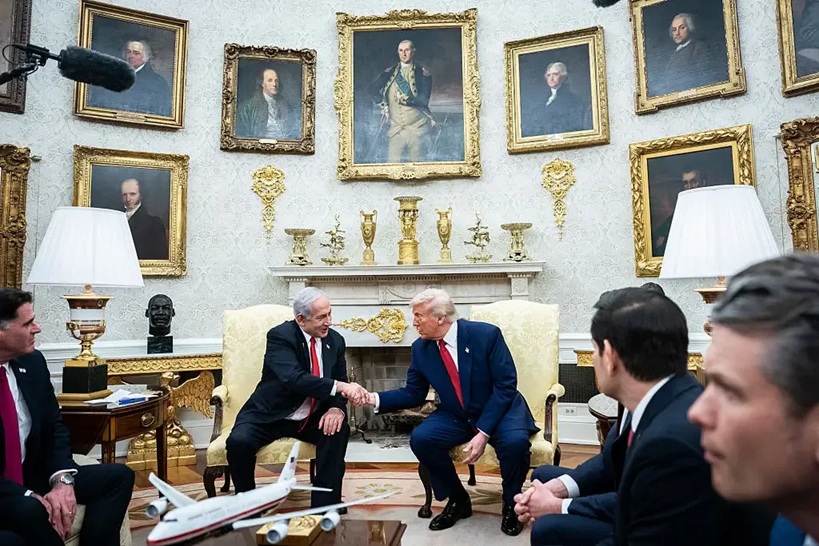
The current occupant of the White House clearly has no use for subtlety and understatement:
And let me say that I don’t think Trump’s vulgarity is irrelevant to understanding what he’s doing to America and the world. One of the best explanations I’ve read of who Trump is, and implicit predictions of what he would do, was a 2017 discussion of his design tastes titled “Dictator Chic.” Trump’s New York apartment, wrote Peter York,
projects a kind of power that bypasses all the boring checks and balances of collaboration and mutual responsibility and first-among-equals. It is about a single dominant personality.
Remember, this was written in 2017, yet it was a better prediction of Trump’s current behavior than almost any judicious-sounding “news analysis.”
In any case, in just 7 months Trump has completely ripped up the foundations of the Pax Americana. Almost all his tariffs are clearly in violation of the GATT, yet Trump has vandalized the world trading system as casually as he has paved over the Rose Garden. We haven’t yet had a test of whether he would honor our obligations under NATO, but he’s said that his willingness to abide by the most central obligation, the guarantee of mutual defense, “depends on your definition.”
Trump’s foreign policy doctrine appears to be Oderint dum metuant — let them hate as long as they fear — supposedly the favorite motto of the Emperor Caligula. America, he seems to believe, is so powerful that it doesn’t need allies; he can bully the world into doing his bidding.
As Phillips O’Brien told me, history shows that such a belief is always wrong. And it’s especially wrong right now, when America is far less dominant than it once was. Whatever Trump may imagine, the world doesn’t fear us. For example, Trump may have imagined that his tariffs would bring India crawling to him, begging for relief; instead, India seems to be moving to closer ties with China.
In fact, not only does the world not fear us. Increasingly, it doesn’t need us. This is even true for nations that used to depend on U.S. military aid. You may remember Trump berating Ukraine’s president Zelenskyy, declaring “you don’t have the cards.” In reality, even in the Ukraine war Trump has far fewer cards than he imagines. At this point Europe is providing far more aid to Ukraine than we are:
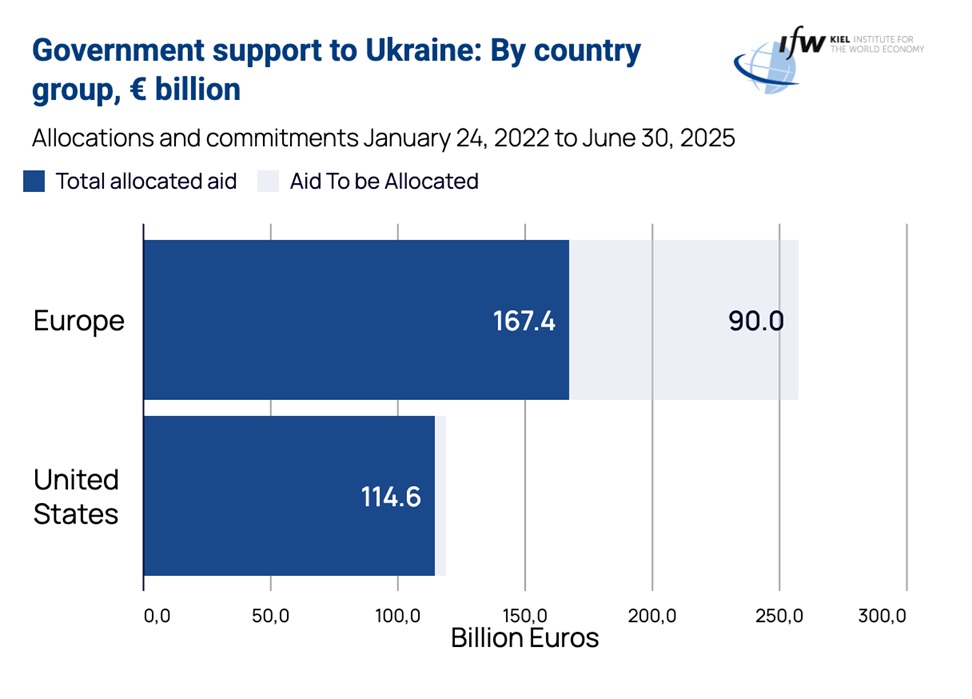
Source: Ukraine Support Tracker
And in an ever-evolving war in which drones, not tanks, rule the battlefield, Ukraine (with European help) is producing many of its own weapons.
One of the many problems with the slogan Make America Great Again was that America already was great. Now, not so much. In a world in which America is no longer the dominant economic and military power it once was — measured by purchasing power, China’s economy is already 30 percent larger than ours — our role in world affairs depends, even more than it did in the past, on having willing allies who trust our promises.
We used to be very good at having allies. But Trump has flushed all of that down the golden toilet.
Everybody gets upset with Trump’s disdain for democracy, his pleasure in bullying others (which makes him feel superior) and his utter lack of empathy or humanity and they always forget that he is the most ignorant and incompetent leader arguably in the history of the world. Everything he says is a lie–Make America Great Again? His administration is the antithesis of that slogan. He is bringing a great nation to its knees.
The Republicans are bringing a great nation to its knees.
Agreed but the GOP would not have the power it does without Trump and they go along with all his craziness because they are selfish cowards.
Daniel:
Will Repubs come to their senses when Tr__p wishes to be king or dictator? The political environment is ripe for such an attempt.
Terrance, I agree that the Republicans would not have the power position they currently have without Trump. They may not have recognized it, but they were in need of a person of Trump’s character to fully implement their wet dream of unitary executive (a polite cover phrase for authoritarian rule). Bush/Cheney were moving in that direction. Gingrich started the all-in with his “all Democrats, Liberal, Progressive, etc) are the enemy so treat them as such. The language was there when Bush/Cheney came online. Just go back in listen to what Carl Rove was saying about the X years of Republican rule. But none of them had the depth of narcissism their ideals of how society should live needed to actually push the social order over the cliff. Then Trump appeared. The Republicans may not have recognized it at Trump’s ride down the escalator, but they figured it out by the time the primary was over and full-on election campaigning was on.
Bill, the Republicans are in their senses already. They have been talking authoritarian since at least Nixon. But they needed a Reagan to get the apparatus in motion. Reagan was an authoritarian, it’s just that he was a Disney character which softened the Republican desire to the populace. The Republicans did not promote him as the greatest president ever because he was. Nope. They did it because they needed a figure head, a martyr. The Republicans are exactly where they want to be. The attempt is happening currently.
We are in the movement to convert our nation to a form of authoritarian rule with all the criminal enterprise and lack of reality that goes along with it. The question for me is how will the citizenry respond when the election denialism begins the night of the midterms.
I warned here years ago that the thing being destroyed was trust. Trust is what made this nation wealthy and powerful. Well, here we are. Look at any authoritarian nation and you see that it is a lack of trust which prevents it from becoming what we and our allies had. Seems our allies realize this and are restructuring their circle of trust without US.
Daniel:
Thank you for your comment. When I talk to some of them, I find they are less rigid. I see the same future as you, We can hope for other things to come to challenge these beliefs too.