
Questions to a Secretary of State
“Five Questions with Maine Secretary of State Shenna Bellows,” Civil Discourse
Shenna Bellows is Maine’s 50th Secretary of State and the first woman to serve in that role. She’s led implementation of reforms like automatic voter registration and online voter registration in her state and has taken strong stands against Donald Trump—she ruled that he wasn’t eligible to be on the 2024 ballot because of his incitement of the January 6.
She’s steeped in the tradition of speaking truth to power; she was Executive Director of the ACLU of Maine before she entered elected office. Shenna also understands the dangers this moment poses to our democracy, having led Maine’s Holocaust and Human Rights Center for several years. Shenna was one of the leaders of Maine’s marriage equality campaign, and she and her husband waited to marry until their gay and lesbian friends and family could. She helped win that campaign by launching Republicans for the Freedom to Marry out of the ACLU even though she’s a Democrat.
That kind of bipartisan coalition building helped her turn a red district blue when she was elected to the state senate—in a district that voted for her and for Donald Trump in 2016. Growing up in rural Maine without electricity or running water has made Shenna Maine tough. In her spare time, she runs half-marathons and goes bird-watching in the Maine woods with her husband Brandon.
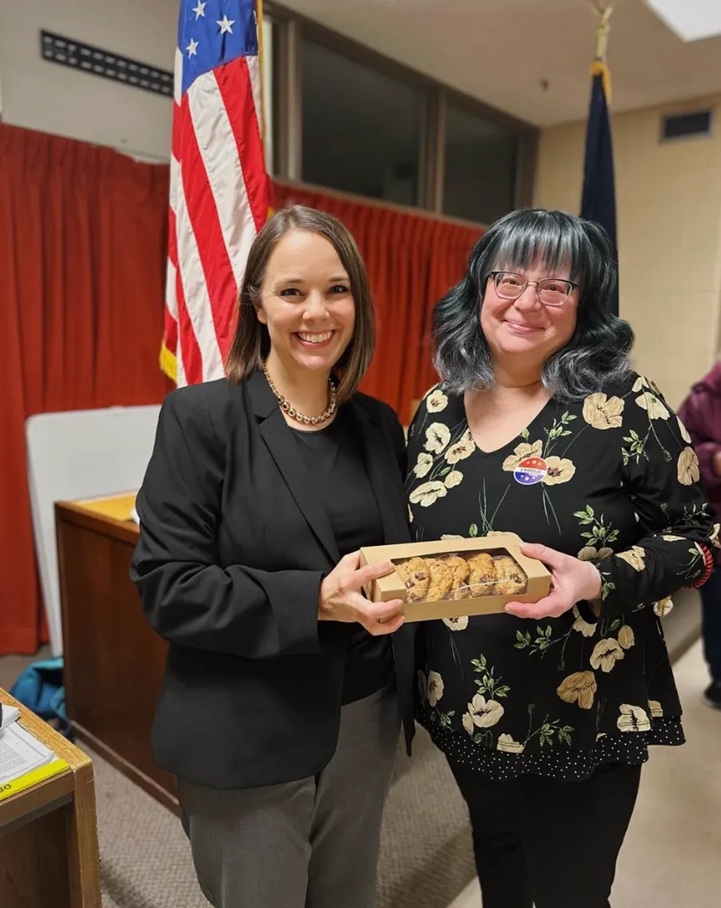
One of the things I really admire about Shenna is the joy she brings to her work. She likes running elections. She thinks the nuts and bolts and doing it right are interesting and important. And she inspires the people around her. When I asked for a “fun” picture for Five Questions, she sent me this one, and wrote about her visits to polling places across the state on election days: “I deliver donuts in the mornings, cookies in the afternoon.”
I’m grateful Shenna has agreed to join us this week as we mark the 60th anniversary of the Voting Rights Act and look to the future.
“Five Questions” is a periodic feature for paid subscribers, my way of thanking those who are able to support this work and make it possible for me to devote the necessary time and resources to it. Whether you’re a paid subscriber or not, I’m happy to have you here. I appreciate everyone who reads the newsletter and works to keep themselves and others informed in this pivotal moment. Free subscriptions are available too, with access to all of the other nightly posts.
Joyce: Recently, the White House asked you to turn over data on Maine voters. You declined pretty epically, telling them they could jump in the Gulf of Maine.
What was the specific ask they made of you, and why did you turn them down?
Shenna: They wanted an electronic copy of the voter file – including the most sensitive personal information of every voter in Maine. In talking to my colleagues across the country, it turns out they’re seeking the sensitive personal information of every American voter.
I told DOJ no because there is no good reason that the federal government should have voter information for every citizen in this country. Article I of the Constitution places responsibility for elections in the states, not the federal government, and there are a host of federal and state laws that protect Americans’ privacy.
The federal government doesn’t get to know everything about you just because they want to. Even folks who aren’t as worried about privacy should be concerned if the DOJ, which has the power to investigate people and put them in jail, suddenly has instant access to the party affiliation and voting history of their targets. This is a very dangerous precedent, no matter which party controls the White House.
Joyce: What do you think the biggest challenge in running the 2026 election will be?
Shenna: The biggest challenge may be attacks on state and local election officials from the federal government. In the last two elections, we’ve had to contend with activist election deniers spouting lies and misinformation about our elections and undermining not only voter confidence but also, in some cases, the safety of our election workers. Now, the election deniers have moved into power at the highest levels of the federal government. They’ve slashed election security funding to the states; they’ve fired the federal workers who helped states and local election officials with election security; and now it feels like they’re attacking state election officials directly.
I’m also deeply concerned about the lack of resources for elections. Election officials are the world’s best contingency planners. We’re used to making do with what we have, but in the absence of meaningful federal funding, our job becomes a lot harder.
Joyce: I have heard you say that as Secretary of State in Maine, you sometimes show up with donuts on election day at local polling places. You have a particular view of what matters about our elections. Help us understand how you do your job as Secretary of State, that position’s responsibility for elections, and why you think that personal touch matters.
Shenna: As Secretary of State, I’m the chief elections official in Maine. I am charged with overseeing every aspect of Maine elections, from qualifying candidates and questions for the ballot, to administering the election, to certifying the results. That being said, the people who are doing the really hard work are the civil service state election officials and the local clerks.
The local clerks are registering voters, distributing ballots, running the polling places and counting the ballots at the end of Election Night. That’s why I think it’s so important to get out to support clerks by showing up in person. (I usually bring donuts!) We also do a lot of community-based voter registration and voter education events all over the state in schools, on college campuses, at fairs, in correctional facilities, and even churches, temples, or mosques where I’m invited. We’re really proud of our high voter registration rate and voter participation. In 2022 we were first in the nation. In 2024, Minnesota and Wisconsin beat us out, but we were still third nationwide in voter turnout!
Joyce: Is there coordination among Secretaries of State nationwide? Or do each of you work on your own? Help us understand what an election looks like in terms of coordination across states.
Shenna: I just got back from a weeklong conference of the National Association of Secretaries of State. We’ve all become close friends, and it’s wonderful to have colleagues who understand the job helping to think through how we protect our democracy in these perilous times. We coordinate very closely on election security and cyber security. For example, on Election Day, we have a virtual situation room where we exchange real time information about threats coming in and how to counter them.
That being said, each state runs elections slightly differently in accordance with state laws. For example, most states run elections at the county level, but in Maine, as in the rest of New England, elections are run at the municipal level. I’m proud that in Maine, every citizen has the right to vote, no exceptions. I’m also proud of laws in Maine like same day voter registration and the ability to vote early up to 30 days prior to Election Day that make it easier for people to participate and ranked choice voting that gives voters more choice.
Joyce: We all know our elections are under attack. Can you give us ideas about some things we can do to make a difference?
Shenna: Bake a pie for your favorite election official. I’m not kidding. One of my favorite, long-time clerks bemoaned that elections used to feel like homecoming with voters bringing her pies and hugs and now things are a lot more stressful. My message on the road is let’s bring back pies and hugs. So if you’re a terrible baker, maybe you can help in another way. We’re always looking for poll workers, especially in the off years like this year or for primary elections. In Maine we recruit poll workers equally from both major political parties for balance at the polls, and we train on the job. Anyone can be a poll worker, and you should!
I’m all for joining the pie brigade on election day! As you know, I’ve applied to be a poll worker in my state, but so far, no response from Alabama’s Secretary of State. Either way, I’m going to plan on showing up with baked goods next election so I can make sure the people who run our elections know how much I appreciate them. There’s a role for each of us.
We’re in this together,