
Will DOGE be an exercise in futility?
The smirking faces of Elon Musk and Vivek Ramaswamy have joined the smirking face of Donald Trump in threatening to burn down government in order to save it. What they’re announcing sure sounds bad to me (eliminate a third of federal spending, including cuts to Social Security, Medicare and Medicaid).
Over at eatingpolicy.com, Jennifer Pahlka lays out her reasons why she’s skeptical that even whackjobs who are richer than God can make over the US government in their image:
“I am guessing that those most worried that DOGE will succeed have never tried their hand at reforming government. It’s hard. But easier, you say, with no respect for the law, and the DOGE team will be unencumbered by such details. But that’s not true. The lawsuits will come. A lot of the government tech community is skipping the hand wringing; they’ve basically just grabbed a bag of popcorn and are watching in real time as Elon and Vivek learn all the things they’ve known, lived, and absolutely hated for their entire time in public service.”
In the link, Pahlka pulls on a number of threads to make her point. There’s history:
“It’s not that Dems haven’t tried the billionaire move. Obama’s Secretary of Defense Ash Carter started the Defense Innovation Board and appointed Eric Schmidt to lead it, for example. Carter’s hope was to transform the military into a modern, effective (and dare I say efficient) institution, and saw Schmidt as extra firepower for change, so to speak. Many grumped about the unaccountable power Schmidt would have, but I served on that board for four years and that concern was laughable. The DIB did a lot of great work that Eric should be proud of (I am), but it was merely advisory, set up according to Federal Advisory Committee Act rules. It didn’t help that the board quickly attracted at least one gadfly ethics-watcher, whose objections to Eric’s actions were so nitpicky and procedural she represented the worst of the Pentagon, the worst of public service, the worst of accountability. In the end, she was an annoying speed bump, but it didn’t matter. We wrote papers that said things like “the Pentagon already knows everything in this paper, but seems unable to act on it,” and watched as the Pentagon appeared to technically act on recommendations without fundamentally changing much. Other efforts like DIUx made real progress, but the dent in the machine is still tiny. I admire what Eric did on DIB. But the presence of a billionaire is certainly no guarantee of change. Mike Bloomberg has the job now, and is still proving the point. Today, we spend even more to get even less deterrence.”
There’s the law:
“Take the issue of respect for the law. Put aside the headline grabbing issues for a second and live in the mundane world of implementation in government. If you’ve spent the past ten years trying to make, say, better online services for veterans, or clearer ways to understand your Medicare benefits, or even better ways to support warfighters, you’ve sat in countless -– and I mean countless — meetings where you’ve been told that something you were trying to do was illegal. Was it? Now, instead of launching your new web form or doing the user research your team needed to do, you spend weeks researching why you are now branded as dangerously lawless, only to find that either a) it was absolutely not illegal but 25 years ago someone wrote a memo that has since been interpreted as advising against this thing, b) no one had heard of the thing you were trying to do (the cloud, user research, A/B testing) and didn’t understand what you were talking about so had simply asserted it was illegal out of fear, c) there was an actual provision in law somewhere that did seem to address this and interpreting it required understanding both the actual intent of the law and the operational mechanics of the thing you were trying to do, which actually matched up pretty well or d) (and this one is uncommon) that the basic, common sense thing you were trying to do was actually illegal, which was clearly the result of a misunderstanding by policymakers or the people who draft legislation and policy on their behalf, and if they understood how their words had been operationalized, they’d be horrified. It is absolutely possible to both respect the rule of law, considering the democratic process and the peaceful transfer of power sacred, and have developed an aversion to the fetishization of law that perverts its intent.”
And there’s the private sector:
“But I don’t want to dismiss the difficulty of confronting commercial interests. I think it’s fair to say that in the time I’ve been working on this issue we haven’t really seen the vendor ecosystem threatened in any meaningful way. The supplier base for government tech, for example, is not all that different from when I started Code for America in 2010. Anduril has made strides at the DoD for sure, and some startups have done some interesting stuff. Companies like Nava, a public benefit corporation whose costs and outcomes in contracting with agencies like CMS and VA should make it a strong choice across civilian government, is now over 500 people. But CGI Federal, just to pick one of the incumbents, is 90,000. Lockheed Martin is 122,000. Anduril is 3,500. It’s not like we’ve seen some massive shakeup.”
Read the whole thing at the link. But if your reaction is tl;dr, the short take is that government inertia is the dominant reality in Washington and it can absorb any punches that Elon and Vivek throw.
Bringing Elon to a knife fight
Futility is the most effective form of public administration reform. It borrows from an idea long embraced by civil rights activists. Once a problem has been solved then it becomes useless for shouting out on one’s soap box to rally public support and raise campaign contributions. But failure last forever. Just pull up that soap box and shout down the opposition party and keep on campaigning the same issue until the end of time. Success is momentary and fleeting, but failure is the gift that keeps on giving.
“No one ever lost money selling to Uncle Sam”.
OTOH, those few civil rights activists that really did set themselves on a path for solving the problems of unequal rights found the cost of freedom buried in the ground (notably Medgar Evers and MLK, but Bobby also and indirectly Jack).
Joel:
Gonna crash again soon.
The money for those tax breaks for the 1-percenters has to come from somewhere. Consider we have a $29 trillion dollar economy to play with today. And why, Social Security, Medicare, and Medicaid? They have little influence in the short term until the next election.
I can not imagine Repubs do not give a sh*t about being in Congress and the presidency again. How much of an impact will any of this have on the DOGE Bros? Nothing except for a bad reputation. On Republicans, they will pay the price for DOGE.
Will these cuts get past Congress? I am sure Dems will have something to say. I believe Repubs will realize the tar pit they will be stuck in. Not that we should not be stomping around with a presentation of the information saying this is a bad move. I hope Dems have the wherewithal TO DO SO.
A relevant Graph:
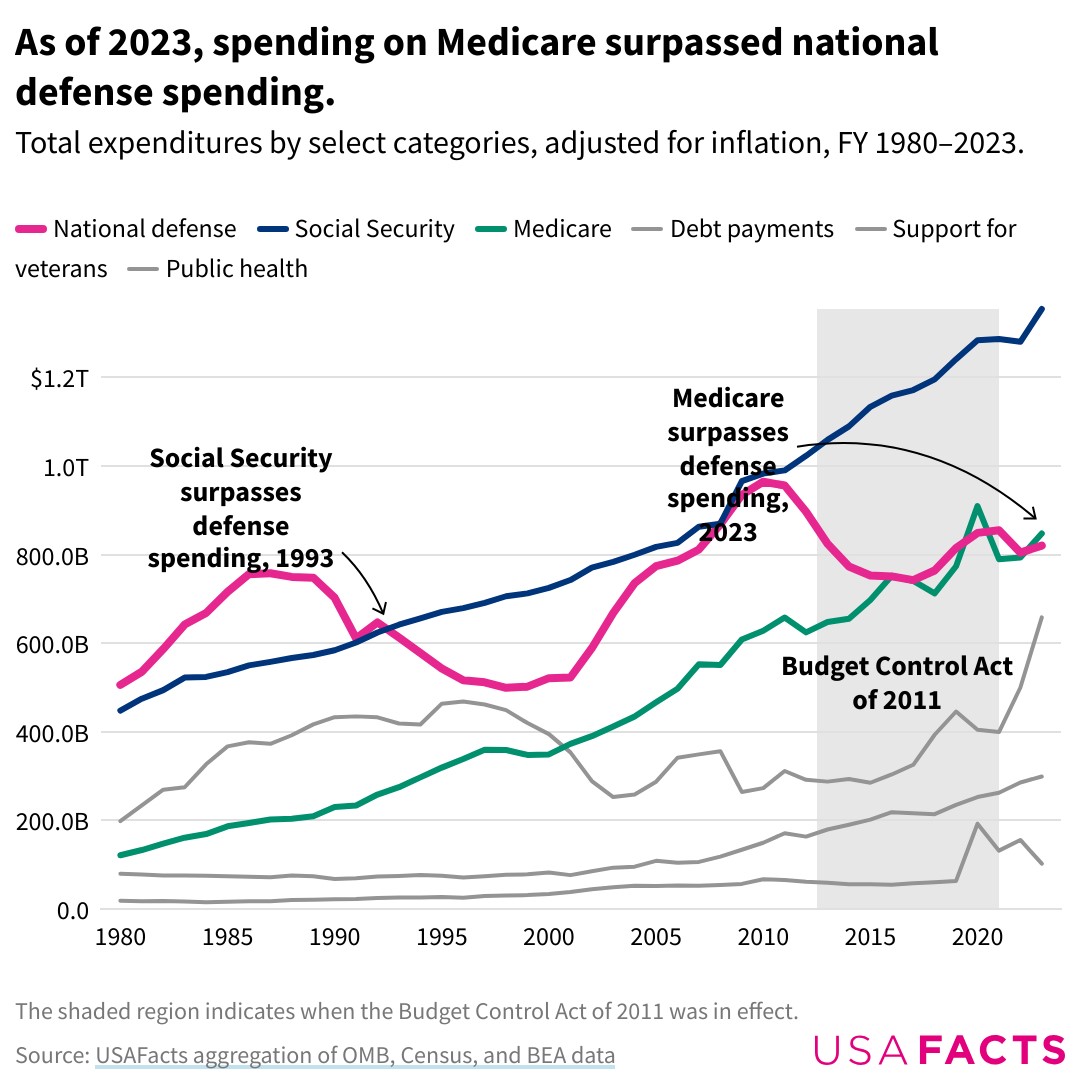
How much does the US spend on the military, Social Security, Medicare, etc. now and in the future?
Guns, Butter, or tax breaks for a minority of wealthy people.
@Bill,
And a significant amount of the surge in Medicare spending is due to Medicare Advantage, the privatization of Medicare. Think the fiscal disciplinarians hunting for savings will eliminate MA and return to the more fiscally responsible traditional Medicare?
Joel:
My mind is still not clear. Excellent commentary adder concerning Medicare Advantage. That and over coding when we go to the doctors for simple things.