
Navient Student-loan Borrowers Cancellation Special . . .
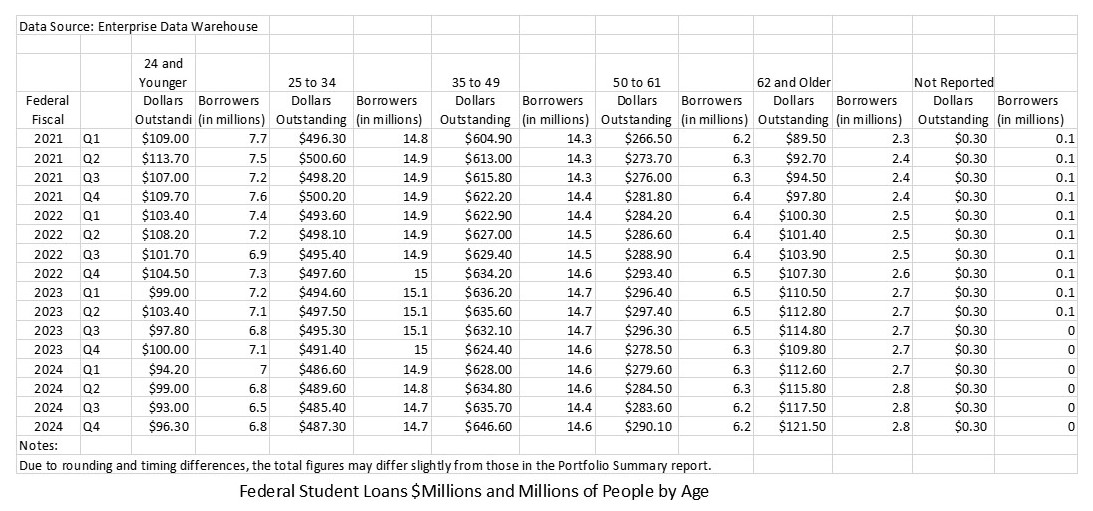
Applications are “carefully reviewed” by a legal team to determine eligibility for debt cancellation, yep! What does continuous growing Student Loan Debt look like today? Federal Student Loan Portfolio by Age. The chart below only shows the last 4 years by Quarter. President Joe Biden has been attempting to grant relief to students. This is a reversal of the many times; he has blocked such relief since he came to Congress. Unfortunately, too little too late as Republicans, business interests such as Mohela, and the Courts, etc.
Student-loan Borrowers Who Applied for Debt Cancellation, Business Insider
Hundreds of student-loan borrowers who applied for debt cancellation are being denied relief by a major lender, over 20 Democratic lawmakers say, Ayelet Sheffey @ Business Insider.
- Sen. Elizabeth Warren led over 20 colleagues in requesting the CFPB and FTC investigate student-loan company Navient.
- They said they’re concerned that Navient might be improperly denying defrauded borrowers debt relief.
- Navient said it’s committed to getting relief to borrowers, but the discharge process is still in its early stages.
A group of Democratic lawmakers said that a major student-loan company is denying some student-loan borrowers relief for which they might qualify.
Sen. Elizabeth Warren led over 20 of her Democratic colleagues, including Rep. Alexandria Ocasio-Cortez and Sen. Ron Wyden, in sending a letter Wednesday to the Consumer Financial Protection Bureau and the Federal Trade Commission urging an investigation into the student-loan company Navient.
In the letter, viewed exclusively by Business Insider, the lawmakers wrote that Navient’s process to cancel student loans for borrowers who said their schools defrauded them is “flawed, convoluted, and opaque,” and it may have resulted in borrowers being “improperly” denied relief they qualified for.
A process known as the borrower defense to repayment allows borrowers with federal student loans to apply for debt cancellation if they believe their schools defrauded them. If approved, the government would wipe out their balances.
However, borrowers with private loans held by Navient cannot access the federal process. Instead, they can request a school misconduct application from Navient, and Navient would then decide whether to approve it.
The company previously said it’s committed to addressing all “valid” misconduct claims.
The issue, the lawmakers wrote, is that Navient has denied relief for the majority of borrowers who applied. Navient wrote to Warren and her colleagues in a September letter, viewed by BI, that the company services about 65,000 borrowers who attended for-profit schools. As of September, Navient has sent 4,233 borrowers a school-misconduct discharge application, and 1,801 borrowers have submitted applications. Of the 1,061 applications Navient fully reviewed, 238 borrowers have been approved for relief, and 823 have been denied.
Navient wrote to the lawmakers that borrowers’ applications are “carefully reviewed” by a legal team to determine eligibility for debt cancellation, and to date, it has approved over $8 million in relief. Still, the lawmakers said that the denials do not contain sufficient explanations, “leaving a fraction of Navient’s borrowers who attended predatory, for-profit colleges with the relief that they deserve.”
BI previously spoke to some borrowers who have attempted to navigate Navient’s school misconduct application process. Nick Eucker, 38, said he received an application from Navient, and after submitting 200 pages worth of paperwork in support of his claim he was defrauded, Navient denied his application. The only reasoning he was provided was: “You do not meet the requirements for discharge based on misconduct by your school.”
A Navient spokesperson previously said that the discharge process is still in its early stages, and the company expects more borrowers to see relief as it rolls out.
Still, the lawmakers said that Navient has the authority to cancel the loans of impacted borrowers without requiring a lengthy application process.
“Navient should cancel all of the private fraudulent debts for borrowers who have been harmed by its misconduct,” they wrote, “all of whom the company is able to identify without an application.”
If the government has already ruled that the school defrauded students, would that not be enough to conclude that a private loan should be discharged as well as a government one? Or are private companies allowed to have their own definition of fraud?
Wouldn’t an assessment of the school’s ability and track record of helping students to get jobs be a part of the risk assessment on whether or not they will be able to repay the loan?
Jane:
No one president has been able to force student loan companies to grant relief. The only relief being death. They slow process things till the next president and resume their debt collection.
Side Story . . .
All of my three had student loans. Two were able to handle them, one married well and was fortunate to have his paid off (he replaced it with his own funds from doing well business wise). My daughter slept through her first year in college and subsequently left. She did become a nurse and NP and paid her loan off . . . but what a waste. The third had a loan and due to circumstance could not pay it off. I picked it up and paid off all the accumulated interest which was $thousands and made a few interest and principal payments. The balance was forgiven. We are clean.
To your question . . .
I have written about student loans for a decade or more. The same people who may go into bankruptcy due to losing a job and having high expenses due to car payments, a way of living, etc. look down on the 40-something million people having these loans of which many of them who have hit 60 will NEVERbe able to pay them off. Student loans are something sacred I guess even if these people can not get a well-paying job they thought they could get by having a college education when, when they were 18 0r 19.
It is like enlisting in the Corps and thinking you are going to be Sgt Rock (cartoon character) and you find out it is nothing like the comics and you can get hurt or even die. I was smart enough to leave as a Sgt at the end of my enlistment even after they promised this and that.
To your point of schools ability to guide students by talking about reality and assisting them in finding jobs, some of it does exist. I have yet to see the stats of each school’s success rate. You venture to colleges and your studies at your own risk.
Student Loan debt is at ~$1.7 trillion.
As you look at this chart, Pres. Biden’s efforts have made barely a scratch. All of this is due to Republican opposing forgiveness and business interests such as Mohela and Navient.
@Jane,
What Bill said. I’d only add this: colleges and universities are not, nor were they ever, vocational schools. While colleges and universities could and should offer advice on how to think about an employed and compensated future, part of being educated is learning good judgement. If you finish college without that, you didn’t do it right. At what point does personal responsibility kick in?
I’ve been in academia nearly all of my adult life. My experience is that most students choose mentors who advise them not only academically but on life choices.
As for student loans, they are not normally dischargeable through bankruptcy, like other loans. They should be. It would put the risk on the lender, where it should be. That’s why the lender gets the big bucks.
Confusing. The main section of this post discusses “school misconduct” but the lawmakers’ letter brings up “its (Navient’s) misconduct”. Are these separate categories with distinct relief?