
Knocking Back The UV
Joel C. Eissenberg and Michael D. Eissenberg
Institute for Thanksgiving Weekend’s Intriguing Standardized Tests (ITWIST)
Evergreen, Colorado 80439
Abstract
Ultraviolet (UV) light is a form of ionizing radiation prevalent on earth during daylight hours. UV light exposure in humans is a risk factor for skin cancer and cataracts. Accordingly, there has been considerable interest in the healthcare and commercial manufacturing sectors for materials that afford UV protection. In this report, we analyze UV transmission properties of various fabrics, contact lens material, and eyeglasses. Our findings include (a) no significant difference in UPF (ultraviolet protection factor)-rated vs unrated fabrics, (b) a mismatch between advertised and measured protection in contact lens material, and (c) dramatic protection afforded by commercial safety sunglasses and eclipse glasses. Our results underscore the importance of rigorous quantitative evaluation of commercial UV protection materials.
Introduction
Ultraviolet (UV)-A and -B light are wavelengths of electromagnetic radiation to which all life on earth is exposed. While humans cannot see light in these wavelengths, other organisms can visually respond and orient to UV light. Additional impacts of UV light exposure in animals include sunburn, skin cancer and cataracts. The UV protective properties of apparel and contact lenses are often advertised by vendors. There are also speculations as to the differential UV protection afforded by apparel fabric content and colors.
To assess UV protection, we have applied a systematic quantitative approach to analyzing UV transmission properties of various fabrics, contact lens material, and eyeglasses. This allowed us to assess the magnitude of UV protection, to assess product claims and to compare certified products to uncertified equivalents.
Material and Methods
UV-A/B measurement: The light source was morning sunlight on a cloudless day in late November in Evergreen, Colorado. “Protection” measurements are expressed as the ratio of the unoccluded detector measurement over the measured transmittance of UV-A/B with sample material covering the sensor. Measurements were made using a UVA/UVB Digital Light Meter (General® Model UV513AB), an instrument designed to measure the power flux per unit area of ultraviolet light in the range from 280 to 400 nanometers. The manufacturer calibrated the instrument using standards traceable to the working standards of the National Measurement Laboratory, the Republic of China.
Fabrics
Some apparel, particularly shirts, are sold with a UPF number indicating relative ultraviolet protection for the wearer. We compared shirts comprised of polyester or cotton from different vendors and with different colors, two of which had advertised UPF numbers. In these experiments, the experiment was blinded so that the measurements were made without prior knowledge of which shirt being measure had a UPF certification.
Eye protection
Contact lens: Air Optix Astigmatism. Class I UV protection (certified as blocking 90% of UV-A and 99% of UV-B.
Protective eyewear: Home Depot brand polycarbonate safety glass lens, (HDX Outdoor Safety Glasses Tinted VS-9300, tinted). Eclipse Shades brand eclipse viewing protective eyewear.
Results
Contact lens UV transmission
Under our illumination conditions, the unobstructed instrument registered 435 µW/cm2. Interposing the contact lens resulted in a reading of 256 µW/cm2 and a protection ratio of 1.7. More than half of solar UV-A/B was transmitted through the contact lens. This is significantly less protection than the advertised protection for this lens (see Materials and Methods).
Protective eyewear
We tested a polycarbonate safety sunglass lens and an eclipse viewing lens. In both cases, transmitted UV light was undetectable with our instrumentation, indistinguishable from the light transmission measured using aluminum foil (data not shown).
Apparel fabric UV transmission
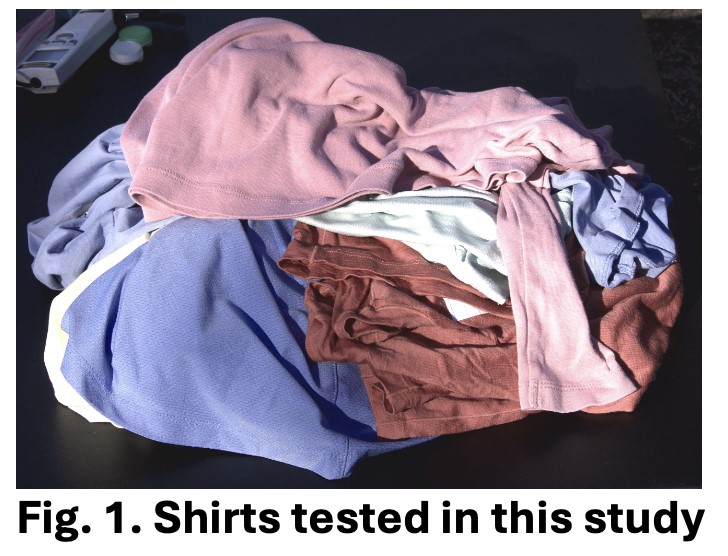
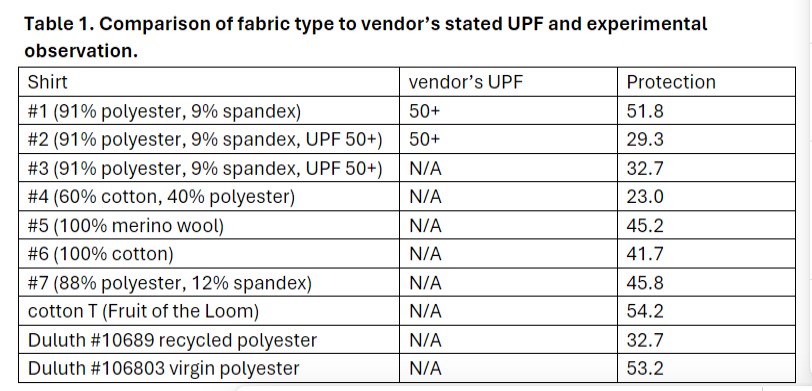
UPF vs non-UPF certification: We tested seven shirts, two of which had published UPF protection levels of >50. While the shirts varied in color, all were pastel colors (Fig. 1) and so the particular color was ignored in these comparisons. The shirts varied in age and number of laundering cycles, fabric weave and fabric thickness among other variables.
Fabric color
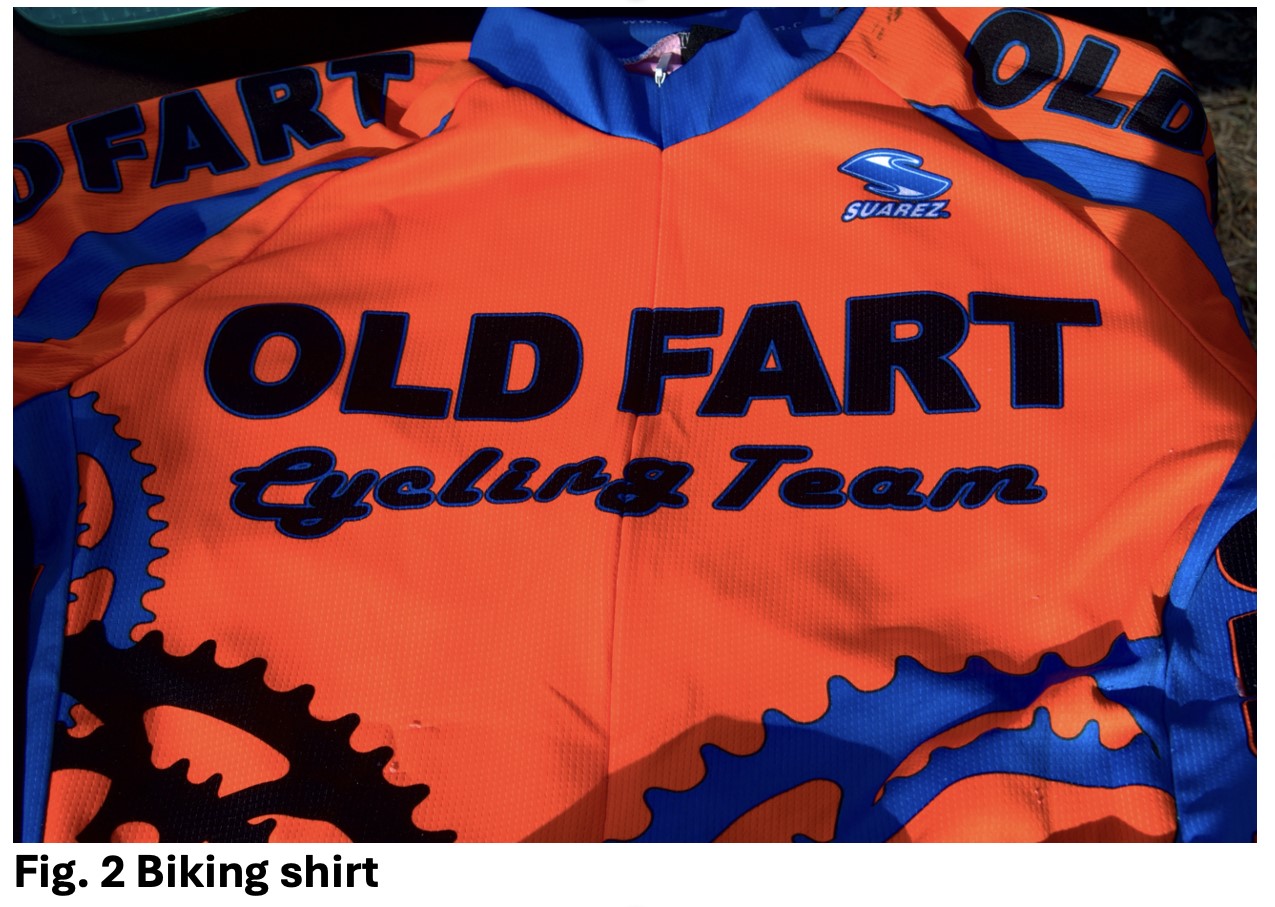
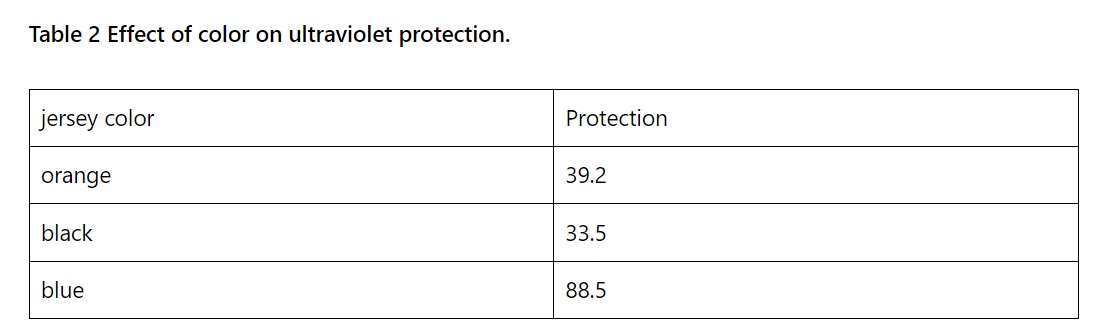
Does the color of the fabric affect UV attenuation? We chose a biking jersey (Fig. 2) that was brightly colored to test the hypothesis that color influences UV absorbance. Three colors were tested as regions on the same jersey: orange, black and blue. The results (Table 2) showed that all three colors were protective, with orange and black providing similar protection, but blue being dramatically more protective. This suggests that visible color could matter for UV protection.
Glass
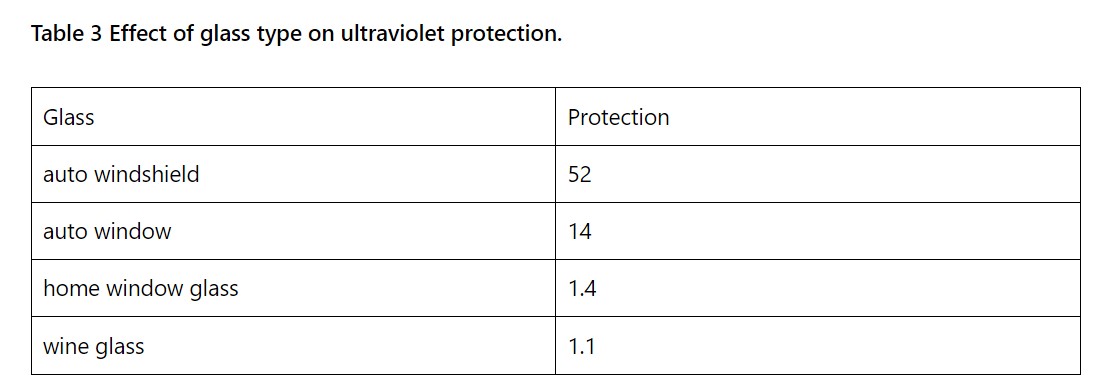
Standard window glass allows more than 50% of UV-A rays to pass through, but is nearly opaque to UV-B. Of particular interest for both skin and eye protection is automobile glazing and whether it affords any greater UV protection than other glazing. In addition to windshield and side window automobile glazing, we measured standard residential window glass, since UV light protection inside houses and apartments may be of interest to the residents. We also measured UV protection by wine glass, since many wine connoisseurs consume wine outdoors. The results (Table 3) show that windshield glass provides a high degree of UV protection, probably because it contains a plastic laminate.
Discussion
The surprising results that emerged from this study were:
• the published UV-A and -B protection for the contact lens we tested was widely divergent from our measured results, raising questions about how much cataract protection contact lenses afford;
• our results with a safety sunglass lens and eclipse viewing lens were impressive, albeit perhaps not surprising. These lenses are explicitly designed for strong UV protection. That they were indistinguishable in our assay from aluminum foil speaks to the lower limit sensitivity of our assays. Eclipse glass lenses are a type of neutral density filter that are designed to transmit no more than 0.00032% of the sun’s light across all wavelengths;
• the similarity between the published UPF protection afforded by some shirts compared to shirts that were not similarly advertised was informative and raises questions about whether UPF labeling is worth paying a premium for. A standard Fruit of the Loom white cotton T shirt afforded much more protection. It appears that virgin polyester may provide more UV protection than recycled polyester;
• that the UV protection afforded by the bright orange and black colors on the same jersey wasn’t necessarily surprising to us; the much greater protection afforded by the dark blue color compared to black was unexpected;
• the wide variation in glazing as UV protection. It is important to acknowledge that auto windshields have plastic reinforcement for crash protection, and passenger windows are made of tempered glass for similar reasons, so comparisons to home windows or beverage glass elide the specific composition of these “glasses.” The results are consistent with reports of color fading in rugs exposed to sunny home windows and more sunburn on arms rested outside a car window versus those by closed windows.
Limitations of our study include considerations of fabric thickness, fiber density and weave. Also, each measurement was made only once. In addition, all the fabric items have been laundered multiple times and no effort was made to control for number of times or laundering conditions.
Acknowledgements: We are grateful to Drs. Susan and Linda Eissenberg for help in experimental design and implementation, Anna Rivers for helpful discussion and the ITWIST for funding, instrumentation and laboratory space.
Nice. Long been a hobby-horse of mine …
what kind of sun did our species evolve under such that the current one would have become so dangerous?
@rjs,
Our species is about 200,000 years old. The sun is about 4.6 billion years old. As far as I know, the sun is no more dangerous today than it was 200,000 years ago.
my thinking, Joel, was that over 200,000 years (or more, counting the species we evolved from), evolution should have selected for those within the population who were less adversely affected by UV rays…
@rjs.
Indeed it did. People with dark skin are less adversely affected. But it’s more complicated than that. Humans also generate vitamin D from sun exposure, which is a selection benefit. In higher latitudes, where sunlight is less plentiful parts of the year and it is colder so people have to cover up, there was selection for lighter skin that absorbed more sunlight. Those of us with pale skin get more vitamin D and more skin cancer. Through most of the history of H. sapiens, people didn’t live long enough to die of skin cancer or be blinded by cataracts, so selection was weak.
Hope that helps.