
Worst Global Conflicts Presently
I can not remember a time when there was no conflicts occurring globally. If I use AI and ask the question. This is what Artificial Intelligence comes back with in reply. I was involved in the late sixties and early seventies. Did my enlistment time and left to civilian life. They promised everything. However, I felt it was time to leave the Corps.
“No there has never been a single year in the last fifty years where there were no global conflicts, as organized armed violence has occurred continuously somewhere on Earth.
However, historians and political scientists classify this era as the “Long Peace” because the globe has avoided direct, all-out war between the major nuclear superpowers.
While the last five decades have seen a drastic reduction in great-power fatalities compared to the early twentieth century, the baseline for human history remains characterized by a complex, ongoing web of civil wars, insurgencies, and regional conflicts.”
Conflicts are on the rise globally, at the highest level since WWII, data shows, NPR, Kate Bartlett
JOHANNESBURG — If you’ve been thinking it seems like there are more wars raging in the world these days, it turns out you’re right and the data proves it.
A new study by researchers at a university in Sweden recorded the highest number of conflicts between states in 2025 since World War II, and the highest number of fatalities recorded since the Rwandan genocide.
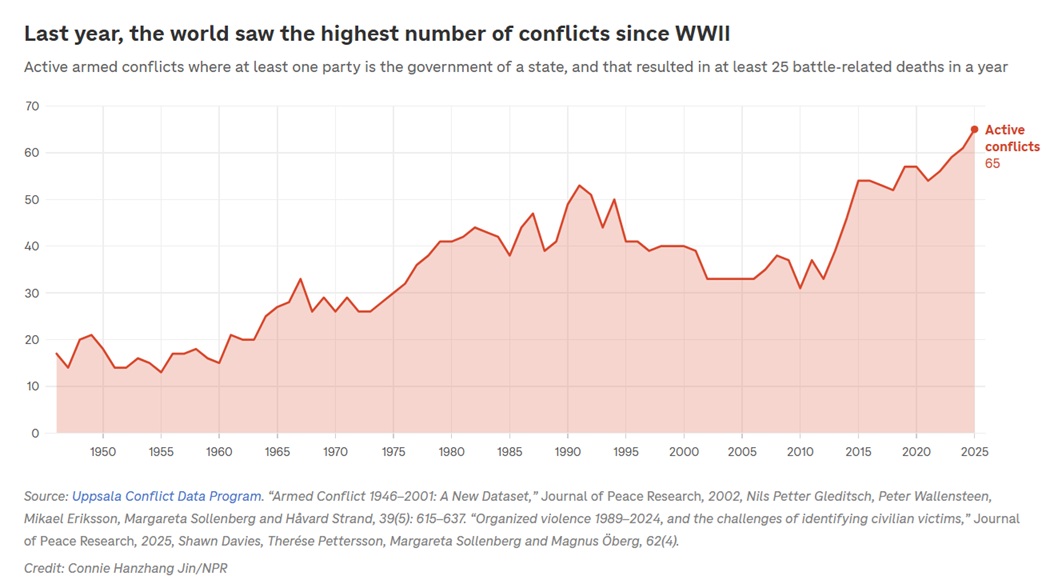
There were 65 active conflicts in 2025, according to researchers at the Uppsala Conflict Data Program (UCDP) at Uppsala University, regarded as a leading source of information on violence worldwide.
Out of that total, the number of direct conflicts between individual states doubled from the previous year to eight in 2025 — the highest number of such conflicts since UCDP began collecting data in 1946.
They included the wars between Russia and Ukraine and between Iran and Israel, as well as conflicts between India and Pakistan, Thailand and Cambodia, and Israel’s conflicts in Syria and Yemen. The final two are: the border conflict between Afghanistan and Pakistan, and the conflict in the Red Sea and Gulf of Aden between the U.S. and U.K. against Yemen’s Houthis.
“We are seeing a clear increase in conflicts between states. For a long time, interstate wars were relatively rare, but developments in recent years point to growing international tensions and a changing global security order,” said Shawn Davies, a senior analyst at UCDP.
The rest of the 65 were all intrastate conflicts — government forces fighting rebel groups within the country.
Most conflict deaths since Rwanda genocide
Fatalities were the highest on record since 1994, with approximately 244,600 people killed in conflict in 2025, the data shows. That’s up from 187,000 deaths in 2024.
“It is not only a story of more conflicts, but also of extremely high levels of lethal violence. Most notably, we see a dramatic increase in violence directed against civilians, particularly in Sudan,” said Therése Pettersson, senior analyst and project manager at UCDP.
Fatalities were the highest on record since 1994, with approximately 244,600 people killed in conflict in 2025, the data shows. That’s up from 187,000 deaths in 2024.
The researchers break down the data into several categories. One is “state-based violence,” which includes both internal, civil wars and “interstate wars,” meaning wars between nations. Either way this grouping means one or both parties to a conflict are a government: for example Ukraine, Sudan and Gaza.
Then there is “non-state violence,” which encompasses clashes between two groups, neither of which is a state: for example sectarian fighting in Pakistan or cartel violence in Mexico.
A third category is “one-sided violence,” which targets civilians, for example last year’s government crackdowns on protests in Tanzania or rebel group attacks on civilians in the Democratic Republic of Congo.
Of last year’s 65 conflicts, 13 of them rose to the level of war — as defined by over 1,000 battlefield deaths a year.
Russia-Ukraine was deadliest war of 2025
The Russia-Ukraine war was the deadliest interstate conflict, accounting for 62% of all battle-related deaths, with 77,700 from the Russian side killed in 2025 and 14,000 from the Ukrainian side. While the warring sides do not regularly release casualty figures, the Uppsala researchers use a variety of open sources, including social media to come up with the tallies.
“Russian battlefield losses have increased and Ukraine losses have remained relatively stable,” the researchers noted.
The Israel-Hamas war was the second-deadliest conflict, with 14,400 fatalities, though that was still a decrease compared to the previous year due to ceasefire agreements.
The third deadliest state-based conflict was Sudan with 12,200 deaths. But those figures only account for fighting between government forces and the paramilitary Rapid Support Forces (RSF). Sudan dominates in terms of violence against civilians. Tens of thousands of Sudanese civilians were killed by the RSF in massacres after the capture of the Sudanese city of El Fasher alone last year.
Part of the reason the researchers gave for the rise in conflicts globally over the past decade was a shift in the international order as led by the U.S. since World War II.
“Now the United States is is turning against the world order it built, as expressed in its 2025 National Security Strategy,” the study said. “The extremely high number of conflicts and wars recorded in 2025, particularly the record number of interstate conflicts lends credence to the growing number of voices arguing that we are witnessing the end of Pax Americana and the liberal world order.”
Asked if that meant wars had become worse under the Trump administration, co-author Petterssen said: “Our data does not allow us to establish a direct causal link between specific U.S. policy changes and the increase in conflicts recorded in 2025.”
“What the data shows is that interstate conflicts have increased sharply over the past decade and reached their highest level since World War II. This trend predates the current U.S. administration and cannot be explained by any single policy decision or political leader,” she added.
“The discussion in the article concerns a broader debate in international relations about whether we are witnessing changes in the post-Cold War international order.”
Whatever the causes, 2026 doesn’t look like it will be any more peaceful than last year, the researchers warn. Data this year so far shows the rise in conflicts globally is a trend that’s likely to continue.