
“the most heinous act in which a democratic government can engage is to use its law enforcement machinery for political ends.”
There is justice protocol for most all American Citizens which is strictly followed. Then there is a justice protocol for those American Citizens who are politically entitled and are not held liable for their actions as most cmmon citizens are held too. I would not try what he did as I would be held responsible. Apparently, Todd has a godfather.
“101 Former Judges Ask the New York Bar to Investigate Acting Attorney General Todd Blanche,” Civil Discourse,
by Joyce Vance
Today, 101 former judges filed a complaint, asking the New York State Bar Attorney Grievance Commission to “initiate an investigation into Acting Attorney General Todd Blanche (Registration No. 4192456) for violation of the New York Rules of Professional Conduct.” The judges are joined by Democracy Defenders Fund and Lawyers Defending American Democracy.
There are three grounds for the request:
- The role Blanche played in the settlement of Trump v. I.R.S., which the referral calls “fundamentally incompatible with his ethical obligations under the New York Rules of Professional Responsibility.” They cite multiple ethics rules that prohibit lawyers from engaging in “Conduct that tends to reflect adversely on the legal profession as a whole and to undermine public confidence in it warrants disciplinary action,” before concluding, “Never could that be clearer than here.”
- Blanche’s abuse of his authority at DOJ against personal and political enemies of his former client, Donald Trump. The complaint points out that this violates ethics rules against bringing frivolous cases, defined as “the lawyer knowingly advances a claim or defense that is unwarranted under existing law.” It also refers to a rule that prohibits lawyers from “engage[ing] in conduct that is prejudicial to the administration of justice” and in harassing conduct.
- Blanche’s “personal involvement in overseeing the Department of Justice’s botched and incomplete release of documents related to Jeffrey Epstein and Ghislaine Maxwell under the Epstein Files Transparency Act (EFTA).” The complaint references “serious concerns” about Blanche’s interview of Ghislaine Maxwell. The complaint argues he failed to meet “expectations of competent and diligent representation of the United States,” that his work “was burdened by his own conflicts of interest,” and that overall, the circumstances “reflected adversely on his fitness as an attorney.” The complaint concludes that “The American public deserves an Attorney General who serves the interests of the Nation, and not those of a single man.”
The question now is whether the New York Bar will investigate, and if so, whether they will take timely action against the acting Attorney General of the United States. Blanche is not the first Attorney General to face a bar complaint while in office. Anyone can send in a referral. Not all of them are meritorious. Prior referrals on Eric Holder, Jeff Sessions, and Bill Barr did not result in action, nor did one filed against Pam Bondi. But the allegations against Blanche are unusual because of their seriousness—they stem from allegations that he is using his role at DOJ to continue to protect his former criminal defendant client, who is now the president of the United States. They also are unique in how early into his tenure in office they come—before he has even been confirmed.
In April, the Trump DOJ proposed a novel rule that would permit the attorney general to swoop in and suspend state bar disciplinary proceedings against current or former DOJ attorneys as long as DOJ had an open investigation into the allegations. It was a bald effort to protect DOJ attorneys who violated ethics rules from facing accountability administered by state bar disciplinary committees with the authority to do so. There isn’t any need for DOJ to seek a rule like that. State bars have historically deferred to the internal DOJ disciplinary process, which involved conscientious investigations conducted by highly experienced DOJ lawyers in the Office of Professional Responsibility.
That system has been broken in Trump 2.0. As the Brennan Center reported late last year, “The Trump administration has dismantled its internal checks on abuses of power, and courts are grappling with the consequences.” Misconduct, at least in the range of cases that the president has demonstrated an interest in, is not being investigated internally at DOJ any longer, leaving federal judges to step in in the most egregious cases. By July of last year, The Washington Post identified dozens of cases where DOJ lawyers flouted court orders, primarily in matters involving immigration, cuts to federal funding, and the federal workforce. The situation has not improved. As we discussed last night, a Judge in Minneapolis quashed subpoenas that were issued in what he termed a witch hunt against Trump’s self-identified political enemies, Governor Walz and Mayor Frey.
In that context, DOJ’s proposal of a rule that would exempt its employees from disciplinary proceedings reveals just how strong the internal concern must be that attorneys have exposed themselves to disciplinary proceedings for their misconduct in the states that license them. That proposal helps us understand just how important it is for state bars to discipline the lawyers they license when they violate ethics rules, with sanctions up to and including disbarment. If state bars won’t act, there is no other entity that will, at least for now.
Norm Eisen, of the Democracy Defenders Fund, told me tonight that “It’s important for every lawyer to adhere to the highest standards of professional ethics. Given the incredible power that our US DOJ leaders enjoy, it’s even more crucial that they meet those standards. We’re profoundly concerned that acting AG Blanche has fallen short again and again with the most serious consequences for vulnerable individuals and our nation. We’re very proud to join with over 100 judges in filing this complaint and we hope the New York disciplinary authorities investigate immediately.”
All of this is happening as Blanche continues to be embroiled in the growing scandal over the slush fund case. He has refused to submit written guarantees to the court in the Eastern District of Virginia that the government has abandoned the plan to give Trump access to $1.776 billion in taxpayer money to use as handouts for January 6 defendants and others of his supporters who claim they were mistreated by a weaponized justice system—by which they mean, of course, that they pled guilty or were convicted by juries in cases brought against them.
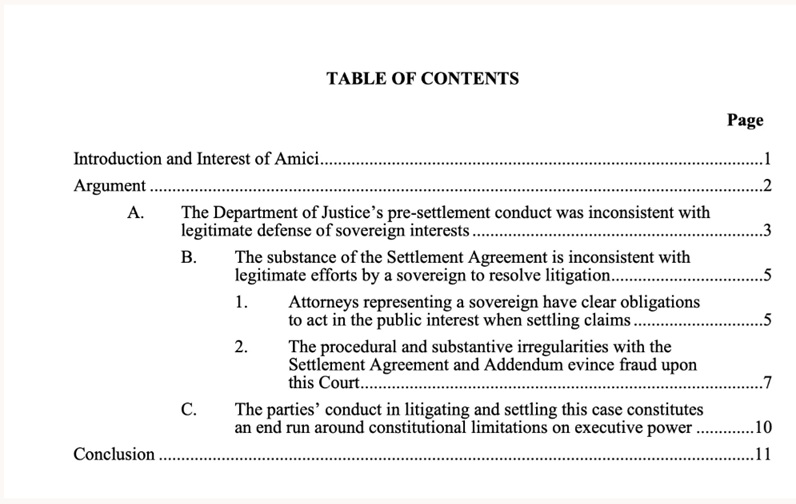
Today, 23 Democratic Attorneys General filed a brief in the original Trump v. IRS case in Florida, joining former judges in urging Judge Kathleen Williams to “rectify the fraud perpetrated upon the Court and deter future misconduct.”
There’s a new controversy in the works involving Blanche, with CNN reporting that “Trump personally pushed acting Attorney General Todd Blanche to issue” subpoenas to journalists at The Washington Post and the Wall Street Journal in connection with investigations into alleged national security leaks. The papers fought back and DOJ withdrew the subpoenas, but the reporting about Blanche’s involvement may raise additional ethics questions that he will have to face. CNN wrote that Trump “delivered the message” to Blanche that he wanted an investigation “with the word ‘Treason’ written in Sharpie — on a stack of printed articles he handed to Blanche.”
There are good reasons that the post-Watergate Justice Department has maintained a strong firewall between its prosecutors and the White House when it comes to determining who will, and won’t, be prosecuted, and what charges they may face. Trump and Blanche are putting all the reasons that independence is a necessity on full display.
It’s important that the people with the power to investigate others are subjected to strict standards of accountability themselves. This Justice Department has dismantled those procedures.
The complaint against Blanche recites the famous words of Attorney General Robert H. Jackson, later a Supreme Court Justice:
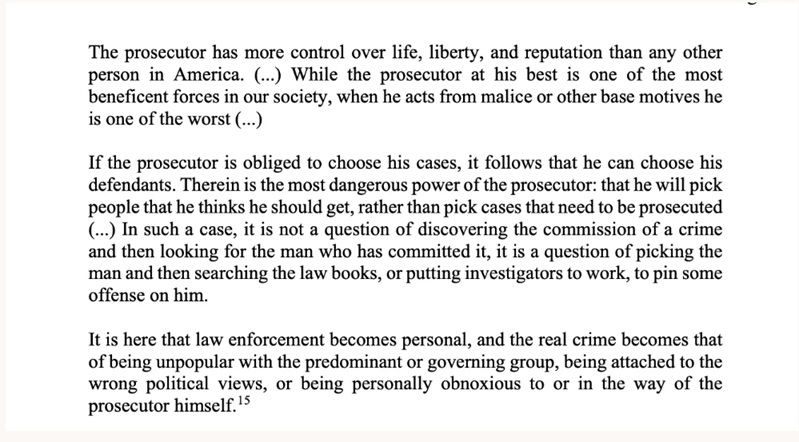
Or as former Deputy Attorney General Laurence Silberman more succinctly put it, “the most heinous act in which a democratic government can engage is to use its law enforcement machinery for political ends.” Blanche has been accused of doing just that. Accountability could come, in his case, in the form of a Senate confirmation hearing, which he must survive to become the Attorney General. But judgment by a bipartisan group of his peers in New York would be a far more fitting place for judgment on the claims that have been made against him to be rendered.
The institutions that are supposed to keep power in check only work if people pay attention when they’re tested. That’s what we’re doing: following the facts, insisting on accountability, and refusing to look away when the rules are bent for the benefit of the powerful. For those of you who already support this work, thank you. And if you’ve been thinking about joining us as a paid subscriber, there’s never been a more important time to become a part of this community.
We’re in this together,
Joyce
i was curious, and wondered if to be the US Attorney General you had to be an attorney. turns out no. and it has happened only once in the US history
@david,
It’s also not required to be an attorney or even to have a law degree in order to be a Supreme Court justice.
Joel:
Remove the restraints from making a logical decision which may fit the issue at hand?