
An Election Referendum on Healthcare
The referendum on healthcare is what the election of a new senator representing Texas is going to amount to this go-around. It will be a referendum on healthcare between the Dem candidate James Talarico and the Repub candidate Ken Paxton.
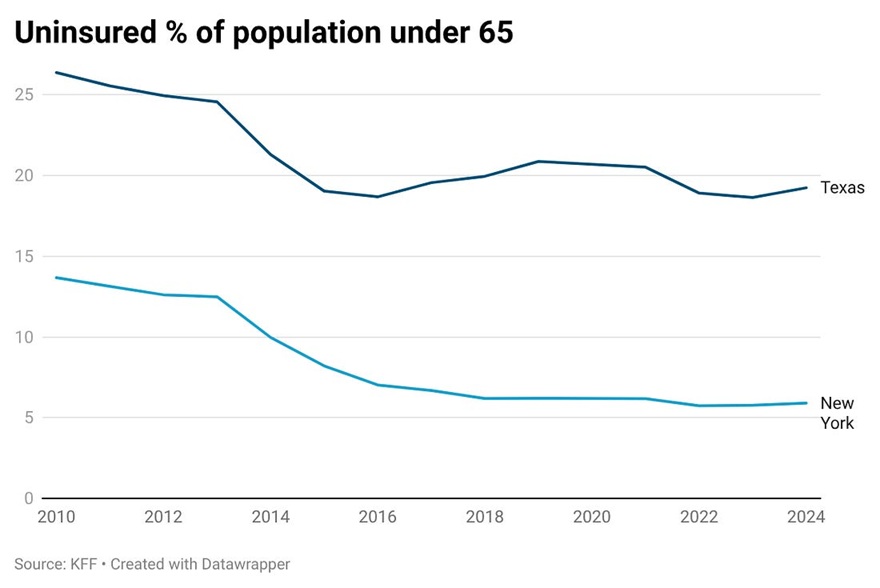
Texas has one of the weakest healthcare policy in the United States and the highest uninsured rate in the nation. Nearly 5 million residents lack health insurance due to a combination of stringent Medicaid eligibility rules and non-expansion of the Affordable Care Act (ACA). The post-pandemic “unwinding” process disenrolled over 1.7 million people from the state healthcare programs. Little to nothing has been done to fix the issue of a lack of healthcare,
I get the feeling Paxton would like to keep healthcare for Texans as it is. Like many Democrats, Talarico favors healthcare for all citizens. However, this is really a state issue even the the Feds will kick in for heaithcare.
~~~~~~~
The latest Paul Krugman discussion on the issue.
“Texas’s Senate Race Will Be a Referendum on Healthcare”
Paul Krugman
How many of the state’s voters prefer cruelty to prosperity?
~~~~~~~
So Texas Republicans have, by a huge margin, rejected Sen. John Cornyn, a hardline conservative whose great failing, from Donald Trump’s point of view, was that he occasionally took stands on principle. To replace him they chose the scandal-ridden, deeply corrupt Texas attorney general Ken Paxton, who received Trump’s endorsement precisely because of his vices. Paxton’s rottenness makes him a Trump kindred spirit and also guarantees that he will be dependent on Trump’s goodwill and hence slavishly loyal.
So much the better for the Democrats, who now may — may, may — have a chance at winning Cornyn’s Senate seat. However, despite Paxton’s utter unfitness for any public office – let alone Senator — knowledgeable observers of Texas politics consider the race between Paxton and the Democratic nominee, James Talarico, no better than a tossup.
What will be at stake in the general election, beyond the question of just how much personal awfulness Texans will overlook? To an important extent it will be a referendum on healthcare.
Texas’s healthcare policy stands out, even among red states, for its cruelty.
Texas has refused to expand Medicaid under the Affordable Care Act. That is, it has turned down federal money that would have provided essential healthcare to hundreds of thousands of its residents, at almost no cost to Texas taxpayers, and injected large amounts of money into the Texas economy. Texan politicians have tried to justify their adamant opposition to expanded healthcare as a matter of principle, a way to prevent dependence on government programs. But in reality there’s no way to make sense of this choice except as a reflection of the drive to keep low-income people desperate and subservient.
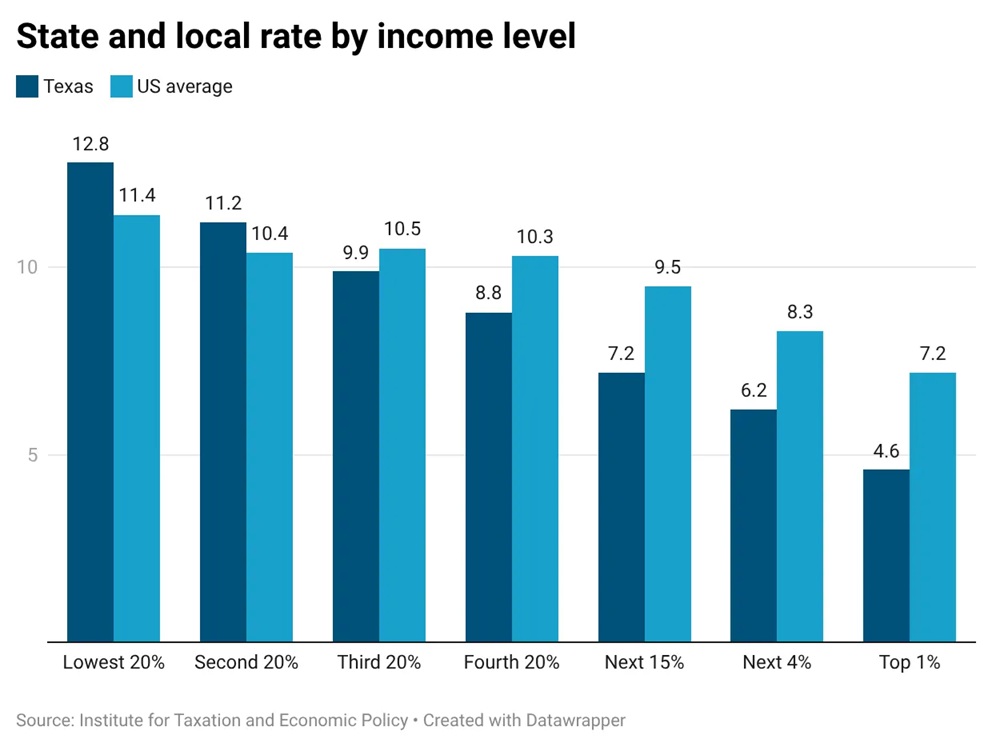
This is the same drive that has led to Texas’s remarkably regressive tax system. Texas conservatives like to say that they rule a low -tax state, but taxes there are only low for the affluent. They’re quite high for the middle and working classes, and very high for the poor and near-poor:
Even among states that rejected the ACA Medicaid expansion, Texas’s Medicaid program is exceptionally harsh. As one summary explains,
In Texas, adults without children are not eligible for Medicaid coverage regardless of their income, and parents are eligible only if they earn less than 13 percent of the FPL [federal poverty line] (an annual income of less than $3,900 for a family of four).
The result is Texas has the worse health insurance coverage than any other state. Moreover, as the chart at the top of this post shows, the big improvement in coverage as a result of the ACA mostly bypassed Texas. Notably, 13.7% of Texan children are uninsured, compared with a 5.9% rate nationwide and 2.5% in New York.
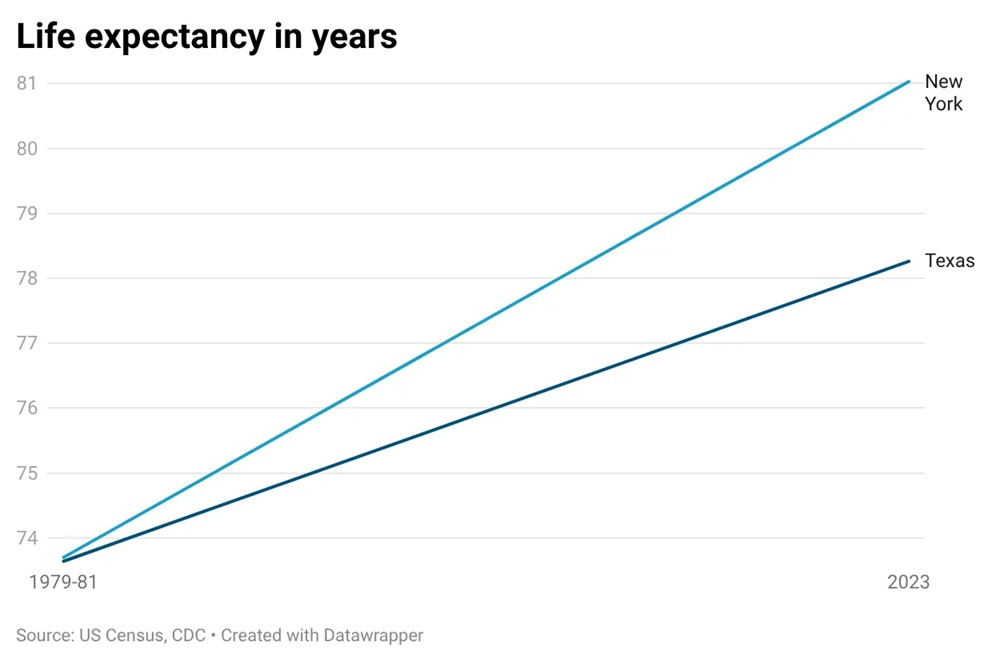
High rates of uninsurance combined with a weak social safety net. In recent years, a growing rejection of vaccines largely explains one striking aspect of Texas’s evolution since 1980: its lagging life expectancy. In 1979-81 life expectancy in Texas and New York were almost identical. But since then, a wide gap has emerged. New York state residents are outliving Texans by an average of nearly 3 years:
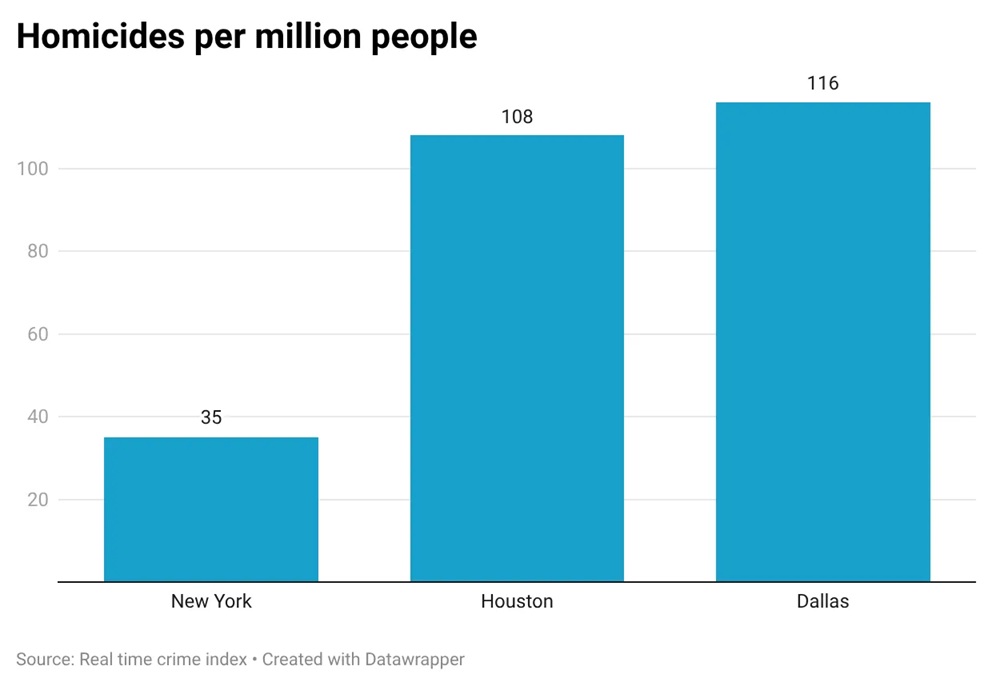
Part of this gap in life expectancy reflects death by violence. Texas is a big law-and-order state, in which politicians love to talk tough about crime. But big Texan cities have much higher crime than big blue cities, New York in particular:
Texas, then, is a state whose healthcare policy has been marked by cruelty and especially by determination to deny care to those who need it.
How does this relate to the Senate race? In a way this is a quintessential match between MAGA and the new Democratic party. Ken Paxton, scandals and corruption aside, has taken a leading role in trying to deny healthcare to needy Americans, both in Texas and in the nation as a whole, repeatedly bringing lawsuits to block implementation of the Affordable Care Act.
Talarico, by contrast, says “health care is a human right.” In particular, he has called for allowing all Americans to buy into Medicare.
So the Texas Senate race will be about corruption and personal morality. But it will also be about healthcare, and whether Texan voters really want to endorse the state’s continuing, systematic cruelty.
You would think that healthcare would be a huge issue in every rural area of the country as well as the damage to farm incomes from Trump policies but I’ll bet they vote against their own interests once again.
@Jack,
Trump cult Republicans don’t use logic and reason, they rely on trust and faith. Farmers and ranchers will have to go out of business before they accept the reality that Trump doesn’t care about them. Rural hospitals will have to close in large numbers before red state voters realize Trump is indifferent to them and not just “those people.” Cognitive dissonance is strong with these folks.