
One European Country Adapting to U.S. Tariffs
Without a doubt, Pres. Tr__p has set up the United States for some type of retaliation in the future. Yes, Europe will adjust in some manner. Perhaps, Switzerland will move the final part of manufacturing to another country which is favored by the US. There are probably ways around this which need to be explored. Tr__p will not be around forever and then the environment will change.
“Trump tariffs: Swiss brands struggle to adapt to 39% tariff.” SWI swissinfo.ch
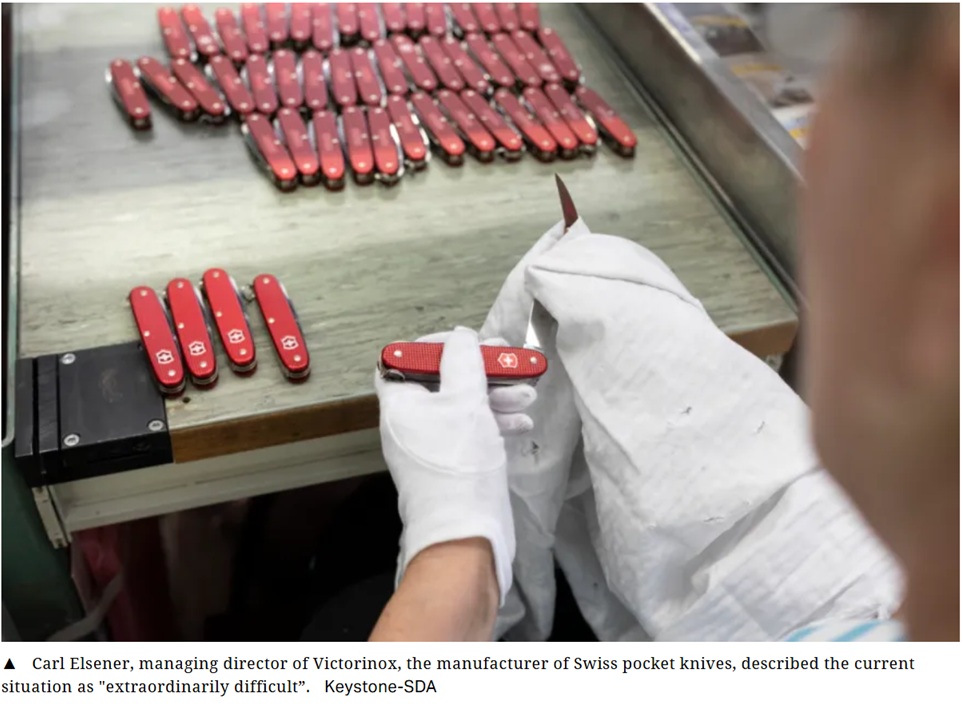
Swiss brands like Victorinox, the manufacturer of the iconic pocket knife, are struggling to adapt to the 39% tariff imposed by the United States on imports of Swiss goods. In addition to price rises, firms are considering moving their activities from Switzerland.
Thermoplan, which exports automated coffee machines to 84 countries, sends around a third of its products manufactured exclusively in Switzerland to the US. “The 39% tariffs will affect us directly and significantly,” the company’s head of marketing, Yves Zurmühle, told the AWP news agency.
Explaining: “In the short term, this means increased pressure on prices and more complex negotiations with our customers. In the medium and long term, it forces us to become more efficient, to examine alternative sourcing and production scenarios and, together with our partners, to find ways of ensuring our competitiveness.”
The company, which is based in Weggis, canton Lucerne, and employs 540 staff, says it will not be able to pass on all the surcharges to its customers. Clients in the United States are concerned about prices, delivery times and planning, while they are already facing 50% US tariffs on Brazilian coffee.
While a complete relocation of production to the US could be considered as a last resort, “a partial relocation to Germany, where one of our subsidiaries is also located, seems much more realistic”, says Zurmühle. The company must first study various scenarios, and stresses that the level of training in Switzerland and Swiss quality are the pillars of its “success”.
For its part, Nespresso, which produces its eponymous coffee capsules and those of the American brand Starbucks in Switzerland, declined to comment. The Nestlé subsidiary, which has three production sites in cantons Fribourg and Vaud, posted sales of CHF3.2 billion in the first half of the year, with double-digit growth in North America.
Victorinox anticipates a hefty bill
The Schwyz-based manufacturer of the famous Victorinox Swiss pocket knife anticipated the customs shock by building up stocks in the US, its main export market. The additional costs are therefore “controllable” this year, but if they were to be maintained, “we are talking about additional costs of up to $13 million a year from 2026 onwards”, managing director Carl Elsener told AWP by e-mail.
Elsener said it was an “extraordinarily difficult situation” right now, as the group is already suffering from a strong Swiss franc. Surcharges are exacerbating the situation, “particularly for products such as professional knives, where we are in direct competition with American and European manufacturers”. Victorinox generates 13% of its sales in the US, and 18% for its sales of professional and kitchen knives.
For the head of the brand, which is also active in watchmaking and luggage, “a total customs duty rate of around 44% on our products, combined with a 12% devaluation of the dollar since the start of the year, represents a massive challenge to our competitiveness, our margins and our strategy”. Victorinox will forego price increases in 2025 and is discussing “achievable” price increases for next year with its US team.
Victorinox is also studying “the possibilities of carrying out certain work stages, such as the final cleaning and packaging of professional knives, directly on site” in the US.
Elsener: “Relocating production abroad, especially for pocket knives, is not an option for us. Our brand lives on its Swiss origin, its quality and its values.”
He said he was attached to the Ibach site in Switzerland, but wanted to remain “sufficiently” flexible.
Meanwhile, Ricola, the manufacturer of herbal sweets, maintains that it has a global business served from Switzerland. It will continue to “stick to this policy”. The group based in Laufon, canton Basel Country, is discussing price adjustments with its American customers, and will “invest in innovations and make cost savings in the supply chain where possible and sensible”.
Trump tariffs: Swiss brands struggle to adapt to 39% tariff – SWI swissinfo.ch