
The New Economy and the Tariffs and Tax Breaks to Launch It
Since we have a new president who favors Tariffs, we should start talking about how those Tariffs will impact the US Economy and Citizens. The Tax Foundation offers up a brief explanation which should be readily understandable for Angry Bear readers. If Trump is able to pull this off and get it out of Congress, I do not see much favoring it in terms of economic growth. Then there is also covering the costs of the 2017 Tax Cuts and Jobs Act (TCJA) which has yet to pay for itself in economic growth.
The TCJA was supposed to die under a Biden Admin. Biden removed himself as a candidate and Democrats lost an election by not turning out. Which is very similar to what happened in 2016 with Clinton v Trump. Must be that Dems do not favor women as the Presidents? More of that later when I can examine the numbers.
There are multiple sources to this commentary on Trumps Tariffs and Tariffs in gemeral. I have linked to each if you wish additional information or check my comments further.
Introduction
President-elect Donald Trump has proposed to implement a universal baseline tariff on imports when he takes office. We estimate a 10 percent universal tariff would raise $2 trillion and a 20 percent universal tariff would raise $3.3 trillion from 2025 through 2034, before factoring in how the taxes would shrink the US economy.
In 2025, a 10 percent universal tariff would increase taxes on US households by $1,253 on average and a 20 percent universal tariff would increase taxes on US households by $2,045 on average.
Revenue raised by tariffs would fall short of what is needed to fully offset the revenue losses of making the expiring provisions of the 2017 Tax Cuts and Jobs Act (TCJA) permanent.
Revenue Estimates of Trump’s Universal Baseline Tariffs (Billions)

Process to Estimate the Revenue Impact of a Tariff
To estimate how much revenue a universal tariff raises? We start with a baseline projection of goods imports over the next decade. Imposing a tax on imports would reduce purchases of foreign-produced goods, resulting in fewer imports. We apply an import elasticity of -1 to project how imports would fall in response to a 10 percent tariff and a 20 percent tariff. How much imports shrink thus varies with the applied tariff rate, implying that doubling the rate does not double the revenue.
From there, we multiply the import tax base by the inclusive tariff rate (the rate divided by one plus the rate) to estimate initial customs duty revenue raised under perfect compliance before making an adjustment to reflect an 85 percent compliance rate, which represents the average tax gap.
After the compliance adjustments and before accounting for income and payroll tax offsets; we estimate a 10 percent universal tariff would generate $2.7 trillion of customs duty revenues and a 20 percent universal tariff would generate $4.5 trillion of customs duty revenues.
The Total Revenue Raised
The total revenue raised will be less than the customs duty revenue generated by the tariff because tariffs reduce incomes (taxes paid as mentioned above), reducing income and payroll tax collections. Accounting for income and payroll tax offsets, our conventional revenue estimate finds that the 10 percent tariff would generate $2 trillion of increased revenue, while the 20 percent tariff would generate $3.3 trillion over a decade.
And The Economy?
Both taxes (Tariffs) would shrink the size of the US economy. The dynamic scores are smaller: $1.7 trillion for the 10 percent tariff and $2.8 trillion for the 20 percent tariff. If foreign countries retaliate, even partially, to the US-imposed tariffs, revenue will fall further as the economy shrinks even more. For example, we estimate a 10 percent tariff on all US exports would shrink tax revenues on a dynamic basis by more than $190 billion over 10 years.
Other Tariffs Tried?
Second Term President Trump once said during his first term. One of his primary foreign policy goals was to rein in global adversaries like China and take U.S. trade partners to task for growing trade deficits (defined as U.S. imports exceeding exports). Trump’s approach to achieving this goal was enacting tariffs, especially focusing on China. These tariffs have negatively impacted trade between the U.S. and China, leading importers to shift toward Mexico’s west coast instead of shipping directly to the United States. As a result, trade between Mexico and China has grown by 60% in one year. And . . . product was being trucked north to the U.S. The tariffs have been circumvented with an additional step. Mexico gained and the US? Nothing . . .
The tariffs were supposed to benefit the average American citizen, who would then buy cheaper products made at home. Another example and this time with Steel. The US attempted to stop the sale ofa steel company. In one politically charged example, U.S. Steel made the first moves to sell the company to the Japan-based Nippon Steel Corporation despite decades of government subsidies. Strategically, this would have been a good idea if the plant was modern. It wasn’t. Chance are, China will lose on this sale.
That did not become the reality. The policy goal of creating and safeguarding American jobs failed. A 2021 study by the U.S.-China Business Council found the Trump tariffs resulted in an estimated 245,000 American jobs lost.
Is there any industrialized nation on the planet that relies solely on tariffs to support its government? The idea of tariffs paying for themselves strikes me as similar to the fantasy that tax cuts pay for themselves.
Joel:
Not Industrialize. That sounds like it would be self-defeating as industrialized countries usually have something to sell.
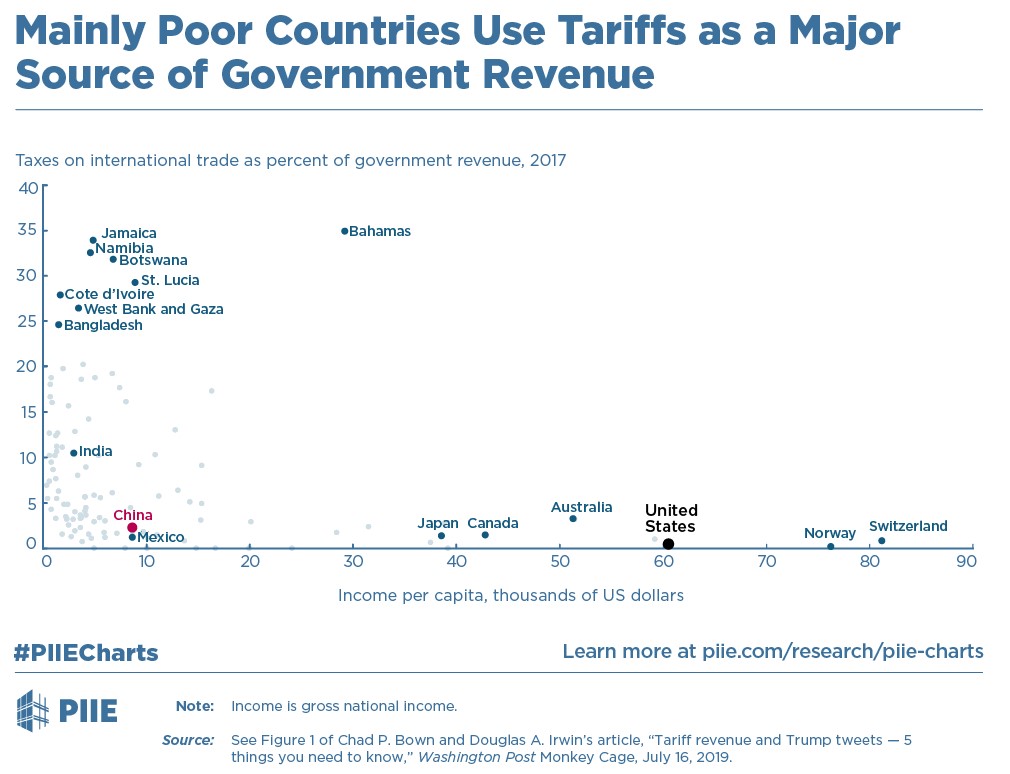
Informational Only . . .
@Bill,
Thanks, you made my point.
Of course the tariffs are a terrible idea; but, paradoxically, they will have little effect on the inflationary perceptions of working class people. Perceived inflation depends on the anchored expectations of regularly purchased items like food and gasoline. But the US is currently a net oil and natural gas exporter, as well as an exporter of grains and meat. In fact, retaliatory tariffs might reduce non-luxury food prices; whilst the globally depressing effect of new tariffs might reduce the world price of oil.
Steep increases in the prices of clothing, cars, toys and electronics will not be perceived as inflationary because they are intermittent purchases, whose prices are not anchored.
yes the US is an exporter of oil, but we import a lot too, as our refineries cant process the oil we have, been that way a long time. food is very seasonal, as weather tends to make it so that some food is in season in the US (sometimes its warmer seasons, while winter we import from countries that have weather), since tariffs are coming for everything friend or foe, prices will be still go up). and while for some, clothes and others you mention might be once every 2-5 years, but its not so for everyone, they will still be mad if all prices dont go down
Roundly, US pumps and stores crude oil at avg 13million barrels per day. Crude input to refineries is 16 million per day. Weekly EIA report.
I have not run numbers but agree some crude imports are to refineries closer to foreign source, aka Mexico and Canada. Also U.S. crude oil is more light/sweet, that does not yield distillate in quantity, this other import factor is need for heavy crude.
US net exports are mainly LNG, exports began rising in 2021, and went and stated higher with US LNG exports coveringNG cut off from Russia, sanctions.
In gasoline and diesel US usually a minor net importer, maybe due to location of refineries.