
Expanded Warren Take on Taxes and Why
I added some more charts and some wording to give the original piece greater depth
The Big Corporations That Avoided All Federal Income Taxes:
ITEP published a list of 88 profitable corporations that reported paying zero federal income taxes on their 2025 U.S. income, in no small part due to the corporate tax cuts pushed through by the Trump administration and a Republican Congress in 2017 and 2025. The report’s methodology is straightforward: it simply republishes a few data points the companies themselves disclose in their 10-K annual financial reports. Even so, a handful of observers took the opportunity to make halfhearted objections to our analysis.
EPI: Taxes are good, actually—especially if you care about affordability:
Two things are true about taxes in the United States.
First, taxes on the richest families and corporations are far too low.
Second, it is broad-based taxes on the middle-class that are the foundation of a functioning public sector and a decent society.
“Identifying the policy levers generating wage suppression and wage inequality,” Economic Policy Institute
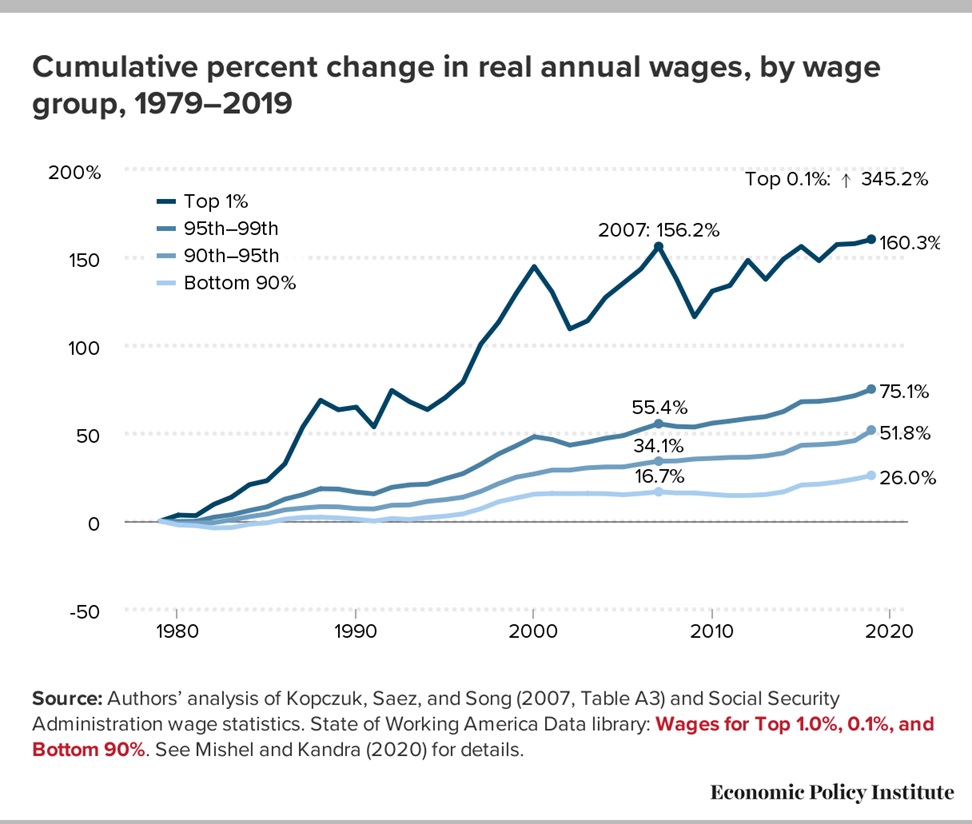
Progressive taxes on the ultrarich and corporations are mostly needed to reduce the potential gains to the rich and powerful from rigging the rules (EPI) of markets. When the powerful rig these rules and hugely disproportionate shares of income concentrate at the top (like in the United States today) progressive taxes can also raise significant revenue.
AB: It would seem to me, the income tax structure has been changed so much as to allow moneyed interests to pay far less. Initially such a practice was meant to encourage investments in the United States. Instead, it has become a way for moneyed interests to profit.
The wealthy and the well-connected have put American government to work for their own narrow interests. The results of which, , a small group of families has taken in a massive amount of the wealth American workers have produced from Labor. As a result . . . data from the Congressional Budget Office shows the share of after-tax income held by the middle three income quintiles has decreased by 6 percentage points since 1979, while top earners doubled their share of the nation’s income.
“The Distribution of Household Income,” for 2022, The Congressional Budget Office
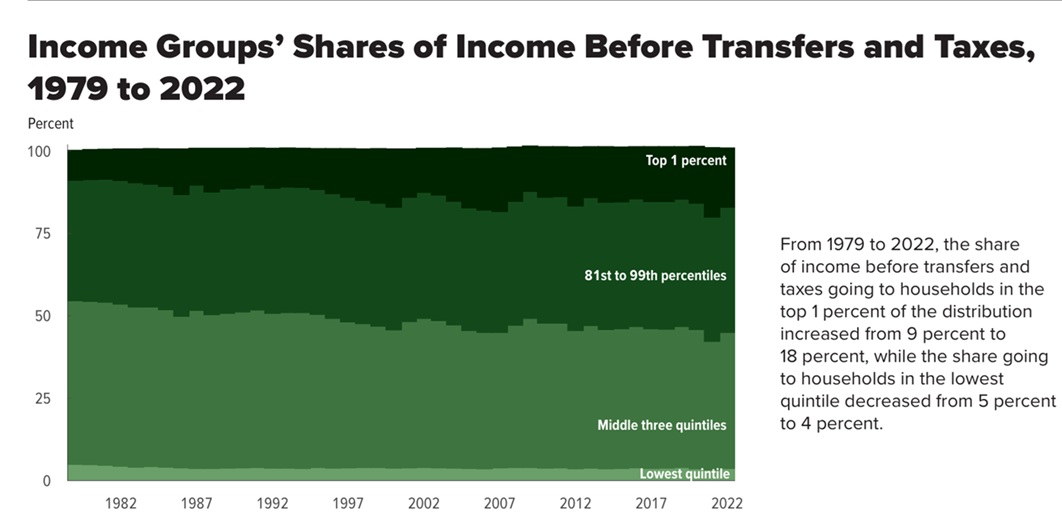
There is an extreme concentration of wealth not seen in other leading economies globally. For example one result of this imbalance is:
The 400 richest Americans currently own more wealth than all Black households and a quarter of Latino house-holds combined.
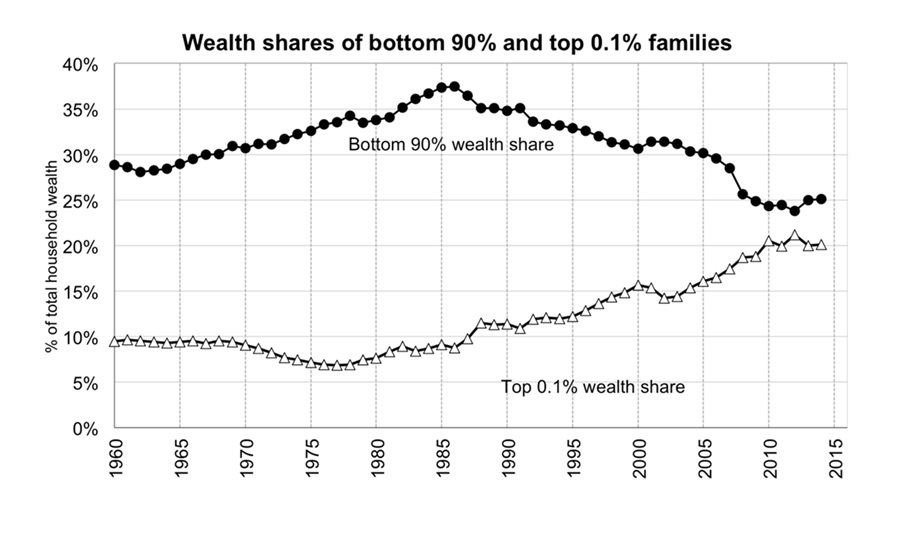
An analysis by economists Emmanuel Saez and Gabriel Zucman (the University of California-Berkeley) reveals the richest top 0.1% has seen its share of American wealth nearly triple from 7% to 20% between the late 1970s and 2016. Indeed, this is occurring while the bottom 90% has seen its share of wealth decline from 35% to 25% during same period of time. The results of which leave the richest 130,000 families in America holding nearly as much wealth as the bottom 117 million families combined.“
As explained in this piece, the US tax code focuses on taxing income. It ignores family’s wealth which is also an important measure of how much it has benefitted from the economy and its ability to pay taxes. As judged against wealth, our tax system and laws allows the rich to pay a lot less than everyone else. Another fact by Saez and Zucman, the families in the top 0.1% are projected to owe 3.2% of their wealth in federal, state, and local taxes this year. The bottom 99% are projected to owe 7.2%.
The imbalance is pretty obvious.
Making income taxes more progressive, that alone will not straighten out a slanted tax code or our lopsided economy. as an example, consider a heir with $500 million in yachts, jewelry, and fine art, and a teacher with no savings in the bank. If both the heir and the teacher bring home $50,000 in labor income next year, they would pay the same amount in federal taxes, despite their vastly different circumstances.
Increasing income taxes won’t address this problem.
Elizabeth Warren proposes a tax on wealth. An Ultra-Millionaire Tax taxes the wealth of the richest Americans. It applies only to households with a net worth of $50 million or more (roughly the wealthiest 75,000 households) or the top 0.1%. Households would pay an annual 2% tax on every dollar of net worth above $50 million and a 6% tax on every dollar of net worth above $1 billion.
As wealth is so concentrated, this small tax on roughly 75,000 households will bring in $3.75 trillion in revenue over a ten-year period.
Warren’s Suggested Rates and Revenue
- Zero additional tax on any household with a net worth of less than $50 million (99.9% of American households)
- 2% annual tax on household net worth between $50 million and $1 billion
- 4% annual Billionaire Surtax (6% tax overall) on household net worth above $1 billion
- 10-Year revenue total of $3.75 trillion
“Ultra-Millionaire Tax,” Elizabeth Warren
“The Rise of Income and Wealth Inequality in America:” Evidence from Distributional Macroeconomic Accounts
“Taxes are good, actually—especially if you care about affordability,” Economic Policy Institute
Cash Transfers And Child Health In The US: What Is Known And What Questions Remain | Health Affairs