
Overtaking Tesla in EV Production
I retired while working at Tier 1s in the world of American and German automotive companies. If I was not in China or the Philippines, I was in western and eastern Europe going to suppliers. Mostly, this was automotive component production for American automobiles and pickups.
As you read this piece, I believe you will realize how BVD has surpassed other manufacturers, not just Tesla. BVD appears to control all of the inputs in what is old technology called vertical integration. Each layer is linked and they feed off of each other supplying information and dates of delivery. Raw material weaved together with production needs and supply chain to plan materials and product demands.
This is not something terribly new as it was once MRPII and then ERP. Both of which demand was fed into and giving purchasing, planning and manufacturing direction. Demand information fed to suppliers for material and components and manufacturing planning capacity and shifts to meet demand.
“BYD’s strategy to overtake Tesla in EV production globally,” Automotive Manufacturing Solutions
BYD has surged onto the global stage, challenging industry giants like Tesla with its aggressive expansion and pioneering battery technology. BYD’s production soared from half a million to over 4 million vehicles. As the company celebrates its 30th anniversary, its blend of vertical integration, cutting-edge automation, and global supply chain mastery has redefined the EV landscape.
Chinese electric vehicles have been making waves overseas in the last few years, especially in places like Mexico, Malaysia, and Thailand. A big part of their appeal is the price tag – these cars usually cost a lot less than their Japanese, South Korean, or European rivals. But if you ask Chinese EV makers, they’ll tell you it’s not just about saving money, they say their cars bring a whole new level of innovation to the table.
In recent years, Chinese carmaker BYD has experienced remarkable growth and success. The numbers tell a compelling story: BYD’s production has surged from approximately 500,000 units to over 4 million in almost seven years. This represents an over 700% increase, a clear indicator of the company’s aggressive expansion strategy. BYD nearly caught up to Tesla in 2024 pure EV deliveries (1.76 million vs. 1.79 million) but stole the show with plug-in hybrids, firmly securing its spot as the world’s top new energy vehicle maker.
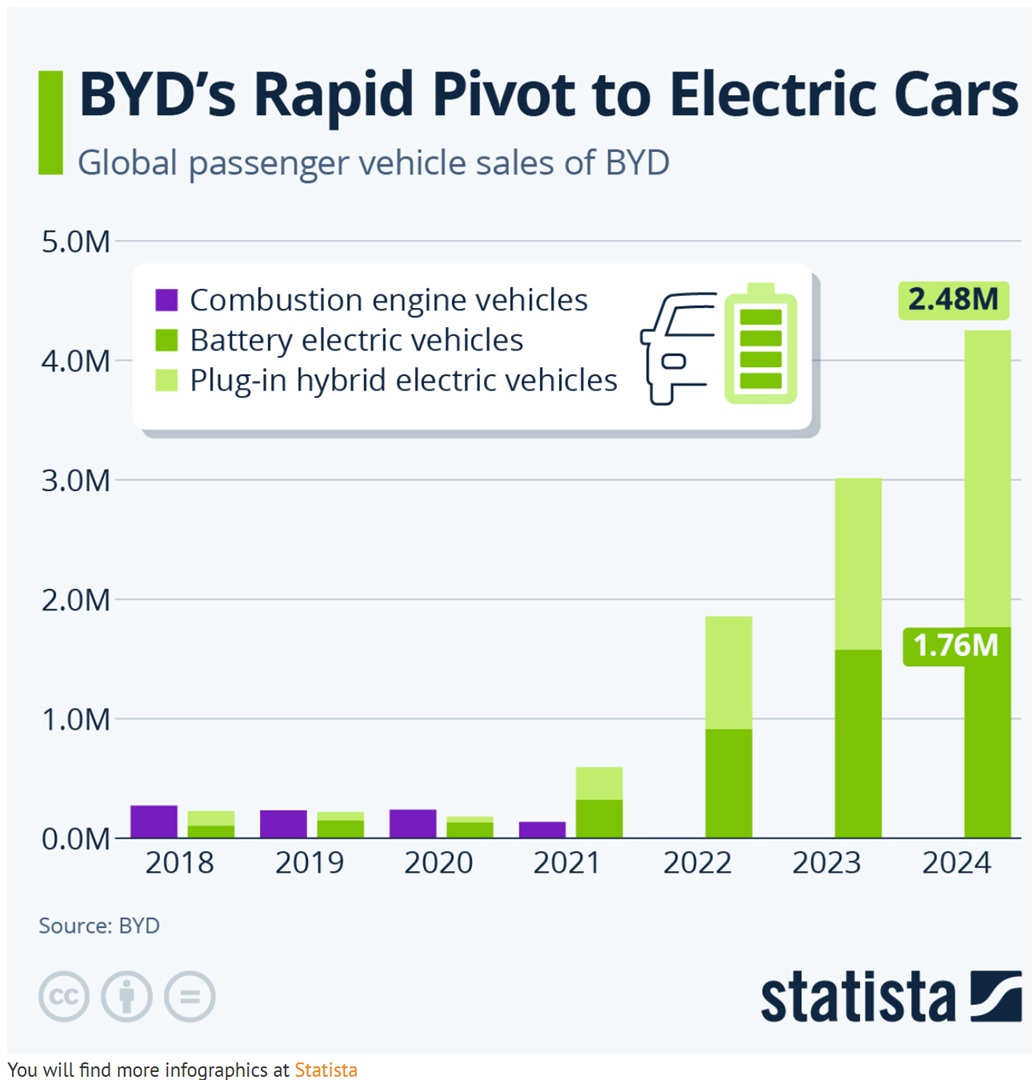
It didn’t stop there; BYD surged past Tesla in Q3 revenue, bringing in $28.2 billion to Tesla’s $25.18 billion. December marked yet another milestone with BYD’s 10 millionth plug-in vehicle rolling off the line. And all of this comes just in time for the company’s 30th anniversary. This growth, driven by their focus on New Energy Vehicles (NEVs), has propelled them to the forefront of the global automotive industry.
Production network and strategy
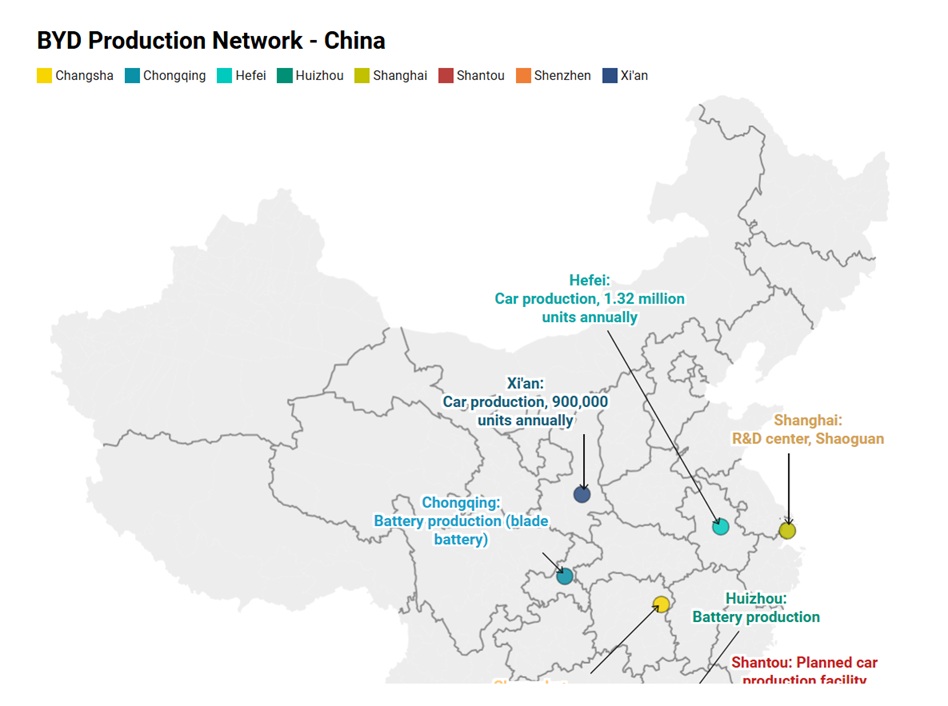
BYD’s manufacturing footprint spans multiple continents, with a significant concentration in China. Key facilities include the Xi’an plant in Shaanxi, with an annual production capacity of 900,000 vehicles, and the Changsha plant in Hunan, capable of producing 600,000 vehicles annually. The Hefei facility in Anhui, operational since June 2022, is set to reach a capacity of 1.32 million vehicles upon completion of its three-phase development. Collectively, BYD’s domestic production capacity in China has reached 5.82 million vehicles annually as of 2024.
Picture
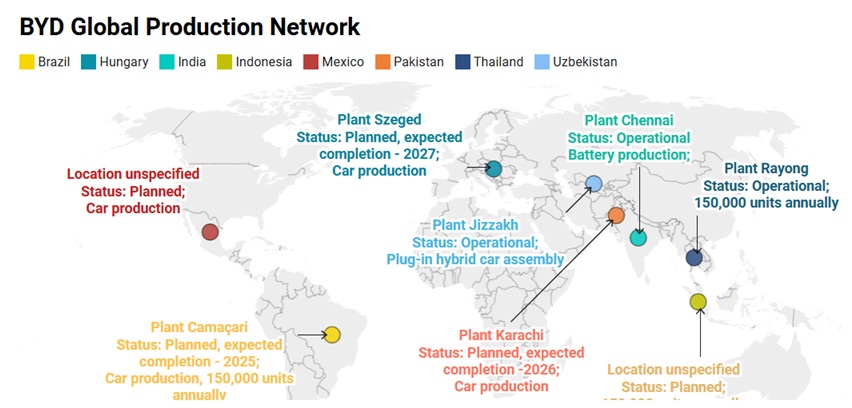
Internationally, BYD has expanded its presence with manufacturing plants in several countries. In July 2024, the company inaugurated a facility in Rayong, Thailand, with an annual capacity of 150,000 vehicles. This plant is BYD’s first wholly owned operation outside of China and is expected to employ 10,000 workers. Additionally, BYD has announced investments in Szegda Hungary along with Camaçari, Brazil, and Manisa, Turkey, each projected to produce 150,000 vehicles annually upon commencement in 2025 and 2026, respectively.
Picture
Battery production and innovation
BYD’s top-notch battery manufacturing lies at the heart of its success in the electric vehicle market. The company’s subsidiary, FinDreams Battery Co., focuses on lithium iron phosphate (LFP) technology, featuring the groundbreaking “Blade Battery,” celebrated for remarkable safety and efficiency. As of December 2023, FinDreams Battery held its place as the world’s second-largest EV battery manufacturer, behind CATL.
To secure a steady supply of critical raw materials, BYD has moved into mining operations. In 2023, the company secured mining rights in Brazil’s “Lithium Valley,” marking its first mining investment beyond China. Looking forward, the company expects to unveil solid-state EV batteries by 2027, aiming to boost energy density and safety.
So how did BYD grow its production volume so rapidly?
BYD’s success in rapidly scaling up to become a leading global EV manufacturer can be largely attributed to a strategic approach that weaves together production innovation, supply chain optimization, and deep vertical integration. Over the past decade, the company has leveraged its heritage in battery production to build a robust ecosystem stretching from raw material sourcing to final vehicle assembly. This strategic control has minimized external dependencies, reducing exposure to both cost fluctuations and supply constraints. At the same time, BYD’s emphasis on advanced production processes has facilitated consistent model rollouts, even amid growing demand across international markets.
1. Vertical integration
One of BYD’s defining strategies has been the in-house production of key components. Rather than relying on external suppliers for core components, BYD manufactures batteries, power electronics, electric motors, and semiconductors in-house. This vertically integrated model became more prominent after the launch of the Blade Battery in 2020, which introduced a new cell-to-pack format, noted for enhanced safety and improved energy density.
2. Platform standardization & modular design
Another crucial element of BYD’s strategy is the use of platform standardisation and modular architecture. The e-Platform 3.0, introduced in 2021, consolidated core EV elements – such as the motor, controller, and chassis – into a single framework. This design reduced parts count and simplified assembly, enabling production lines to switch between different vehicle models with relative ease.
3. Simultaneous engineering & rapid product development
Another crucial factor in BYD’s rise is its simultaneous engineering methodology. Rather than isolating design, engineering, and manufacturing functions, BYD’s teams operate in parallel from the early concept stage through to production. By integrating R&D, design, and manufacturing decisions, BYD can rapidly incorporate new features or rectify potential production hurdles.
4. Automation & gigacasting
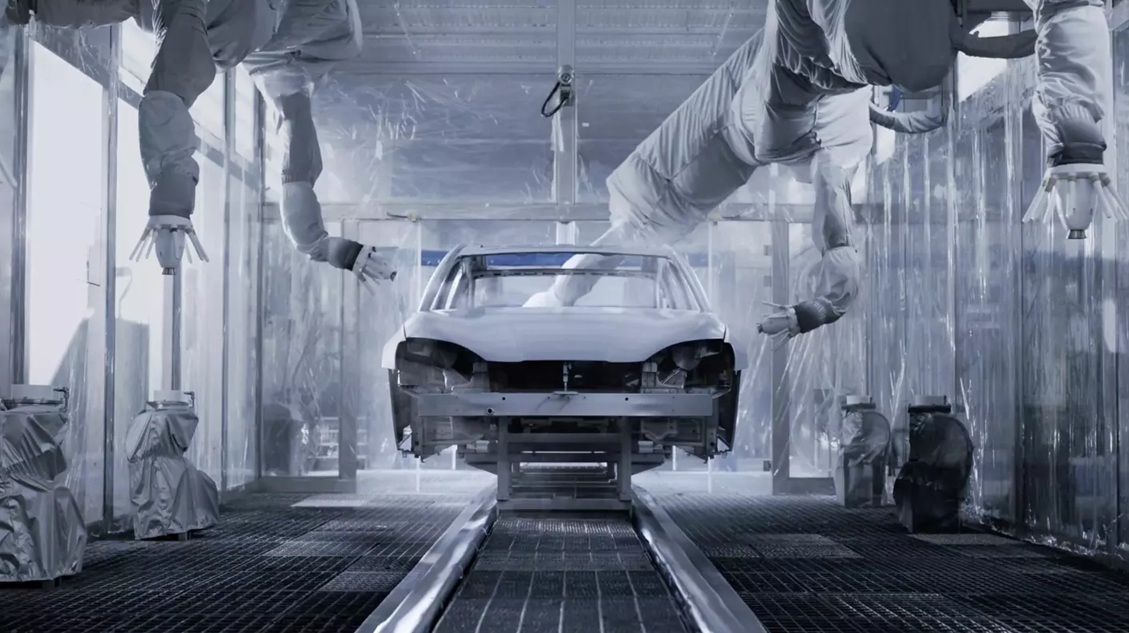
High levels of automation have played a key role in BYD’s ability to scale. Automation extends from welding and painting, to pack assembly and final inspection, supported by real-time monitoring systems for quality control. BYD’s Xi’an plant reported 97% automation in 2020, using automated guided vehicles (AGVs), robots, and intelligent warehousing for maximal efficiency.
5. Global supply chain coordination
Beyond China, BYD’s strategy of localizing elements of production—such as electric bus chassis in Hungary and battery assembly in Brazil—demonstrates a flexible, region-specific approach to supply chain management. The ability to source components locally, align logistics precisely with production schedules, and collaborate with regional suppliers ensures stable inventory levels and cost efficiencies.
BYD is aiming for 5-6 million sales by 2025, with Stella Li, CEO of BYD Americas predicting “nearly half” from overseas. Additionally, Li emphasised, “We stand behind our products. As with any groundbreaking technology, there are challenges, but we are committed to ensuring the highest levels of safety and performance,” from a November 2023 statement.
Battery technology remains a key pillar of BYD’s strategy. As a pioneer in blade battery technology, the company is now developing next-generation solid-state batteries, which promise higher energy density, longer lifespan, and improved safety.
In addition to technological advancements, BYD is also focusing on fleet electrification and commercial vehicles, including electric buses and trucks, which are gaining traction globally. The company is further enhancing its models by integrating advanced driver assistance systems (ADAS) as a standard feature, providing cutting-edge safety and automation at no extra cost.
The Unintended Consequences Of The ACA’s Medical Loss Ratio Requirement | Health Affairs
And let us not forget government subsidies (from ChatGPT):
Overview of BYD and Government Subsidies
BYD, a leading electric vehicle (EV) manufacturer in China, has significantly benefited from government subsidies aimed at boosting the EV industry. These subsidies have played a crucial role in reducing production costs and enabling competitive pricing in both domestic and international markets.
Types of Subsidies Received
The Chinese government provides various forms of support to BYD, including:
Direct Payments: BYD has received substantial direct financial assistance, with reports indicating that the company was granted around $3.7 billion to enhance its competitive edge in the EV market. (between 2018 and 2022 – added note.)
Tax Exemptions: The company benefits from exemptions on sales taxes, which can significantly lower the final price of vehicles for consumers.
Infrastructure Support: Government funding for charging infrastructure has also been crucial, as it helps expand the necessary facilities for EV adoption.
Impact of Subsidies
The cumulative support for the Chinese EV sector, including BYD, has reached approximately $230.9 billion from 2009 to 2023. This funding has allowed BYD to:
Reduce Vehicle Prices: Subsidies enable BYD to offer competitive pricing, making its vehicles more attractive to consumers.
Expand Production: The financial backing has facilitated rapid growth and expansion into international markets, including plans for manufacturing in Mexico.
Also see: “China Heavily Subsidized BYD to Expand Its EV Market Share”
John:
I added the title to the link for Oil Price. Did you read this part of the article also?
“’China’s subsidy policy has been a controversial issue for years: European industries often struggle to compete with Chinese counterparts on price,’ said Dirk Dohse, Research Director at the Kiel Institute and co-author of the report.
‘However, without China’s subsidized technology, products crucial for Germany’s green transformation would become more expensive and scarce as well,’ Dohse added.
European carmakers are already spooked by Chinese EV manufacturers’ plans to boost sales in the EU.”
I believe it to be a smart move by China. Get off of the oil consumption and convert to something which is better for the environment and the country overall. If you have ever been in China, Tianjin, Shanghai, Beijing, etc., you would realize the air quality there is poor on many days. You do not sleep with an open window.
China is taking the right steps to convert to other forms of transportation not involving oil. The next step is to get off the usage of coal
What did China achieve? Something that the United States likely achieve years later.
Stats are kind of old for China. Here is one chart.
I believe it is a good move by China and something the US and Europe need to promote more and push.
I did read the whole article, and a couple of others. I actually agree with you; (IMO) the free market works especially poorly for new technologies with tremendous long-term benefits but lots of short-term obstacles. That’s part of government’s role in the economy (again IMO) – funding stuff that won’t be funded privately because of high risk for each individual venture, but for which the government can easily bear the risk, and across a portfolio of highly risky ventures, something will almost certainly pay off enormously.
The sad thing is that the Mojave Desert is one of the four great potential solar areas in the world, along with where China is building stuff, the Atacama desert in South America, and Antarctica. Of those four, the Mojave has by far the lowest power transmission line loss to major population centers. Yet here we are, pushing… coal and oil. (Although I wouldn’t mind if all the AI and crypto data centers got moved to Antarctica.)
@John,
“. . ..funding stuff that won’t be funded privately because of high risk for each individual venture, but for which the government can easily bear the risk, and across a portfolio of highly risky ventures, something will almost certainly pay off enormously.”
Indeed. This is why government needs to fund basic biomedical research–it is the feedstock for industry. Trump is disinvesting in government research, which will do lasting damage to American healthcare. Industry won’t pick up the slack.
John:
Between the cities of Phoenix and Maricopa is flat out desert. No major trees, etc. Much belongs to the native Indian tribes. ~ 12 miles of desert in length and many miles between I10 and beyond AZ 347. If sun is what you need.
The thing about the Mojave is the high elevation (and no pollution) increases the amount of sunlight available, and it’s also a lot cooler – heat being death to inverter efficiency. This latter is why, for example, Saudi Arabia is not a good place for solar energy; you need to use some of that power to keep the inverters cool enough to operate with any efficiency. But yes, Phoenix – Maricopa would save on power transmission loss. (This is why Antarctica is so great; high elevation, even thinner air due to being near/at the pole, and cold.)
Not sure why it is linked here, but that MLR article is something that I was wondering about since ACA started. If the insurers’ “slice” can’t be bigger than (1-MLR) x premiums, one incentive is to make premiums as big as possible. I also found it disturbing that any refunds for not hitting the MLR seem to go to the policyholder even if they were subsidized. The subsidy program is supposed to control the individual’s cost as a function of their income. If their original credit was correctly calculated, then their portion is correct and the rebate should be entirely to the subsidizing party until the subsidy has been entirely offset. Who has been looking out for taxpayers on this? Not sure it’s a big phenomenon, but it’s pretty easy to think it through.